
 AU
AU
 UK
UK
 US
US
 NZ
NZ
 IND
IND

 CA
CA

 Share
Share
 X (Formerly Twitter)
 Whatsapp
 Facebook
 LinkedIn
 Telegram
 Email This Article
 Copy Link
 Summarize with AI
 Chat GPT
 Perplexity
Dividend Yields, Distribution Schedules, and Portfolio Strategies for Income Investors
Executive Summary
High-yield dividend ETFs have become one of the most popular investment strategies among income-focused investors in Canada. In recent years, a new category of investment products has emerged on the Toronto Stock Exchange (TSX): single-stock covered call ETFs.
These ETFs provide exposure to well-known companies such as Tesla, NVIDIA, Coinbase, and Palantir while generating significant income through options strategies. As a result, many of these funds now deliver annual distribution yields ranging from 15% to more than 70%.
For investors seeking monthly income, these ETFs can offer a compelling alternative to traditional dividend stocks or bonds. However, the high yield potential comes with meaningful risks, including volatility in the underlying stocks and possible net asset value (NAV) erosion.
This comprehensive guide analyzes the top 10 high-yield dividend ETFs available to Canadian investors in 2026, explaining their strategies, yields, dividend schedules, and risks.
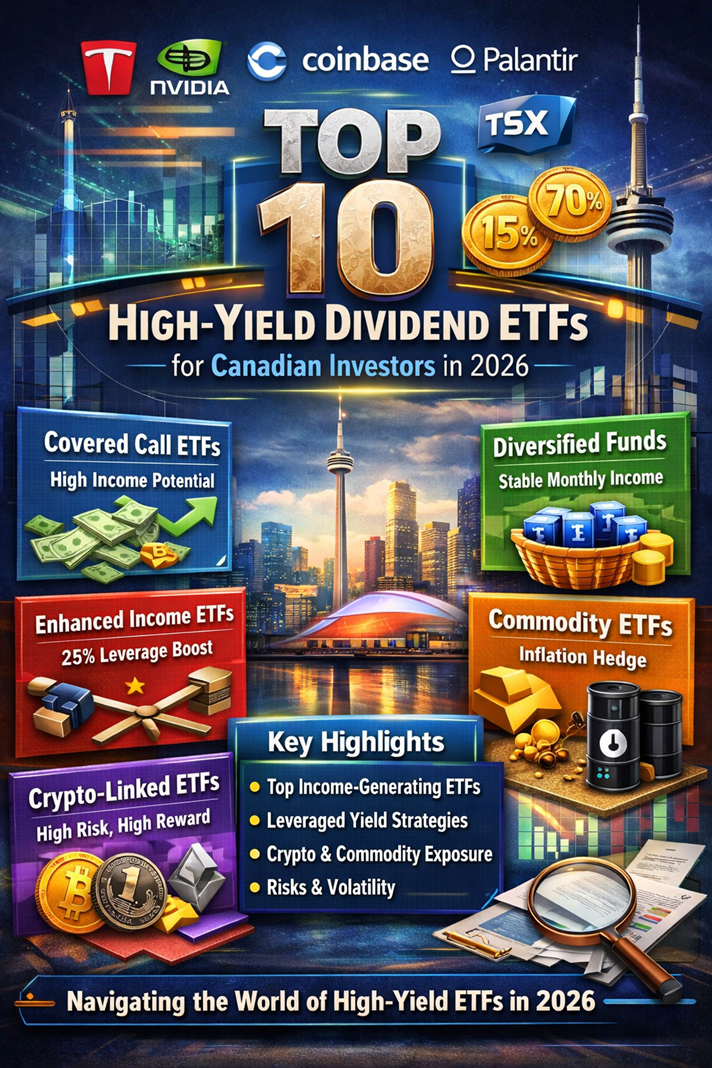
Key Highlights
- Covered call ETFs on the TSX are among the highest income-generating investment products available to investors today.
• Enhanced income ETFs use approximately 25% leverage to increase options premium income.
• Crypto-linked ETFs such as CNYE and MSTY offer the highest yields but also carry the greatest volatility risk.
• Diversified funds such as HHIS provide more stable income streams by holding multiple ETFs.
• Commodity exposure through CCOM can help diversify income portfolios and hedge against inflation.
Source: Kalkine Group
Why High-Yield Dividend ETFs Are Surging in Popularity
Several structural trends are driving the rapid growth of income-focused ETFs.
Rising Market Volatility
Higher volatility increases options premiums, which directly boosts the income generated by covered call strategies.
Demand for Passive Income
Many investors are seeking monthly income streams to replace traditional salary income or supplement retirement funds.
Growth of Options Markets
Global options trading volumes have increased significantly, providing deeper liquidity for ETF managers implementing covered call strategies.
Technology Sector Dominance
Technology companies such as Tesla, NVIDIA, and Palantir often experience large price swings, creating rich options premiums that support high ETF distributions.
Together, these factors have created a new class of investment vehicles capable of delivering double-digit or even triple-digit distribution yields.
What Are Covered Call Income ETFs?
Covered call ETFs generate income by selling call options against an underlying stock or portfolio.
Simplified Example
- The ETF holds or synthetically replicates shares of a company.
- The fund sells call options on those shares.
- Buyers of the options pay premiums to the ETF.
- Those premiums are distributed to investors as income.
This strategy allows investors to collect income even if the stock price moves sideways or declines moderately.
However, if the underlying stock rises significantly above the option strike price, the ETF’s upside potential becomes limited.
Standard vs Enhanced Covered Call ETFs
Covered call ETFs are typically offered in two structures.
Standard High Income ETFs
- No leverage
• Lower yield
• Lower volatility risk
Enhanced Income ETFs
- Approximately 25% leverage
• Higher income generation
• Greater NAV volatility during market downturns
Most of the highest-yielding ETFs in Canada use the enhanced structure.
Dividend Yield Tiers Explained
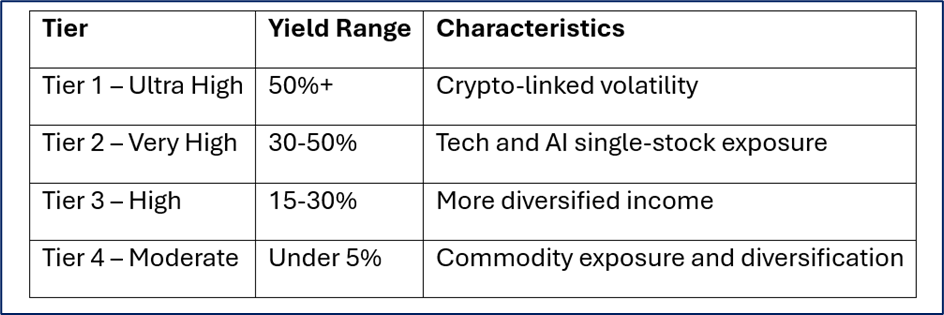
To compare these ETFs more easily, they can be grouped into four yield tiers.
Source: Market Data
Dividend Calendar: Ex-Dividend Dates and Payment Dates
Understanding dividend timing is critical for income investors.
Declaration Date
The ETF manager announces the distribution amount.
Ex-Dividend Date
Investors must own the ETF before this date to receive the distribution.
Record Date
The fund confirms eligible investors.
Payment Date
The distribution is deposited into brokerage accounts.
Most Harvest ETFs follow the same schedule:
- Ex-dividend date: Last business day of each month
• Payment date: Around the 5th–9th of the following month
Top 10 High-Yield Dividend ETFs in Canada (2026)
- Harvest Tesla Enhanced High Income Shares ETF (TSLY)
- Harvest MicroStrategy High Income Shares ETF (MSTY)
- Harvest Coinbase Enhanced High Income Shares ETF (CNYE)
- CI Auspice Broad Commodity Fund (CCOM)
- Harvest Coinbase High Income Shares ETF (CONY)
- Harvest Palantir Enhanced High Income Shares ETF (PLTE)
- Harvest Eli Lilly Enhanced High Income Shares ETF (LLHE)
- Harvest Eli Lilly Enhanced High Income Shares ETF USD (LLHE.U)
- Harvest Diversified High Income Shares ETF (HHIS)
- Harvest NVIDIA Enhanced High Income Shares ETF (NVHE)
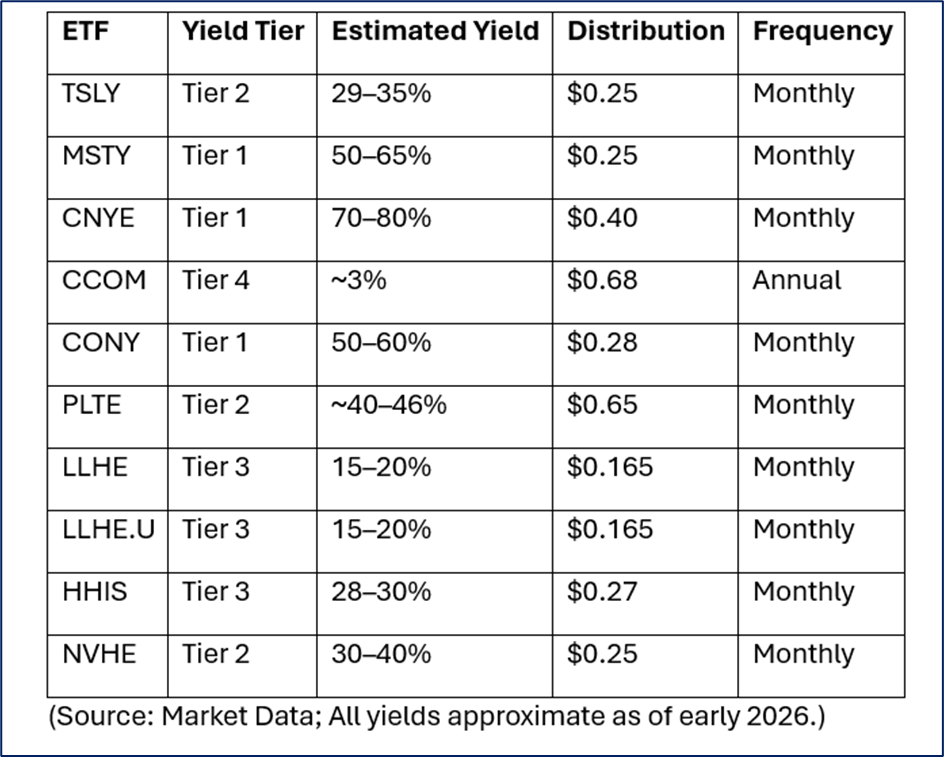
Complete Dividend Data Table
Individual ETF Profiles
Tesla Enhanced High Income ETF (TSLY)
TSLY provides leveraged exposure to Tesla while generating income through covered call options.
Key metrics:
Strategy: Enhanced covered call
Underlying asset: Tesla
Yield range: ~30–35%
Distribution: $0.25 monthly
Tesla’s high volatility supports strong options premiums that power the ETF’s income.
MicroStrategy High Income ETF (MSTY)
MSTY tracks MicroStrategy, a company whose stock performance is strongly linked to Bitcoin.
Because MicroStrategy acts as a leveraged Bitcoin proxy, options premiums on its shares are extremely high.
Estimated yield: 50–65%
Coinbase Enhanced High Income ETF (CNYE)
CNYE is one of the highest-yielding ETFs on the TSX.
The fund generates income from options on Coinbase stock, which is highly volatile due to cryptocurrency market cycles.
Estimated yield: 70%+
CI Auspice Broad Commodity Fund (CCOM)
CCOM tracks a diversified commodity futures strategy covering:
- energy
• metals
• agriculture
Yield: approximately 3% annually
This ETF is often used as an inflation hedge within diversified portfolios.
Palantir Enhanced High Income ETF (PLTE)
PLTE generates income through options on Palantir stock.
Because Palantir is a highly volatile AI-focused technology company, options premiums are significant.
Monthly distribution: approximately $0.65
Eli Lilly Enhanced High Income ETF (LLHE)
LLHE provides exposure to pharmaceutical giant Eli Lilly, whose weight-loss and diabetes drugs have driven massive investor interest.
Yield range: 15–20%
Lower volatility results in a lower but more stable yield compared with tech-linked ETFs.
Diversified High Income ETF (HHIS)
HHIS holds a portfolio of multiple Harvest single-stock ETFs.
This diversified approach reduces single-stock risk while still producing strong income.
Estimated yield: 28–30%
NVIDIA Enhanced High Income ETF (NVHE)
NVHE provides leveraged exposure to NVIDIA, the dominant supplier of AI chips.
The high volatility of NVIDIA shares allows the fund to generate strong options premium income.
Estimated yield: 30–40%
Liquidity and Trading Volume Considerations
Investors should evaluate ETF liquidity before purchasing.
Key metrics include:
- daily trading volume
• bid-ask spread
• assets under management (AUM)
Higher AUM and volume generally indicate stronger liquidity and tighter spreads.
Distribution Sustainability Analysis
The sustainability of these high yields depends on three main factors:
- underlying stock volatility
- options premium levels
- leverage structure
When volatility declines, options premiums may shrink and distributions can decrease.
Therefore investors should view distribution yields as variable rather than guaranteed income.
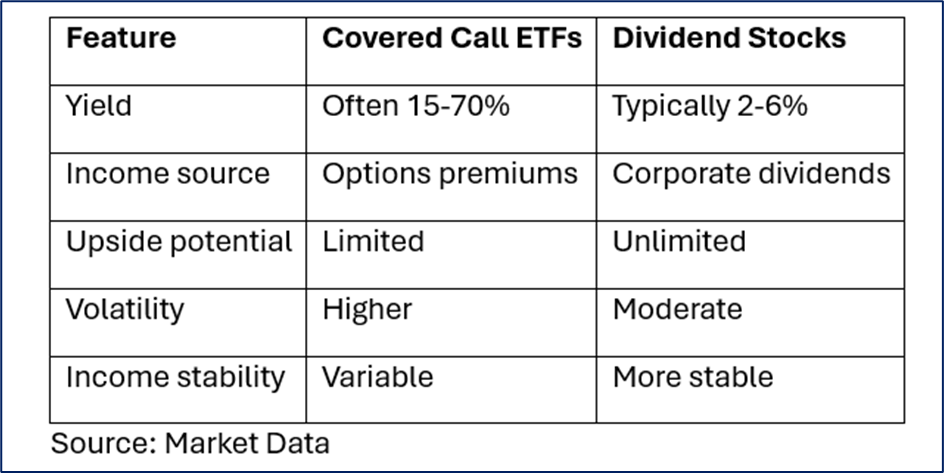
Covered Call ETFs vs Traditional Dividend Stocks
Risk Factors Every Income Investor Must Understand
NAV Erosion
ETF prices may decline if the underlying stock falls.
Concentration Risk
Many funds depend on a single company.
Upside Limitation
Covered calls cap gains during strong bull markets.
Leverage Risk
Enhanced ETFs amplify both gains and losses.
Volatility Dependency
Lower volatility may reduce future distributions.
Portfolio Construction Strategies
Conservative Income Portfolio
HHIS
LLHE
NVHE
CCOM
Estimated yield: 20–25%
Balanced Income Portfolio
HHIS
TSLY
PLTE
NVHE
CONY
Estimated yield: 30–40%
Aggressive Yield Portfolio
CNYE
MSTY
PLTE
CONY
Estimated yield: 60%+
This approach carries very high risk.
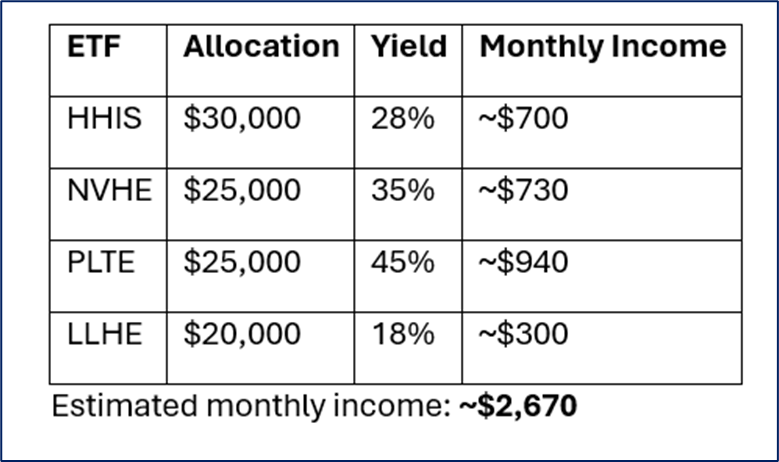
Monthly Income Example
If an investor allocates $100,000 across several ETFs:
Tax Considerations for Canadian Investors
ETF distributions may include:
- dividend income
• foreign income
• capital gains
• return of capital
Return of capital reduces the investor’s cost base and defers taxes until the ETF is sold.
Many investors hold these ETFs within:
- TFSA
• RRSP
• RRIF
to maximize tax efficiency.
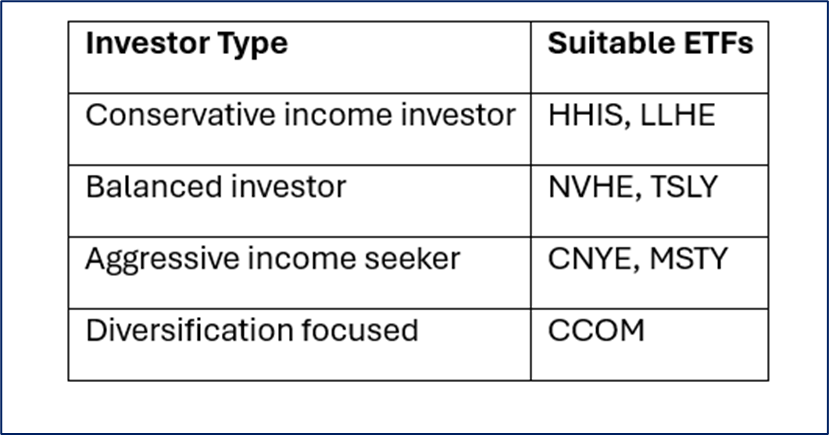
Investor Suitability Matrix
Global Investor Perspective
International investors can often purchase TSX-listed ETFs through global brokerage platforms.
Common platforms supporting TSX trading include:
- Interactive Brokers
• Charles Schwab Global
• Saxo Markets
• Fidelity International
Investors should consider currency conversion costs and tax treatment before investing.
Expanded Frequently Asked Questions
Are covered call ETFs suitable for retirement income?
Yes, they can generate strong monthly income but should be combined with other investments to reduce risk.
Why are some ETF yields above 50%?
These yields come primarily from options premium income and leverage, not traditional dividends.
Do covered call ETFs outperform stocks?
Not always. They often underperform in strong bull markets because the upside is capped.
What is NAV erosion?
NAV erosion occurs when the ETF’s price declines faster than the income it generates.
Are monthly distributions guaranteed?
No. Distribution amounts can change depending on market volatility and options premiums.
Can investors reinvest ETF distributions?
Yes. Most brokerage platforms allow Dividend Reinvestment Plans (DRIP) for ETFs.
2026 Outlook for High-Income ETFs
Several trends suggest continued growth for covered call ETFs.
AI Sector Volatility
Companies such as NVIDIA and Palantir continue to generate strong options premiums.
Crypto Market Cycles
Crypto-linked stocks will likely remain highly volatile, supporting high ETF yields.
Rising Demand for Passive Income
More investors are seeking monthly income investments.
ETF Innovation
New single-stock income ETFs are likely to launch as demand increases.
Key Takeaways
- Covered call ETFs offer some of the highest income yields available in public markets.
• Single-stock ETFs generate income primarily from options volatility.
• Diversification across multiple ETFs is essential to manage risk.
• Investors should evaluate total return rather than focusing only on yield.
• Monthly distribution ETFs can be powerful tools for income-focused portfolios.


 Jun 22, 2026




 Please wait processing your request...