
 AU
AU
 UK
UK
 US
US
 NZ
NZ
 IND
IND

 CA
CA

 Share
Share
 X (Formerly Twitter)
 Whatsapp
 Facebook
 LinkedIn
 Telegram
 Email This Article
 Copy Link
 Summarize with AI
 Chat GPT
 Perplexity
Views Expressed Disclaimer:
You are reading a free article with opinions that may differ from the recommendation given by Kalkine in its paid research reports. Become a Kalkine member today to get access to our research reports, in-depth technical and fundamental research.
How Investors Could Benefit from Gold’s Surge Toward US$5,000 and Beyond
Gold Enters a Historic Supercycle
Gold has moved into a new phase of its long-term cycle. After rallying close to 70% during 2025, the precious metal crossed the US$5,000 per ounce milestone in early 2026 and is now trading near US$5,600 — levels that would have seemed unrealistic just a few years ago when prices were below US$2,000.
Major global banks have rapidly revised forecasts higher. Some projections suggest gold could remain near US$5,000 through late 2026, while more bullish scenarios point toward US$6,000 if macroeconomic and geopolitical pressures persist.
The drivers behind this surge appear structural rather than speculative:
- Central bank accumulation led by emerging economies diversifying reserves away from the US dollar
- Persistent inflation and fiscal deficits across developed economies
- Geopolitical fragmentation and trade tensions increasing safe-haven demand
- Institutional portfolio rebalancing after years of underweight exposure to commodities
For gold mining companies, the implications are dramatic. Producers with all-in sustaining costs near US$1,300 per ounce can generate margins exceeding US$3,500 per ounce at current prices, creating record free cash flow, rapid debt reduction, expansion funding, and stronger shareholder returns.
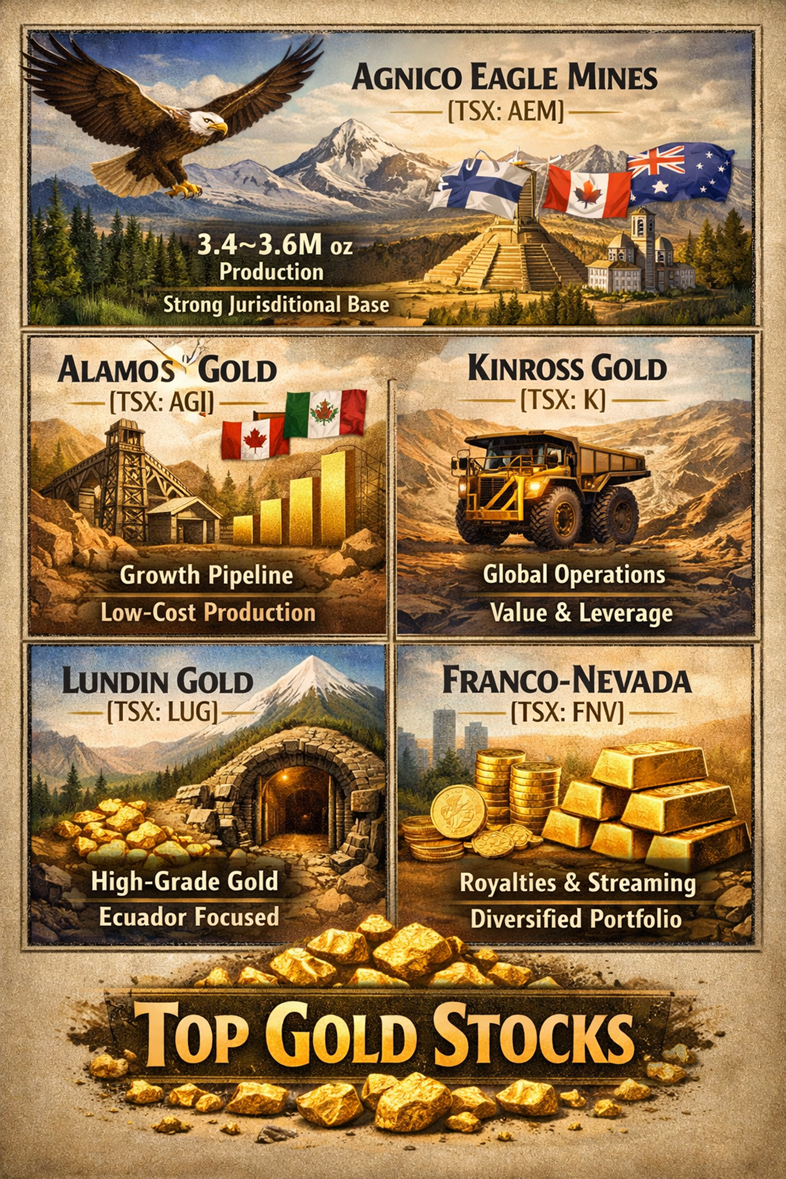
The Toronto Stock Exchange (TSX) remains the world’s leading hub for gold equities, offering investors multiple ways to gain exposure to this powerful commodity trend. Below are five TSX-listed companies frequently highlighted for their strategic positioning in the current gold environment.
Source: Kalkine Group
Agnico Eagle is widely considered one of the highest-quality senior gold producers globally. With annual production guidance around 3.4–3.6 million ounces through 2026, the company benefits from a diversified portfolio across Canada, Mexico, Finland, and Australia.
A key competitive advantage is its jurisdictional strength. A large portion of production comes from Canada, Finland, and Australia — regions viewed as politically stable and mining-friendly. This geographic profile often commands a premium valuation compared with peers operating in higher-risk regions.
The company also maintains a strong balance sheet with significant net cash, giving it flexibility for acquisitions, project expansion, and shareholder returns. For long-term investors seeking a core holding in the gold sector, Agnico Eagle is frequently viewed as a benchmark.
Alamos Gold has emerged as a prominent mid-tier producer combining strong current cash generation with a visible multi-year growth pipeline.
The company operates primarily in North America, with assets in Ontario and Mexico, a strategy designed to reduce geopolitical and execution risk. Its cost profile is competitive globally, with all-in sustaining costs placing it among lower-cost producers.
The most significant catalyst is the Island Gold District expansion, which could meaningfully increase production while reducing unit costs. If executed successfully, this project may transform Alamos into a larger senior producer over time.
For investors looking for growth potential within the gold sector, Alamos represents a notable candidate.
Kinross has undergone a significant operational turnaround in recent years, improving efficiency, strengthening its balance sheet, and focusing on higher-quality assets.
The company operates mines across the Americas and West Africa, positioning it among the world’s larger gold producers. Debt reduction efforts have moved Kinross toward a stronger financial position, increasing flexibility for dividends, share buybacks, and growth investment.
Kinross often trades at a more moderate valuation relative to some mega-cap peers, which can attract investors seeking a combination of value and leverage to gold prices. However, exposure to emerging market jurisdictions remains an important risk consideration.
Lundin Gold offers one of the purest high-grade gold exposures available on the TSX through its flagship Fruta del Norte mine in Ecuador.
High-grade deposits typically generate superior economics because more gold is recovered per tonne of ore processed. The mine has delivered strong production, profitability, and free cash flow, contributing to exceptional share price performance over recent years.
However, the company’s reliance on a single asset creates concentration risk. Any operational or regulatory disruption could significantly impact performance. Investors considering Lundin often balance this risk against the potential for exceptional margins at elevated gold prices.
Franco-Nevada operates under a royalty and streaming model rather than owning and operating mines directly. This structure allows the company to benefit from commodity price increases while avoiding many operational risks associated with mining.
The company maintains exposure to hundreds of assets globally, providing diversification across metals and energy commodities. Historically, Franco-Nevada has delivered strong risk-adjusted returns with lower volatility compared with many mining companies.
The primary trade-off is valuation. Because the business model is viewed as lower risk, the stock often trades at a premium relative to traditional producers. Still, in a high-gold-price environment, cash flow growth can remain substantial.
Understanding the Gold Investment Opportunity
These five companies represent different approaches to gaining exposure to the gold market:
- Agnico Eagle — Large-scale producer with high-quality jurisdictions
- Alamos Gold — Mid-tier growth story with expanding production potential
- Kinross Gold — Turnaround and value-oriented exposure
- Lundin Gold — High-grade, high-margin single-asset opportunity
- Franco-Nevada — Royalty model with reduced operational risk
While the sector’s strong rally has increased valuations, the underlying macro drivers supporting gold remain in place. Central bank buying, geopolitical uncertainty, fiscal expansion, and currency concerns continue to reinforce gold’s role as a strategic asset.
For investors who believe the precious metal’s long-term trajectory remains upward, TSX gold equities provide multiple pathways to participate in the trend — from conservative royalty exposure to higher-growth mining opportunities.
Important Notice: This article is for informational and educational purposes only and does not constitute financial advice. Always conduct your own research and consult a licensed financial adviser before making any investment decisions. Past performance is not indicative of future results. The information in this article is general in nature and does not take into account your personal financial situation, objectives, or needs. It should not be relied upon as a substitute for professional financial advice. Stock prices, analyst targets, and market conditions referenced herein are subject to change. Investing in equities involves risk, including the potential loss of principal. Always do your own research.


 Jun 21, 2026




 Please wait processing your request...