The Offer

Company Overview
Generate Biomedicines, Inc. (GENB) is a clinical-stage biotechnology company focused on applying generative artificial intelligence to the design and development of novel protein therapeutics. Through its proprietary Generate Platform, the company integrates diffusion-based and predictive computational models with scalable biohardware in a closed design–build–test–learn loop, enabling de novo protein engineering and optimization across therapeutic areas and modalities. Its lead candidate, GB-0895, a long-acting anti-TSLP monoclonal antibody for severe asthma, is currently enrolling patients in Phase 3 trials, with additional oncology programs advancing toward early-stage clinical development. By combining large-scale proprietary data generation, high-throughput biological validation, and modular engineering capabilities, the company aims to systematically “program biology” to create differentiated medicines while continuously improving model performance through iterative data feedback.
Key Highlights
Primary Offering:
25,000,000 shares (30-day option to the underwriters to purchase up to 3,750,000 additional shares of common stock)
Use of proceeds:
- IPO Proceeds and Capital Structure Impact: Generate Biomedicines, Inc. expects to generate approximately USD 368.8 million in net proceeds from the offering of 25 million shares at an assumed price of USD 16.00 per share, increasing to approximately USD 424.9 million if the underwriters exercise their full allotment option. Net proceeds are sensitive to pricing and share count adjustments, with each USD 1.00 change in the offering price altering proceeds by roughly USD 23.4 million. The offering is intended to establish a public market for the company’s common stock, enhance corporate visibility, and provide access to additional capital to support clinical and platform development initiatives.
- Allocation of Proceeds Across Clinical and Platform Programs: The majority of proceeds will be directed toward advancing the company’s lead clinical asset, GB-0895, with approximately USD 300.0 million allocated to complete two Phase 3 trials in severe asthma and an additional USD 100.0 million earmarked to complete the ongoing Phase 1b COPD study and potentially initiate the next development phase, subject to data and regulatory alignment. Approximately USD 75.0 million is designated to further develop and scale the proprietary generative biology platform, supporting candidate nomination and IND-enabling activities across multiple programs. A further USD 15.0 million will support early clinical progression of GB-4362 and GB-5267 through topline Phase 1 data, with remaining funds allocated toward additional R&D initiatives, working capital, and general corporate purposes.
- Funding Runway, Strategic Flexibility and Capital Management: Based on current operating assumptions, the company anticipates that IPO proceeds combined with existing cash resources will fund operations into the first half of 2028, though timelines remain subject to clinical, regulatory, and operational variables. Management retains discretion in capital deployment and may allocate a portion of funds toward potential in-licensing, acquisitions, or strategic investments to strengthen pipeline breadth and intellectual property positioning. Pending operational deployment, proceeds are expected to be invested in capital preservation instruments, including investment-grade and U.S. government-backed securities, with no assurance of return.
Dividend policy:
The Company has never declared or paid cash dividends and currently expects to retain all available funds and any future earnings to support ongoing business development and expansion, with no anticipated dividends in the foreseeable future. Any future dividend decision will remain entirely at the Board’s discretion and will be contingent upon prevailing financial performance, capital needs, contractual and regulatory constraints, and other relevant considerations, including potential restrictions under future agreements.
Strategic Oncology Pipeline Expansion: Targeted Toxicity Mitigation and Armored Cell Therapy Innovation
- Bladder Cancer Opportunity and Rationale for GB-4362: Bladder cancer represents a substantial and growing global burden, with more than 573,000 new cases reported worldwide in 2020 and incidence projected to nearly double by 2040. Urothelial cancer accounts for over 90% of cases and frequently progresses to metastatic disease, where prognosis remains poor. While the introduction of immune checkpoint inhibitors and antibody-drug conjugates (ADCs), including enfortumab vedotin (EV) combined with pembrolizumab, has improved outcomes in first-line metastatic urothelial cancer, treatment-limiting toxicities remain a critical constraint. Peripheral neuropathy, driven by systemic exposure to free monomethyl auristatin E (MMAE), occurs in a majority of treated patients and is a leading cause of dose reductions, interruptions and discontinuations, highlighting a meaningful unmet need for toxicity-mitigating strategies.
- GB-4362: MMAE Neutralization Strategy and Clinical Development Plan: GB-4362 is designed as a systemically administered antibody that selectively binds and neutralizes circulating free MMAE while preserving intracellular payload delivery of MMAE-based ADCs. Preclinical data demonstrated picomolar affinity for free MMAE, preservation of ADC-mediated tumor cytotoxicity within a defined therapeutic window, and dose-dependent reductions in circulating MMAE exposure and associated toxicities in non-human primate models. An Investigational New Drug (IND) application was cleared in December 2025, and the program received Fast Track designation in January 2026. A Phase 1 dose-escalation and expansion trial is planned in patients receiving EV plus pembrolizumab, with endpoints including safety, pharmacokinetics, free MMAE reduction and exploratory evaluation of peripheral neuropathy mitigation. Beyond metastatic urothelial cancer, the approach may have broader relevance across other FDA-approved and investigational MMAE-containing ADCs.
- GB-5267: Armored MUC16-Directed CAR-T for Platinum-Resistant Ovarian Cancer: GB-5267 is an armored, MUC16-directed CAR-T cell therapy engineered to address the significant unmet need in platinum-resistant ovarian cancer, a setting where objective response rates remain below 30% and no curative therapies exist. Solid tumors have historically posed challenges for CAR-T approaches due to antigen heterogeneity and an immunosuppressive tumor microenvironment (TME). GB-5267 incorporates a high-affinity MUC16 binder, 4-1BB/CD3ζ signaling domains and cytokine armoring intended to enhance T-cell activation, persistence and local immune modulation. Preclinical studies demonstrated antigen-specific activation, selective tumor cytotoxicity, in vivo persistence and tumor burden reduction in orthotopic models, supporting progression into first-in-human evaluation.
- Clinical Roadmap and Platform Expansion Potential: An IND for GB-5267 was cleared in December 2025, with a Phase 1 open-label trial expected to initiate in 2026 in collaboration with Roswell Park. The study will evaluate safety, dose escalation and preliminary anti-tumor activity, exploring both intravenous and combined intravenous plus intraperitoneal administration without planned lymphodepleting chemotherapy. Collectively, GB-4362 and GB-5267 illustrate the application of the Generate Platform to distinct modalities—antibody-based toxicity modulation and armored cell therapy—while offering potential for label expansion into additional indications. The modular design and mechanistic selectivity underlying both programs position them as differentiated approaches within large oncology markets characterized by persistent unmet medical needs.
Financial Highlights (Results of Operations) (FY25, Expressed in USD)
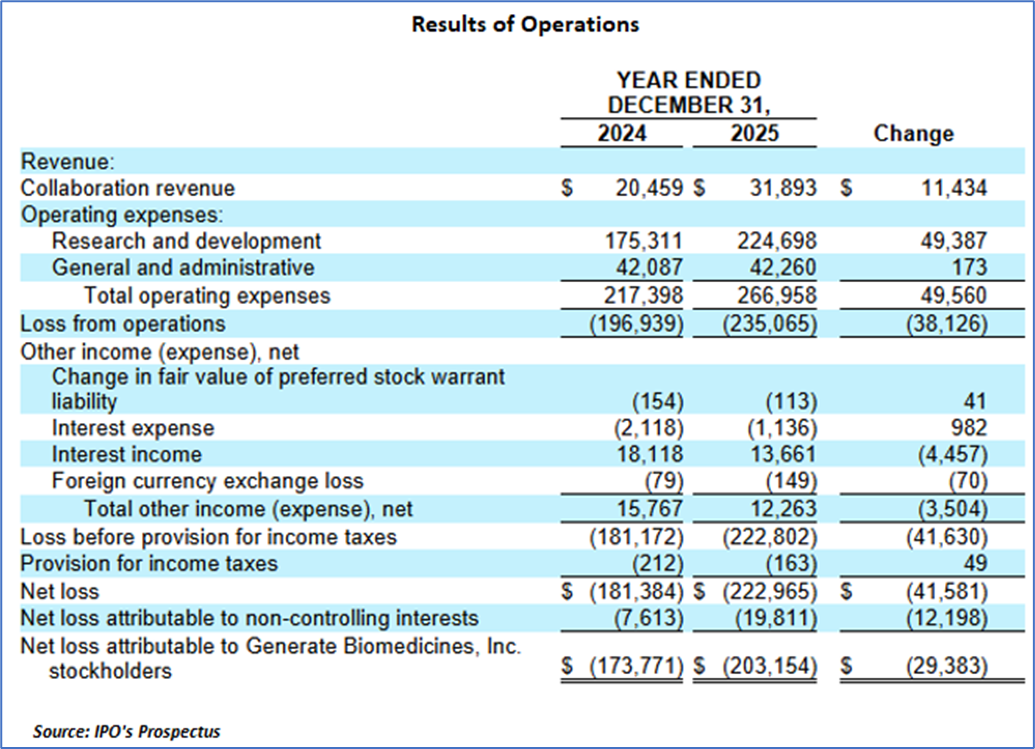
- Collaboration Revenue Expansion and Partner Dynamics: Generate Biomedicines, Inc. generated collaboration revenue exclusively from its strategic agreements with Novartis and Amgen, recognizing revenue based on research progress and cost incurrence. Collaboration revenue increased to USD 31.9 million in 2025 from USD 20.5 million in 2024, primarily driven by accelerated development activities under the Novartis agreement, which contributed USD 25.1 million in 2025 compared to USD 2.3 million in the prior year. In contrast, revenue from the Amgen agreement declined to USD 6.7 million from USD 18.2 million as performance obligations are near completion. Overall, revenue trends reflect shifting program maturity across partnerships, with Novartis activities ramping and Amgen obligations approaching conclusion.
- Research and Development Investment Acceleration: Research and development (R&D) expenses increased materially to USD 224.7 million in 2025 from USD 175.3 million in 2024, reflecting expanded clinical and platform activity. The largest driver was the advancement of GB-0895, with program-specific spending rising by USD 26.1 million due to Phase 1b and Phase 3 clinical trial initiation and related CMC activities. Additional increases were attributable to higher discovery and development candidate costs, expanded early research infrastructure, and increased personnel-related expenses driven by headcount growth. These investments underscore the company’s transition toward later-stage clinical execution while continuing to scale its generative biology platform capabilities.
- Operating Results, Liquidity Profile and Cash Flow Trends: General and administrative expenses remained stable at approximately USD 42.3 million in 2025, reflecting disciplined overhead management despite organizational growth. Other income declined to USD 12.3 million from USD 15.8 million due to lower interest income on reduced cash balances. Operating cash outflows widened to USD 200.6 million in 2025, reflecting increased R&D intensity, while investing activities generated net inflows of USD 116.8 million primarily from marketable security maturities. Financing inflows moderated to USD 28.1 million. Since inception, the company has raised over USD 934 million through equity, debt and collaboration funding, positioning it to support continued platform expansion and clinical advancement, albeit with ongoing reliance on external capital given sustained operating losses.
Key Management Highlights
Risk Associated (High)
Investment in the IPO of “GENB” is exposed to a variety of risks such as:
- Clinical Development and Regulatory Risk: The company’s value proposition is highly dependent on successful clinical outcomes, particularly for GB-0895 and GB-4362 as they advance through late-stage and early-stage trials, respectively. Failure to demonstrate safety, efficacy, or meaningful differentiation in Phase 3 (GB-0895) or Phase 1 (GB-4362, GB-5267) studies could materially delay timelines or limit regulatory approval prospects. Additionally, evolving FDA requirements, unexpected adverse events, enrollment delays, or manufacturing (CMC) challenges could significantly increase costs and extend development timelines.
- Platform Translation and Technology Risk: Generate Biomedicines’ strategy relies on its AI-driven “Generate Platform” to consistently translate computational protein design into clinically viable therapeutics. While early progress has been demonstrated, there is inherent risk that generative biology models may not reliably produce differentiated or commercially competitive candidates across multiple programs. If the design–build–test–learn loop fails to scale effectively, or if predictive performance does not translate into clinical success, the perceived technological advantage could diminish.
- Capital Intensity and Funding Risk: The company has incurred substantial operating losses and continues to generate negative cash flow from operations. With R&D expenses exceeding USD 224 million in 2025 and increasing clinical-stage commitments, future capital requirements are expected to remain significant. If capital markets become less accessible, collaboration funding declines, or trial costs exceed projections, the company may need to secure additional financing on unfavorable terms, potentially resulting in dilution or operational constraints.
Conclusion
Generate Biomedicines, Inc. (GENB) is a clinical-stage biotechnology company seeking to raise approximately USD 368.8 million through its IPO to advance its AI-driven protein engineering platform and pipeline, led by GB-0895, a Phase 3 asset in severe asthma. The majority of proceeds are expected to fund late-stage development of GB-0895, expansion into COPD, continued platform innovation, and early-stage oncology programs including GB-4362 and GB-5267, with an operational runway projected into the first half of 2028 under current assumptions. Financially, collaboration revenue increased to USD 31.9 million in 2025, driven primarily by progress under the Novartis agreement, while R&D expenses rose to USD 224.7 million reflecting intensified clinical activity and infrastructure scaling; operating cash outflows widened accordingly, underscoring ongoing capital dependence. The oncology pipeline targets meaningful unmet needs, including mitigation of MMAE-related toxicity in metastatic urothelial cancer and development of an armored MUC16-directed CAR-T therapy for platinum-resistant ovarian cancer, both supported by preclinical data and planned Phase 1 studies in 2026. However, the company remains exposed to substantial clinical, regulatory, technology translation, and funding risks typical of pre-commercial biotechnology enterprises, with long-term value contingent on successful trial outcomes, platform scalability, and sustained access to capital markets.
Hence, given the financial performance of the company, use of proceeds, and associated risks “Generate Biomedicines, Inc. (GENB)” IPO seems “Neutral" at the IPO price.
Past performance is not a reliable indicator of future performance.

 NZ
 UK
 US
 AU
 IND

 CA

 Please wait processing your request...