Amcor plc
Amcor plc (NYSE: AMCR) is engaged in packaging solutions for consumer and healthcare products. The Company develops sustainable packaging in flexible and rigid formats across multiple materials. The Company operates through two segments: Flexibles and Rigid Packaging. The Flexibles segment consists of operations that manufacture flexible and film packaging in the food and beverage, medical and pharmaceutical, fresh produce, snack food, personal care, and other industries.

Key Business and Financial Updates:
- Strong Revenue Expansion Driven by Strategic Acquisition: Amcor plc (NYSE: AMCR) delivered robust top-line growth, with quarterly net sales reaching USD 5.45 billion, representing a 68% year-over-year increase, while first-half fiscal 2026 revenue stood at USD 11.19 billion, up 70%. This growth was primarily driven by the Berry Global acquisition, which contributed approximately USD 2.2 billion in quarterly sales and USD 4.5 billion in first-half revenue. Despite a modest volume decline of approximately 1.5%, overall revenue expansion reflects successful integration and scale benefits.
- Earnings Growth Supported by Synergies and Operational Discipline: The Company reported strong earnings performance, with adjusted EBITDA increasing 83% to USD 826 million in the quarter and 89% to USD 1.74 billion for the first half. Adjusted EBIT rose 66% to USD 603 million in Q2 and 77% to USD 1.29 billion in the first half, supported by approximately USD 50 million in quarterly and USD 83 million in half-year synergy benefits from the Berry acquisition. Adjusted EPS increased 7% to USD 0.86 in the quarter and 14% to USD 1.83 for the first half, highlighting effective cost management and integration execution.
- Margin Profile and Cost Structure Dynamics: Amcor demonstrated improvement in profitability margins, with adjusted EBITDA margin expanding to 15.2% in the quarter from 14% in the prior year, and 15.5% for the first half compared to 13.9%. Adjusted EBIT margin remained stable at 11.1% in Q2 and improved to 11.5% for the first half. However, margin expansion was partially offset by lower volumes and acquisition-related integration costs, indicating that further efficiency gains and synergy realization will be key drivers of future margin improvement.
- Cash Flow Generation, Balance Sheet, and Capital Allocation: The Company generated free cash flow of USD 289 million in the quarter despite incurring USD 69 million in acquisition-related costs, reflecting resilient cash generation capabilities. Net debt stood at USD 14.08 billion as of December 2025, primarily due to acquisition financing. Amcor continues to demonstrate strong shareholder return commitment, declaring a quarterly dividend of USD 0.65 per share, supported by its expectation of generating USD 1.8–1.9 billion in free cash flow for fiscal 2026.
- Outlook, Growth Visibility, and Strategic Positioning: Amcor has reaffirmed its fiscal 2026 guidance, projecting adjusted EPS in the range of USD 4.00–4.15, implying 12–17% constant currency growth, supported by at least USD 260 million in synergy benefits from the Berry acquisition. The Company’s strategy focuses on portfolio optimization, scale expansion, and leadership in consumer packaging across health, nutrition, and wellness segments. While near-term risks include integration execution and volume softness, the combination of strong cash flow visibility, synergy realization, and global scale positions Amcor for sustained long-term growth.
Key Risks for Amcor plc (NYSE: AMCR):
- Leverage and Balance Sheet Risk Post-Acquisition: Amcor’s balance sheet has become significantly leveraged following the Berry Global acquisition, with net debt reaching approximately USD 14.1 billion. The increase in interest expense (up materially year-over-year) reflects higher acquisition-related borrowings, which could constrain financial flexibility, especially in a higher interest rate environment. Elevated leverage levels may also limit the Company’s ability to pursue further strategic investments or withstand cyclical downturns.
- Integration and Synergy Execution Risk: The Company’s growth thesis is heavily dependent on the successful integration of the Berry acquisition and realization of projected synergies (at least USD 260 million expected in FY2026). While early synergy realization has been strong, any delays in integration, cost overruns, or operational inefficiencies could impact profitability and dilute expected returns. Large-scale integrations inherently carry execution risk, particularly across global operations and complex supply chains.
- Volume Weakness and Demand Sensitivity: Despite strong revenue growth driven by acquisitions, underlying organic volume declined by approximately 1.5%, indicating softness in core demand across certain segments. Continued volume pressure, particularly in non-core or cyclical end markets, could weigh on revenue quality and margin expansion. Additionally, the Company’s performance remains sensitive to consumer demand trends, input cost fluctuations, and pricing dynamics, which may impact future growth sustainability.
Technical Observation (on the daily chart):
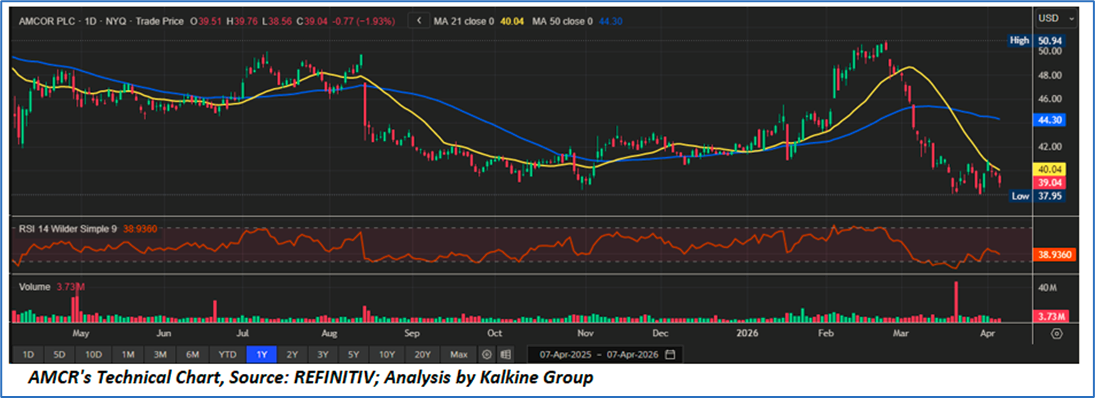
- Structural Breakdown and Transition into a Downtrend Regime: Amcor plc (AMCR) has undergone a clear trend reversal from a prior uptrend into a bearish structural regime, as evidenced by the sharp rejection from the ~USD 50.9 peak and the subsequent formation of consistent lower highs and lower lows. The breakdown below key dynamic supports, particularly the 50-day moving average (~USD 44.3), confirms a shift in market structure toward distribution. Price is now firmly trading below both the 21-day (~USD 40.0) and 50-day moving averages, with both indicators sloping downward—signaling sustained selling pressure and trend deterioration. The inability to reclaim these moving averages suggests that near-term rallies are likely to be sold into, reinforcing a bearish bias.
- Momentum Degradation and Absence of Reversal Signals: The RSI (~38) reflects weakening momentum, remaining below the neutral 50 level and indicating persistent bearish dominance. Notably, the RSI has not reached extreme oversold levels, implying that downside momentum has not yet fully exhausted, leaving room for further price weakness or prolonged consolidation. The absence of bullish divergence further diminishes the probability of an imminent reversal, while repeated failures to sustain momentum recovery reinforce a continuation pattern rather than accumulation. This momentum profile aligns with a controlled downtrend rather than capitulation, which typically precedes extended consolidation or further declines.
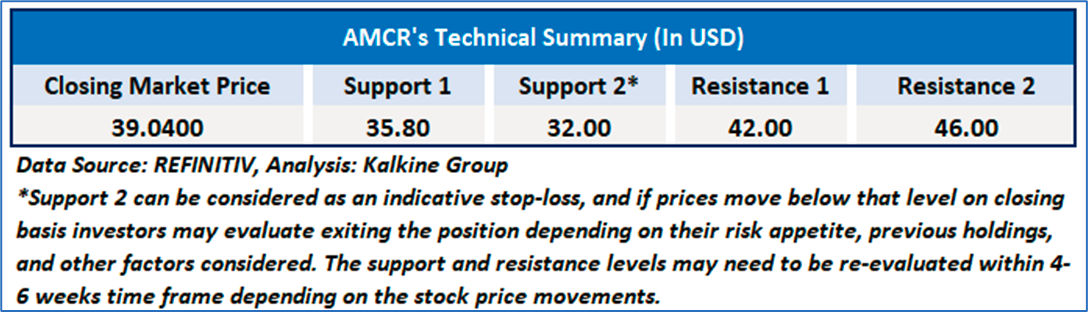
- Volume-Driven Distribution and Critical Support Inflection Zone: Volume dynamics reveal intermittent spikes during price declines, indicative of institutional distribution rather than retail-driven volatility. While recent sessions show some contraction in volume, this appears more reflective of temporary stabilization than genuine accumulation. The stock is currently testing a critical support band around USD 38–USD 39, which serves as a key inflection point. A decisive breakdown below this zone could trigger a downside extension toward lower structural supports, whereas any recovery would require a high-conviction, volume-backed reclaim of the USD 40–USD 42 resistance zone. Until such confirmation is observed, the technical setup remains bearish with limited evidence of accumulation or trend reversal.
Amcor plc (NYSE: AMCR) demonstrates a resilient and scalable growth profile supported by strong revenue expansion (USD 5.45 billion quarterly sales, +68% YoY) and robust earnings momentum driven by disciplined execution and synergy realization from the Berry acquisition. The Company’s improving margin profile, with adjusted EBITDA margins rising to ~15.5%, alongside substantial free cash flow generation and projected USD 1.8–1.9 billion for FY2026, underscores its strong financial foundation. Strategic investments in global capacity expansion and portfolio optimization, combined with at least USD 260 million in expected synergy benefits, enhance long-term earnings visibility. Despite near-term technical weakness and integration-related pressures, Amcor’s scale, diversified end-market exposure, and consistent shareholder returns through dividends position it favorably for sustained value creation and potential re-rating as integration efficiencies and margin improvements materialize.
As per the above-mentioned price action, important support near USD 35.00- USD 38.00, momentum in the stock over the last month, and technical indicators analysis, a ‘Buy’ rating has been given for Amcor plc (NYSE: AMCR), at the closing price of USD 39.04, as of April 07, 2026.
Individuals can evaluate the stock based on the support and resistance levels provided in the report in case of keen interest taking into consideration the risk-reward scenario.
Markets are trading in a highly volatile zone currently due to certain macro-economic issues and prevailing geopolitical tensions. Therefore, it is prudent to follow a cautious approach while investing.
Related Risk: This report may be looked at from a high-risk perspective, and a recommendation is provided for a short duration. This report is solely based on technical parameters, and the fundamental performance of the stocks has not been considered in the decision-making process. Other factors which could impact the stock prices include market risks, regulatory risks, interest rates risks, currency risks, social and political instability risks etc.
Note 1: Past performance is not a reliable indicator of future performance.
Note 2: The reference date for all price data, currency, technical indicators, support, and resistance level is April 07, 2026. The reference data in this report has been partly sourced from REFINITIV.
Note 3: Investment decisions should be made depending on an individual's appetite for upside potential, risks, holding duration, and any previous holdings. An 'Exit' from the stock can be considered if the Target Price mentioned as per the Valuation and or the technical levels provided has been achieved and is subject to the factors discussed above.
Note 4: Target Price refers to a price level that the stock is expected to reach as per the relative valuation method and or technical analysis taking into consideration both short-term and long-term scenarios.
Note 5: ‘Kalkine reports are prepared based on the stock prices captured either from the New York Stock Exchange (NYSE), NASDAQ Capital Markets (NASDAQ), and or REFINITIV. Typically, all sources (NYSE, NASDAQ, or REFINITIV) may reflect stock prices with a delay which could be a lag of 15-20 minutes. There can be no assurance that future results or events will be consistent with the information provided in the report. The information is subject to change without any prior notice.

 NZ
 UK
 US
 AU
 IND

 CA

 Please wait processing your request...