ROBN is an actively managed exchange-traded fund that seeks to deliver 200% of the daily performance of Robinhood Markets, Inc. (HOOD), before fees and expenses. The fund does not invest directly in HOOD shares. Instead, it primarily gains exposure through swap agreements with major global financial institutions, under which the fund and counterparties exchange returns linked to HOOD’s daily price movements.

Understanding the Daily Leverage Objective
The core objective of ROBN is straightforward but highly specialized: to provide twice the daily return of HOOD’s common stock. This leveraged exposure functions as follows:
- If HOOD rises by 1% on a given trading day, ROBN is designed to rise by approximately 2% before fees and expenses.
- Conversely, if HOOD declines by 1% in a single session, ROBN is expected to fall by approximately 2%.
It is important to emphasize that this target applies only on a daily basis. The fund resets its leverage at the end of each trading session, ensuring that the next day’s exposure again targets 200% of HOOD’s daily move.
The Impact of Daily Reset and Compounding
One of the most critical features of ROBN is its daily reset mechanism. Because leverage is recalibrated every trading day, the fund’s performance over periods longer than one day may diverge significantly from two times the cumulative performance of HOOD over the same period.
In trending markets, this compounding effect may enhance returns. However, in volatile or range-bound conditions, compounding can work against investors, potentially leading to performance erosion even if HOOD ends a multi-day period relatively unchanged. This characteristic makes ROBN unsuitable for passive or buy-and-hold strategies.
Who Is This Fund Designed For?
ROBN is engineered for sophisticated, risk-tolerant traders who actively monitor markets and manage positions closely. Typical use cases include:
- Short-Term Tactical Trading: Traders with strong short-term conviction in HOOD’s price direction may use ROBN to magnify potential gains over intraday or multi-day horizons.
- Momentum-Based Strategies: Given HOOD’s sensitivity to retail sentiment, earnings updates, regulatory headlines, and crypto-related activity, ROBN may appeal to momentum-focused traders.
- Capital-Efficient Exposure: By providing leveraged exposure through derivatives, ROBN allows traders to express a bullish view on HOOD without deploying the full capital required to purchase shares outright.
This fund is not designed for long-term investors, retirement portfolios, or those unable to tolerate rapid and amplified losses.
Key Considerations and Risks
Engaging with a leveraged ETF such as ROBN requires a thorough understanding of its risks:
- Compounding Risk: Due to daily leverage reset, returns over longer holding periods can deviate materially from expectations, particularly during volatile market conditions.
- Single-Stock Concentration: ROBN’s performance is entirely dependent on HOOD, exposing investors to company-specific risks such as regulatory scrutiny, earnings volatility, and shifts in retail trading behavior.
- Derivative and Counterparty Risk: The fund relies on swap agreements with financial institutions, introducing counterparty exposure and potential tracking inefficiencies.
- Heightened Volatility: Leverage magnifies both gains and losses, increasing the likelihood of sharp drawdowns during adverse market moves.
Price Chart Technical Summary
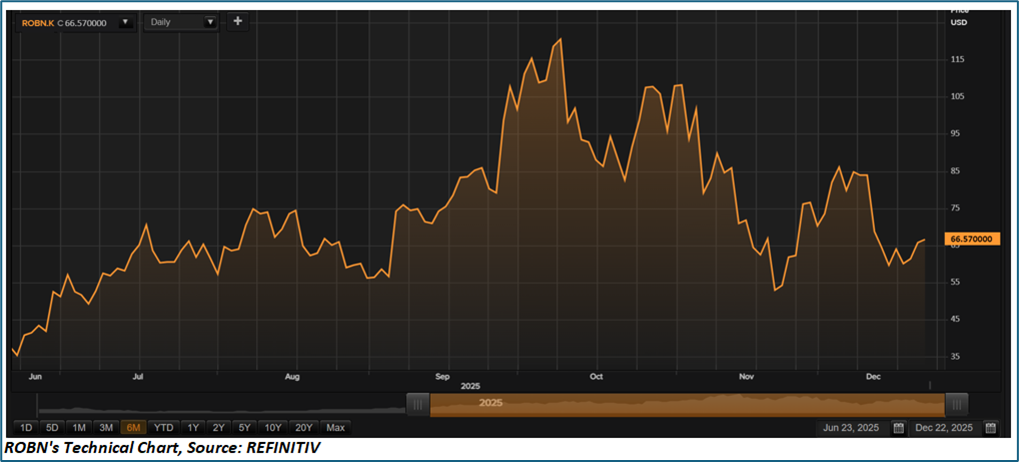
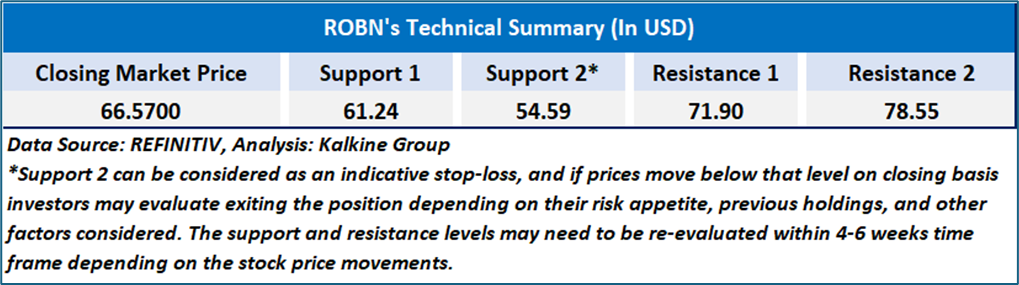
Conclusion
T The T-Rex 2X Long HOOD Daily Target ETF (ROBN) provides a powerful, precision-driven instrument for traders seeking amplified daily exposure to Robinhood Markets, Inc. Built for short-term execution rather than long-term ownership, ROBN offers opportunities in strongly directional markets but demands active management and disciplined risk controls. A clear understanding of daily leverage mechanics, compounding effects, and HOOD’s inherent volatility is essential before considering this tactical ETF.
Note 1: Past performance is not a reliable indicator of future performance.
Note 2: The reference date for all price data, currency, technical indicators, support, and resistance level is December 22, 2025. The reference data in this report has been partly sourced from REFINITIV.
Note 3: Investment decisions should be made depending on an individual's appetite for upside potential, risks, holding duration, and any previous holdings.
Note 4: ‘Kalkine reports are prepared based on the prices captured either from the New York Stock Exchange (NYSE), NASDAQ Capital Markets (NASDAQ), and or REFINITIV. Typically, all sources (NYSE, NASDAQ, or REFINITIV) may reflect stock prices with a delay which could be a lag of 15-20 minutes. There can be no assurance that future results or events will be consistent with the information provided in the report. The information is subject to change without any prior notice.

 AU
AU
 UK
UK
 US
US
 NZ
NZ
 IND
IND

 CA
CA
 Please wait processing your request...