The Fund seeks daily inverse investment results of -2.0 times (-200%) the daily percentage change of the common stock of Super Micro Computer, Inc. The Fund is an actively managed exchange traded fund that attempts to achieve 2 times the inverse of the daily percentage change in the price of the Underlying Securities.

The field of high-performance computing and AI infrastructure has become one of the most dynamic and competitive areas in modern technology. Super Micro Computer, Inc. (SMCI) has emerged as a key player in this space, delivering cutting-edge server and storage solutions that power AI, cloud computing, and enterprise systems worldwide. However, this remarkable growth has also led to significant stock price volatility.
For traders who anticipate a short-term pullback in SMCI’s stock price, the Defiance Daily Target 2X Short SMCI ETF (SMCZ) provides a way to capitalize on that view.
SMCZ is an actively managed exchange-traded fund designed with a focused and aggressive objective:
To seek daily inverse investment results, before fees and expenses, that correspond to two times the inverse (-2x) of the daily performance of Super Micro Computer, Inc. (SMCI) common stock.
SMCZ is not a suitable investment for the average long-term portfolio. It is a highly specialized instrument designed for experienced traders and investors with a high tolerance for risk. Its intended applications are tactical and short-term:
- Speculating on Downturns: Traders who have a strong, data-driven conviction that Super Micro Computer, Inc. (SMCI) stock is overbought or poised for a near-term pullback can use SMCZ to seek potential profits from that decline.
- Hedging Sector Exposure: Investors with substantial long positions in AI infrastructure, data center hardware, or high-performance computing stocks may use SMCZ as a hedge against a potential correction in the broader AI or semiconductor technology sector, where SMCI is a major component.
Because of its leveraged and inverse structure, holding SMCZ for extended periods requires active management, frequent monitoring, and a thorough understanding of compounding effects and volatility risks.
Key Considerations and Risks
- Compounding Risk: The fund’s daily reset feature can cause performance to diverge from its target over time, especially in volatile or range-bound markets where SMCI’s price fluctuates without a sustained trend. As a result, SMCI could finish a multi-day period with a modest gain or loss, while SMCZ may experience a more pronounced loss due to compounding effects.
- Extreme Volatility: Super Micro Computer (SMCI) operates in the AI and high-performance computing industry, an area characterized by rapid innovation and shifting market sentiment. News related to AI demand, semiconductor supply chains, or competitor performance can cause sharp movements in SMCI’s stock price—magnifying both potential gains and losses for SMCZ hol ders.
- Higher Costs: Like other actively managed and leveraged ETFs, SMCZ typically carries a higher expense ratio than traditional index funds. These costs can reduce returns over time, especially if the fund is held longer than intended for tactical trading purposes.Top of Form
Bottom of Form
Price Chart Technical Summary
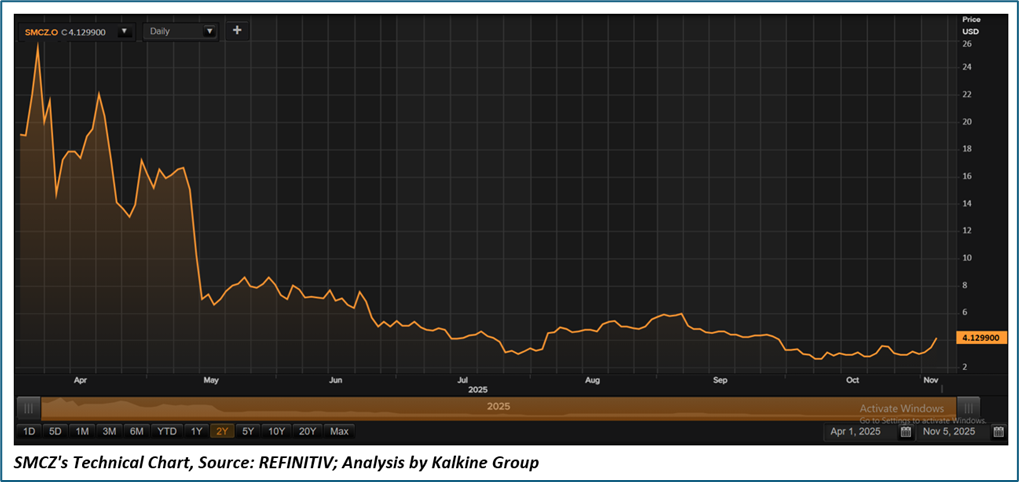
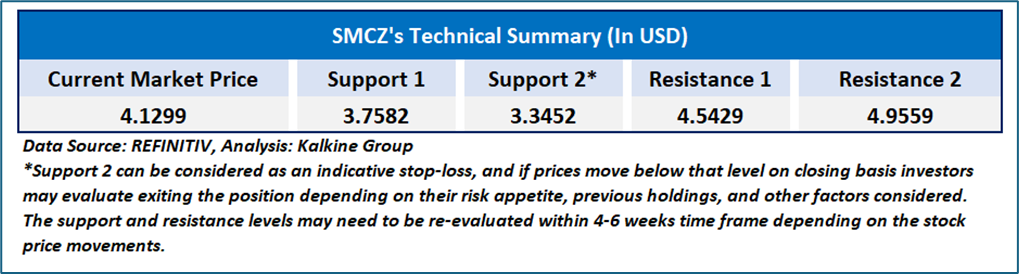
Conclusion
The Defiance Daily Target 2X Short SMCI ETF (SMCZ) offers a powerful tool for experienced traders seeking to capitalize on or hedge against short-term weakness in Super Micro Computer, Inc. (SMCI) stock. It is designed for precision and short-term execution, enabling tactical exposure to the inverse performance of one of the most volatile names in the AI and high-performance computing sector. However, its power is matched by its complexity and risk. Any potential investor should fully understand the mechanics of daily leverage, the effects of compounding, and the heightened volatility of the AI hardware and data infrastructure markets before considering this specialized trading instrument.
Note 1: Past performance is not a reliable indicator of future performance.
Note 2: The reference date for all price data, currency, technical indicators, support, and resistance level is November 5, 2025. The reference data in this report has been partly sourced from REFINITIV.
Note 3: Investment decisions should be made depending on an individual's appetite for upside potential, risks, holding duration, and any previous holdings.
Note 4: ‘Kalkine reports are prepared based on the prices captured either from the New York Stock Exchange (NYSE), NASDAQ Capital Markets (NASDAQ), and or REFINITIV. Typically, all sources (NYSE, NASDAQ, or REFINITIV) may reflect stock prices with a delay which could be a lag of 15-20 minutes. There can be no assurance that future results or events will be consistent with the information provided in the report. The information is subject to change without any prior notice.

 AU
AU
 UK
UK
 US
US
 NZ
NZ
 IND
IND

 CA
CA

 Please wait processing your request...