Rocket Lab Corporation
Rocket Lab Corporation (NASDAQ: RKLB) is an end-to-end space company. The Company designs and manufactures small and medium-class rockets, spacecraft and spacecraft components, and related software and services to support the space economy. The Company delivers reliable launch services, satellite manufacture, spacecraft design services, spacecraft components, spacecraft manufacturing, and other spacecraft and on-orbit management solutions that make it easier to access space.

Key Business and Financial Updates:
- Record Revenue Growth and Expanding Margins in Q3 2025: Rocket Lab USA, Inc. (NASDAQ: RKLB) delivered record third-quarter 2025 revenue of USD 155 million, representing a 48% year-over-year increase and a 7.3% sequential rise. GAAP gross margin reached 37%, at the upper end of prior guidance, while non-GAAP gross margin expanded to 41.9%. The improvement reflects operational scale, stronger launch economics, and favorable revenue recognition dynamics. Over a five-year horizon, the company has expanded revenue from USD 35 million in 2020 to an implied approximately USD 600 million for full-year 2025 at the midpoint of guidance, alongside a transition from negative 34% gross margin in 2020 to positive mid-30% levels in 2025, underscoring structural margin progression.
- Segment Performance, Backlog Visibility, and Revenue Conversion: Space Systems generated USD 114.2 million in Q3 revenue, increasing 16.7% sequentially, supported by higher satellite manufacturing activity. Launch Services contributed USD 40.9 million, declining 12.3% quarter-over-quarter due to timing delays in customer spacecraft readiness, though launch cadence is expected to accelerate in Q4. Total backlog stood at approximately USD 1.1 billion at quarter-end, split 47% launch and 53% space systems, with 57% projected to convert into revenue within 12 months. Seventeen Electron launch contracts were signed during the quarter, reinforcing forward visibility and international demand momentum.
- Neutron Development Progress and Capital Investment Phase: The Neutron medium-lift rocket program advanced through integrated qualification and acceptance testing, with management targeting pad readiness in Q1 2026, subject to completion of risk retirement milestones. Capital expenditures totaled USD 45.9 million in Q3, reflecting engine testing, composite structure integration, and infrastructure scaling. Total headcount increased to 2,602 employees, with R&D expansion focused on propulsion and structural validation. Management indicated that Neutron R&D spending is approaching peak levels, suggesting a transition toward production scaling and future operating leverage as development risk moderates.
- Liquidity Strength, Capital Strategy, and M&A Positioning: Rocket Lab exited Q3 with over USD 1 billion in cash, cash equivalents, restricted cash, and marketable securities, supported by USD 468.8 million raised through its at-the-market equity program. GAAP operating cash flow was negative USD 23.5 million, while non-GAAP free cash flow reflected a USD 69.4 million outflow due to development and infrastructure investment. The strengthened liquidity position supports planned acquisitions, including Mynaric, and broader vertical integration initiatives. Management continues to pursue disciplined M&A to expand payload, communications, and systems capabilities across government and commercial markets.
- Q4 2025 Guidance and Strategic Outlook: For Q4 2025, the company guided revenue of USD 170–180 million, implying sequential growth of approximately 13% at the midpoint. GAAP gross margin is projected at 37–39%, with non-GAAP margins expected between 43–45%, driven by higher launch mix and improved launch absorption. Operating expenses are forecast to rise modestly as Neutron development continues, though spending is expected to gradually shift from R&D to flight hardware inventory. Overall, Rocket Lab’s Q3 results reflect sustained top-line momentum, expanding margins, and disciplined execution across launch and space systems, while near-term financial performance remains influenced by ongoing investment in the Neutron program and strategic scaling initiatives.
Key Company specific risks for RKLB:
- Execution and Development Risk (Neutron Program): Rocket Lab’s medium-lift Neutron vehicle represents a critical inflection point for long-term revenue diversification and margin expansion. Delays in qualification testing, cost overruns, supply-chain bottlenecks, or technical setbacks during first-flight campaigns could defer revenue realization and extend elevated R&D and capital expenditure levels. Given the capital intensity of launch vehicle development, prolonged development timelines may pressure cash flow and operating leverage assumptions.
- Revenue Concentration and Contract Timing Volatility: Although backlog stands at approximately USD 1.1 billion, revenue recognition remains sensitive to launch cadence, customer spacecraft readiness, and government procurement cycles. Launch Services revenue can fluctuate quarter-to-quarter due to mission timing, while large satellite manufacturing contracts introduce inherent lumpiness in bookings and conversion. A slowdown in government awards or delays in commercial program execution could affect near-term revenue visibility.
- Competitive and Market Dynamics Risk: The global launch and space systems market remains highly competitive, with established players and emerging entrants targeting both small and medium-lift segments. Pricing pressure, technological differentiation requirements, and increasing launch capacity from competitors may affect margin sustainability. Additionally, reliance on government and defense programs exposes the company to geopolitical, regulatory, and budgetary uncertainties that could influence contract flow and funding stability.
Technical Observation (on the daily chart):
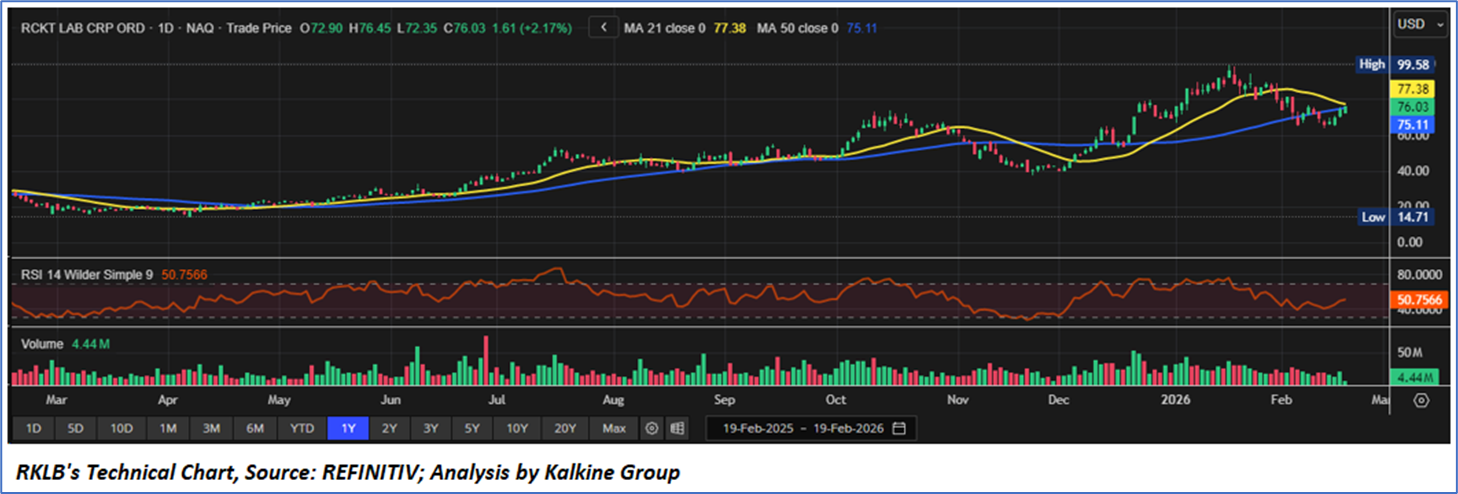
- Trend Structure and Moving Average Configuration Reflect Constructive Medium-Term Bias: Rocket Lab Corporation (NASDAQ: RKLB) is currently trading near USD 76.03, positioned above both its 21-day moving average (USD 77.38) and 50-day moving average (USD 75.11), with the intermediate-term moving averages maintaining a generally upward slope. The broader one-year structure reflects a sustained sequence of higher highs and higher lows, indicative of a constructive medium-term uptrend despite intermittent corrective phases. Recent consolidation beneath the USD 80–85 zone appears to represent digestion following the prior advance toward the USD 99.58 high. The relative alignment of price near key moving averages suggests equilibrium rather than distribution, with structural bias remaining positive so long as the 50-day moving average continues to act as dynamic support.
- Momentum Indicators Signal Neutral-to-Positive Accumulation Without Overextension: The RSI-14 is currently positioned near 50.8, closely aligned with the neutral threshold, indicating balanced buying and selling pressure. This mid-range momentum profile suggests that the stock is neither overbought nor oversold, preserving technical flexibility for directional expansion. Notably, prior pullbacks toward the 40 RSI region have historically attracted renewed buying interest, reinforcing the broader accumulation pattern. Volume dynamics remain stable, with no material evidence of distribution spikes during recent consolidations. The absence of elevated selling pressure during corrective phases supports the interpretation of orderly consolidation rather than structural breakdown.
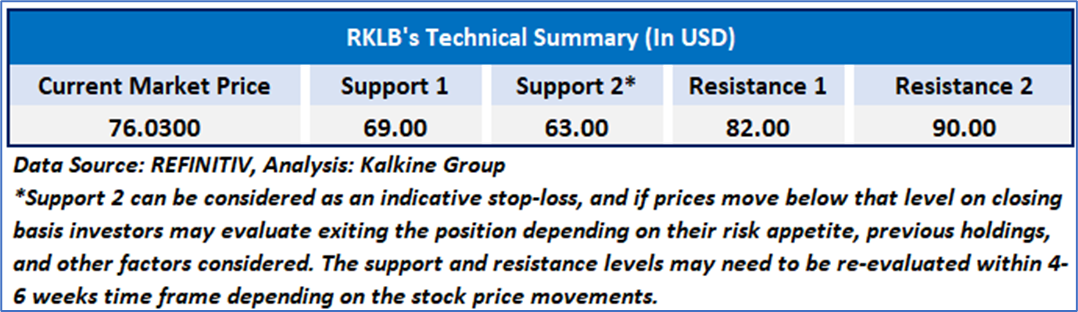
- Key Support and Resistance Levels Define Near-Term Inflection Framework: From a structural perspective, immediate resistance is concentrated in the USD 80–82 range, with a more consequential supply zone near USD 99.50 corresponding to the prior cyclical high. A sustained breakout above the USD 82 level, accompanied by expanding volume, would likely reestablish short-term upward momentum and potentially initiate a retest of the prior peak. On the downside, primary support is observed near USD 75, aligned with the 50-day moving average, while deeper structural support resides near USD 65–68 should broader market volatility intensify. Overall, RKLB’s technical configuration reflects constructive consolidation within a prevailing uptrend, with directional resolution contingent upon a decisive break beyond established resistance thresholds.
Rocket Lab Corporation (NASDAQ: RKLB) reported record Q3 2025 revenue of USD 155 million, representing 48% year-over-year growth and continued margin expansion, with GAAP gross margin reaching 37% and non-GAAP gross margin 41.9%. Space Systems led performance with USD 114.2 million in revenue, while Launch Services contributed USD 40.9 million amid temporary cadence variability. Backlog remained robust at approximately USD 1.1 billion, with 57% expected to convert into revenue over the next 12 months. The company continues to invest heavily in the Neutron medium-lift rocket program, with capital expenditures of USD 45.9 million during the quarter and management indicating development spending is approaching peak levels. Liquidity exceeded USD 1 billion following equity financing, providing flexibility for ongoing R&D, infrastructure expansion, and targeted acquisitions. While near-term cash flow remains pressured by development and scaling costs, the company’s operational execution, expanding gross margins, diversified segment contribution, and disciplined capital strategy reflect a transition toward greater scale within a competitive and capital-intensive space industry landscape.
As per the above-mentioned price action, important resistance near USD 75.00- USD 80.00, momentum in the stock over the last month, and technical indicators analysis, a ‘WATCH’ rating has been given for Rocket Lab Corporation (NASDAQ: RKLB), at the current price of USD76.03, as of February 19, 2026, 08:20 am PST.
Individuals can evaluate the stock based on the support and resistance levels provided in the report in case of keen interest taking into consideration the risk-reward scenario.
Markets are trading in a highly volatile zone currently due to certain macro-economic issues and prevailing geopolitical tensions. Therefore, it is prudent to follow a cautious approach while investing.
Related Risk: This report may be looked at from a high-risk perspective, and a recommendation is provided for a short duration. This report is solely based on technical parameters, and the fundamental performance of the stocks has not been considered in the decision-making process. Other factors which could impact the stock prices include market risks, regulatory risks, interest rates risks, currency risks, social and political instability risks etc.
Note 1: Past performance is not a reliable indicator of future performance.
Note 2: The reference date for all price data, currency, technical indicators, support, and resistance level is February 19, 2026. The reference data in this report has been partly sourced from REFINITIV.
Note 3: Investment decisions should be made depending on an individual's appetite for upside potential, risks, holding duration, and any previous holdings. An 'Exit' from the stock can be considered if the Target Price mentioned as per the Valuation and or the technical levels provided has been achieved and is subject to the factors discussed above.
Note 4: Target Price refers to a price level that the stock is expected to reach as per the relative valuation method and or technical analysis taking into consideration both short-term and long-term scenarios.
Note 5: ‘Kalkine reports are prepared based on the stock prices captured either from the New York Stock Exchange (NYSE), NASDAQ Capital Markets (NASDAQ), and or REFINITIV. Typically, all sources (NYSE, NASDAQ, or REFINITIV) may reflect stock prices with a delay which could be a lag of 15-20 minutes. There can be no assurance that future results or events will be consistent with the information provided in the report. The information is subject to change without any prior notice.

 NZ
 UK
 US
 AU
 IND

 CA

 Please wait processing your request...