Ellington Financial Inc
Ellington Financial Inc. (NYSE: EFC) is a real estate investment trust. The Company acquires and manages mortgage-related, consumer-related, corporate-related, and other financial assets. The Company’s segments include the Investment Portfolio Segment and the Longbridge Segment.

Key Business and Financial Updates:
- Corporate Overview: A Multi-Strategy Mortgage Credit Platform with Diversified Earnings Engines: Ellington Financial Inc. (NYSE: EFC) reported third quarter 2025 results demonstrating resilient earnings power across its diversified mortgage credit platform. The company’s model combines securities investing with loan-originator exposure, enabling earnings generation through both portfolio carry and securitization-driven capital recycling. Management emphasized that the quarter benefited from robust securitization activity, strong performance in the securities businesses, and continued solid credit outcomes across loan portfolios, including the Longbridge segment. As a result, EFC continues to position itself as a cash-generative mortgage credit franchise capable of operating across varying macro regimes.
- Q3 2025 Financial Delivery: Net Income Strength with Meaningful Dividend Coverage: EFC delivered net income attributable to common stockholders of USD 29.5 million, equivalent to USD 0.29 per share, supported primarily by investment portfolio performance. Importantly, the company reported Adjusted Distributable Earnings of USD 0.53 per share, materially exceeding quarterly dividends of USD 0.39 per share, reinforcing the sustainability of payout capacity under current operating conditions. Book value per share ended the quarter at USD 13.40, inclusive of dividends paid, indicating stable capital positioning alongside shareholder returns. Collectively, the results reflect solid profitability and a favourable earnings-to-dividend relationship, which is a key decision variable for mortgage credit REIT investors.
- Credit Strategy Performance: NIM Expansion and Low Realized Credit Loss Profile: The credit strategy remained the primary driver of investment portfolio profitability, generating USD 42.4 million (USD 0.42 per share) of results during the quarter. The adjusted long credit portfolio expanded 11% sequentially to USD 3.56 billion, driven by net purchases across non-QM loans, commercial mortgage bridge loans, residential mortgage loans, CLOs, and retained non-QM RMBS exposures. A notable positive development was the increase in credit portfolio net interest margin to 3.65% from 3.11%, reflecting improved asset yields and lower financing costs, supported by favourable carry on swap hedges. Management also highlighted exceptionally low life-to-date realized credit losses across both residential and commercial loan books, supporting confidence in underlying credit quality and risk management execution.
- Agency Strategy and Longbridge: Tactical Positioning with Growth in Reverse Mortgage Origination: EFC’s Agency strategy produced positive results in Q3, generating USD 4.5 million (USD 0.04 per share), supported by net gains on Agency RMBS and hedges amid declining rates, lower volatility, and spread tightening. The long Agency RMBS portfolio was reduced by 18% sequentially to USD 220.7 million, indicating a more tactical deployment posture. Separately, the Longbridge segment reported USD 8.6 million of net income, with Longbridge assets (excluding non-retained securitization tranches) increasing 37% to USD 750.0 million, driven by a record quarter in proprietary reverse mortgage originations. While the segment experienced some offsetting mark-to-market pressure on retained tranches due to updated assumptions, the operating contribution from origination and servicing remained a notable earnings stabilizer.
- Balance Sheet Strategy: Structural Evolution Toward Long-Term, Non-Mark-to-Market Financing: A defining strategic development for EFC in Q3 2025 was the deliberate shift toward long-term, non-mark-to-market financing, aimed at improving earnings stability and reducing dependence on short-term repo funding. The company priced seven securitizations during the quarter, and by including activity after quarter end, it reached 20 securitizations year-to-date, materially accelerating capital markets execution. Additionally, EFC priced USD 400 million of five-year senior unsecured notes, rated by Moody’s and Fitch, at a yield of 7.375%, representing a spread of 3.63% to the five-year U.S. Treasury. This development meaningfully strengthens funding duration and improves liability structure quality, supporting a more resilient balance sheet across rate cycles. With conservative recourse leverage (1.8x debt-to-equity) and significant liquidity (USD 184.8 million cash plus USD 1.04 billion in other unencumbered assets), EFC enters the coming quarters positioned to sustain dividend coverage while continuing to optimize capital structure and portfolio growth.
Key Company specific risks for EFC:
- Credit Cycle Deterioration and Loan Loss Risk (Non-QM, Bridge, CLO Exposure): EFC has meaningful exposure to credit-sensitive assets including non-QM residential loans, commercial mortgage bridge lending, residential transition loans, and CLO-related holdings. A downturn in housing fundamentals, weaker borrower performance, rising delinquencies, or commercial real estate stress could lead to higher realized credit losses, mark-to-market declines, and pressure on book value and earnings.
- Funding and Liquidity Risk (Repo Dependence and Financing Market Stress): Although EFC is increasingly shifting toward securitization and unsecured term funding, a substantial portion of its strategy still relies on secured financing (repo and warehouse-style funding). In periods of market dislocation, funding spreads can widen, collateral haircuts can increase, or financing availability can tighten—creating risks of forced deleveraging, reduced net interest margins, or liquidity strain.
- Interest Rate, Spread, and Hedging Effectiveness Risk: EFC’s returns remain sensitive to interest rate volatility, mortgage spread movements, and hedge performance. Rapid rate shifts, curve steepening/flattening, or widening spreads can reduce portfolio valuations and impair earnings stability, particularly if hedges underperform or basis risk rises. This is especially relevant for Agency RMBS, MSR-related investments, and securitization retained tranches.
Technical Observation (on the daily chart):
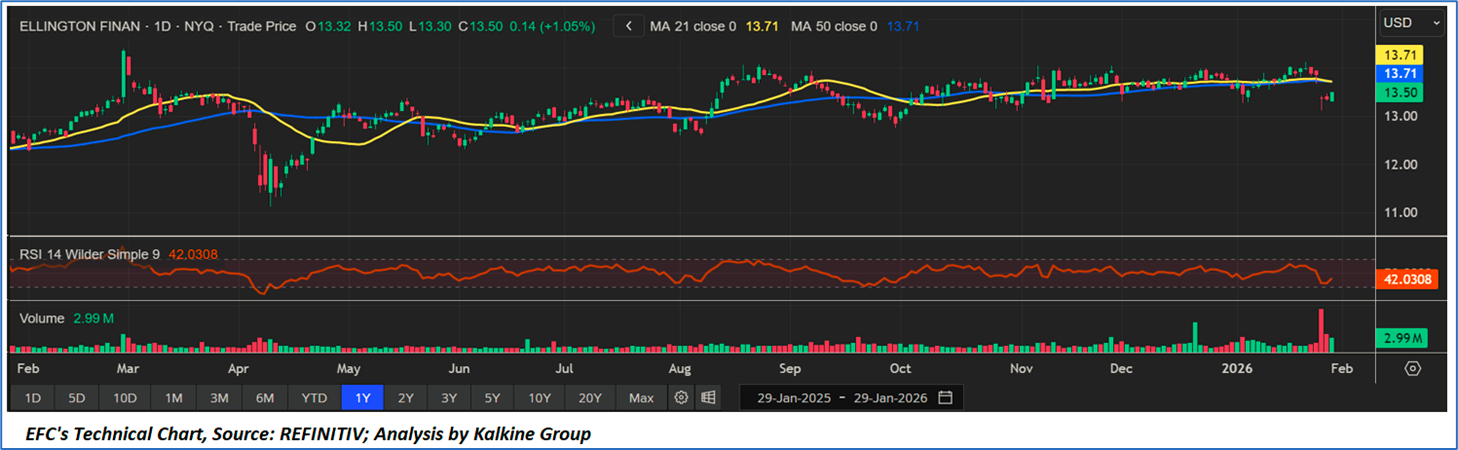
- Price Structure: Range-Bound Consolidation: EFC is trading in a sideways range near USD ~13.50, indicating a balanced market with limited directional momentum. The prolonged consolidation suggests base-building but no confirmed breakout yet. Summary: Price is stable, but trend acceleration has not resumed.
- Trend Confirmation: Neutral Moving Average Setup: EFC is hovering around both the 21-day and 50-day MAs (~USD 13.71), which are flattening and converging—signalling a neutral regime. A breakout above USD 13.8–14.2 would strengthen the bullish case. Summary: Trend is neutral; upside confirmation requires a decisive breakout.
- Momentum: RSI Shows Soft Demand: The RSI near ~42 reflects weak momentum and limited upside conviction, though not extreme oversold conditions. Volume is moderate with occasional spikes but no sustained accumulation. Summary: Momentum is soft; stronger direction needs RSI recovery and higher-volume buying.
Ellington Financial Inc. (NYSE: EFC) delivered solid Q3 2025 performance, supported by resilient earnings across its diversified mortgage credit platform, with Adjusted Distributable Earnings of USD 0.53 per share comfortably covering the USD 0.39 dividend and book value holding stable at USD 13.40 per share. The quarter’s strength was primarily driven by the credit strategy, supported by net interest margin expansion and continued low realized credit losses, while Longbridge added incremental earnings benefit through increased reverse mortgage origination activity. Strategically, EFC’s ongoing shift toward long-term, non-mark-to-market financing—via accelerated securitizations and a USD 400 million senior unsecured note issuance—represents a meaningful balance sheet upgrade that may enhance earnings durability through future volatility cycles. However, the investment profile remains exposed to key structural risks including credit cycle deterioration, funding market tightening, and interest rate/spread volatility, all of which can pressure book value and returns. From a technical standpoint, the stock remains range-bound near USD ~13.5 with soft momentum, implying that while fundamentals remain supportive, clearer market upside may require stronger directional catalysts and technical confirmation.
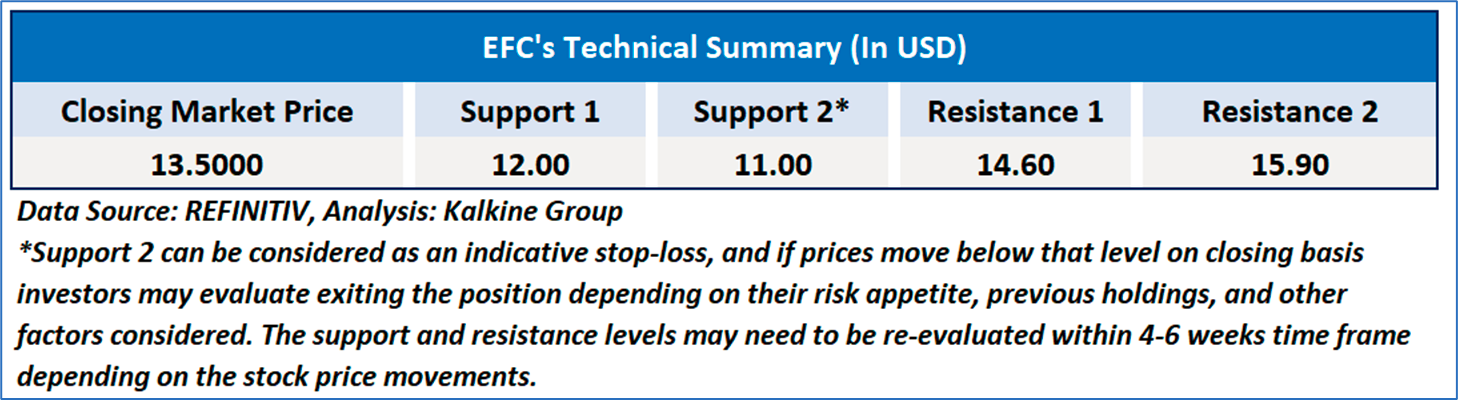
As per the above-mentioned price action, important support near USD 12.80- USD 13.00, momentum in the stock over the last month, and technical indicators analysis, a ‘WATCH’ rating has been given for Ellington Financial Inc. (NYSE: EFC) at the closing price of USD13.50, as of January 29, 2026.
Individuals can evaluate the stock based on the support and resistance levels provided in the report in case of keen interest taking into consideration the risk-reward scenario.
Markets are trading in a highly volatile zone currently due to certain macro-economic issues and prevailing geopolitical tensions. Therefore, it is prudent to follow a cautious approach while investing.
Related Risk: This report may be looked at from a high-risk perspective, and a recommendation is provided for a short duration. This report is solely based on technical parameters, and the fundamental performance of the stocks has not been considered in the decision-making process. Other factors which could impact the stock prices include market risks, regulatory risks, interest rates risks, currency risks, social and political instability risks etc.
Note 1: Past performance is not a reliable indicator of future performance.
Note 2: The reference date for all price data, currency, technical indicators, support, and resistance level is January 29, 2026. The reference data in this report has been partly sourced from REFINITIV.
Note 3: Investment decisions should be made depending on an individual's appetite for upside potential, risks, holding duration, and any previous holdings. An 'Exit' from the stock can be considered if the Target Price mentioned as per the Valuation and or the technical levels provided has been achieved and is subject to the factors discussed above.
Note 4: Target Price refers to a price level that the stock is expected to reach as per the relative valuation method and or technical analysis taking into consideration both short-term and long-term scenarios.
Note 5: ‘Kalkine reports are prepared based on the stock prices captured either from the New York Stock Exchange (NYSE), NASDAQ Capital Markets (NASDAQ), and or REFINITIV. Typically, all sources (NYSE, NASDAQ, or REFINITIV) may reflect stock prices with a delay which could be a lag of 15-20 minutes. There can be no assurance that future results or events will be consistent with the information provided in the report. The information is subject to change without any prior notice.

 NZ
 UK
 US
 AU
 IND

 CA

 Please wait processing your request...