
 NZ
 UK
 US
 AU
 IND

 CA

 Share
 X (Formerly Twitter)
 Whatsapp
 Facebook
 LinkedIn
 Telegram
 Email This Article
 Copy Link
 Summarize with AI
 Chat GPT
 Perplexity

Summary
- TFSAs allow tax-free growth and tax-free withdrawals at any time, with the 2026 dollar limit at $7,000.
- RRSPs allow tax-deductible contributions and tax-deferred growth, with the 2026 dollar limit at $33,810.
- Self-directed versions of both accounts allow the holder to choose qualified investments.
- TFSAs offer more Withdrawal flexibility; RRSPs offer larger contribution room for high earners.
- The right mix depends on income, Tax Bracket, time horizon and goals.
What readers need to know
Flexibility is not one thing. TFSAs are flexible on withdrawal. RRSPs are flexible on tax timing.
Most Canadians benefit from using both accounts, with the optimal balance set by their tax situation.
Introduction
Few questions come up more often in Canadian Personal Finance than RRSP vs TFSA. When both accounts are self-directed, the question gets sharper: which gives more flexibility?
The honest answer is that they are flexible in different ways. TFSAs let you withdraw tax-free at any age. RRSPs let you defer tax during high-income working years and pay it later, often at a lower rate.
What each account does
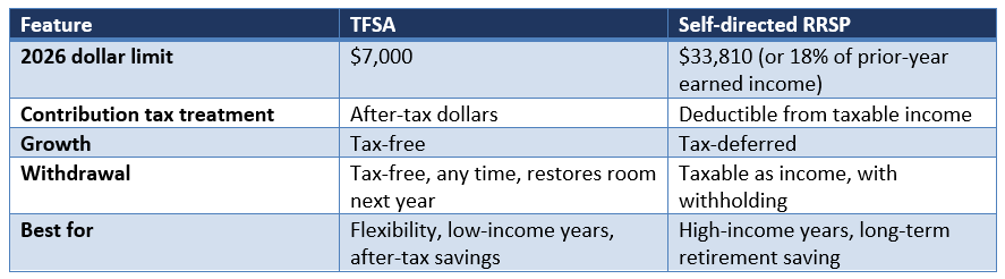
A TFSA is a tax-free account. Contributions are made with after-tax dollars. Investments grow tax-free. Withdrawals are tax-free and create new contribution room in the following calendar year. The 2026 annual limit is $7,000.
An RRSP is a tax-deferred account. Contributions are deductible from Taxable Income. Growth is sheltered. Withdrawals are taxable as ordinary income. The 2026 dollar limit is $33,810, with personal room based on 18 per cent of prior-year Earned income.
Contribution room and access
TFSA limits are the same for every eligible Canadian — currently $7,000 per year — and unused room carries forward indefinitely. Withdrawals can be re-contributed the following calendar year.
RRSP room scales with earned income, capped at $33,810 in 2026. Unused room also carries forward, but withdrawn amounts do not restore contribution room.
Investment control
Both accounts can be self-directed. The qualified-investment rules are nearly identical, with some technical differences. Both can hold stocks, ETFs, GICs, bonds and other qualified securities.
Investors often use TFSAs for higher-growth Assets, given the tax-free nature, but tax planning is highly individual.
Tax timing
RRSPs typically win when contributions are made in a high-tax-bracket year and withdrawals occur in lower-bracket retirement years. TFSAs typically win when current and future tax brackets are similar, or when after-tax dollars are easier to spare.
Low-income earners often benefit more from TFSAs because the RRSP deduction is less valuable in lower brackets.
Withdrawal flexibility
TFSAs are flexible — withdraw any amount, any time, with no tax. Withdrawals create new room.
RRSPs are less flexible — withdrawals trigger Withholding tax and are taxable as ordinary income. Withdrawn room is generally lost (except for repayments under the Home Buyers' Plan or Lifelong Learning Plan).
TFSA vs self-directed RRSP — 2026
Key takeaways
- TFSAs and RRSPs are flexible in different ways.
- Most Canadians benefit from using both, with the mix driven by income and tax bracket.
- Self-directed versions of both accounts allow control of investments.
- Withdrawals from a TFSA are tax-free; from an RRSP, taxable.
- Professional advice can help optimise the mix.


 Nov 22, 2026





 Please wait processing your request...