
 NZ
 UK
 US
 AU
 IND

 CA

 Share
 X (Formerly Twitter)
 Whatsapp
 Facebook
 LinkedIn
 Telegram
 Email This Article
 Copy Link
 Summarize with AI
 Chat GPT
 Perplexity

Summary
- An RRSP is for accumulating retirement savings; a RRIF is for drawing income from those savings.
- RRSPs must be converted to a RRIF, Annuity or withdrawn by December 31 of the year the holder turns 71.
- RRIFs require a minimum annual Withdrawal, calculated by a CRA prescribed Factor.
- A self-directed RRIF allows continued Investment choice, just like a self-directed RRSP.
- Withdrawals from a RRIF are taxable as ordinary income.
What readers need to know
Conversion to a RRIF is mandatory by age 71. Failing to convert can cause the entire RRSP to become taxable in one year.
Minimum RRIF withdrawals are required each year after the RRIF is opened (with the first withdrawal in the year after the conversion year).
Introduction
The transition from RRSP to RRIF is one of the most important moments in a Canadian retiree's financial life. The accumulation phase ends and the income phase begins. The tax rules change, the Cash Flow patterns change, and the planning focus shifts from saving to drawing down.
The good news is that the investments themselves do not have to change. A self-directed RRSP can be converted to a self-directed RRIF, keeping the same portfolio and the same brokerage relationship.
What an RRSP does
An RRSP accumulates retirement savings tax-deferred. Contributions are deductible, growth is sheltered, and withdrawals are taxable when made.
The 2026 RRSP dollar limit is $33,810, with personal room based on 18 per cent of prior-year Earned income.
What a RRIF does
A RRIF — Registered Retirement Income Fund — is the typical income-paying counterpart to an RRSP. The investments inside continue to grow tax-deferred, but the account is required to pay out a minimum amount each year, based on the holder's age and the value of the plan on January 1.
At age 71, the prescribed withdrawal factor is 5.28 per cent. At age 80, it rises to 6.82 per cent. By age 95 and over, the factor is 20 per cent.
Conversion rules
The RRSP must be converted to a RRIF, used to buy an annuity, or withdrawn in cash by December 31 of the year the holder turns 71. Missing this deadline can cause the entire RRSP balance to be taxed in a single year.
Conversion is a tax-free event. Investments can typically be transferred in kind, with no need to sell.
Self-directed RRIF basics
A self-directed RRIF is essentially a self-directed RRSP that is required to pay out a minimum amount each year. Investment choice continues — the holder can keep buying and selling qualified investments. Many Canadians simply convert their existing self-directed RRSP to a self-directed RRIF at the same brokerage.
Asset allocation often shifts toward income-generating and more conservative holdings as the income phase begins, but this is a planning decision, not a rule.
Tax and cash flow
Minimum RRIF withdrawals are required, but holders can withdraw more if they wish. Amounts above the minimum are subject to Withholding tax. All withdrawals are taxable as ordinary income.
Some retirees elect to use the younger spouse's age to calculate minimum withdrawals, which can reduce the mandatory annual amount.
RRSP vs RRIF
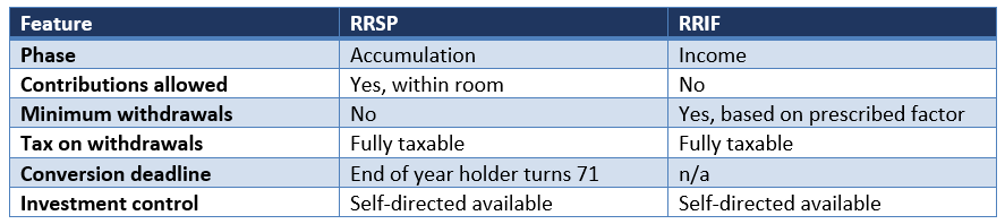
Key takeaways
- RRSPs save, RRIFs spend.
- Conversion to a RRIF, annuity or full withdrawal is mandatory by year-end of the year you turn 71.
- Self-directed RRIFs let retirees keep their investment portfolio intact.
- RRIF withdrawals are taxable as ordinary income.
- Plan the transition well in advance with professional advice.


 Nov 22, 2026





 Please wait processing your request...