
 NZ
 UK
 US
 AU
 IND

 CA

 Share
 X (Formerly Twitter)
 Whatsapp
 Facebook
 LinkedIn
 Telegram
 Email This Article
 Copy Link
 Summarize with AI
 Chat GPT
 Perplexity

Summary
- A regular RRSP usually holds packaged mutual funds chosen by the financial institution.
- A self-directed RRSP lets the holder choose any CRA-qualified Investment.
- Tax treatment, contribution rules and Withdrawal rules are identical.
- Self-directed RRSPs tend to be lower cost but require more attention.
- The right option depends on the investor's interest, knowledge and willingness to manage a portfolio.
What readers need to know
The tax framework of an RRSP is set by federal law and does not change based on whether the plan is self-directed.
The difference is operational: who picks the holdings, what is on the menu and what it costs to run.
Introduction
Most Canadians open their first RRSP at a bank, where the default is a line-up of in-house mutual funds. Over time, many of those investors hear about self-directed RRSPs — accounts at a brokerage that let them pick their own stocks, ETFs and bonds. The question that follows is usually the same: what is actually different?
The short answer is choice. The longer answer involves fees, responsibility and the personality of the investor.
Tax rules are the same
Contribution room, deduction rules, Withholding on withdrawals, the $2,000 lifetime overcontribution buffer and the requirement to convert to a RRIF, Annuity or full withdrawal by December 31 of the year the holder turns 71 apply equally.
The 2026 RRSP dollar limit is $33,810. Personal room is the lesser of that limit or 18 per cent of prior-year Earned income, less any pension adjustment, plus unused room.
The investment menu is different
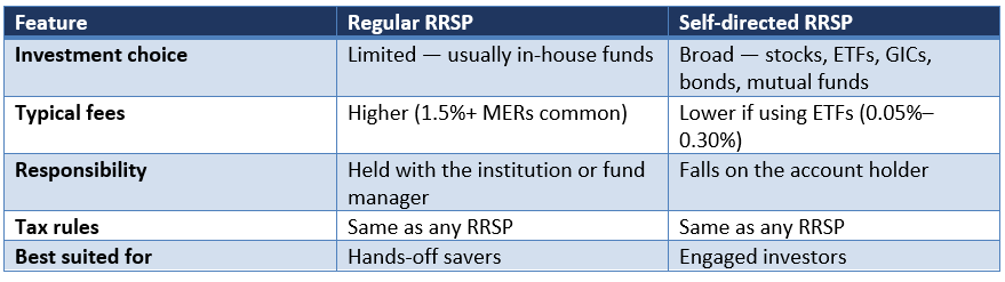
Regular RRSPs at banks typically offer the institution's own family of mutual funds, perhaps a small selection of GICs, and savings Options. Choice is limited and fees tend to be higher.
Self-directed RRSPs at brokerages typically offer thousands of stocks, ETFs and mutual funds across many providers, plus bonds, GICs and other qualified investments. The breadth of choice is enormous.
Fees and costs
Mutual fund RRSPs frequently carry MERs of 1.5 to 2.5 per cent per year. ETF-based self-directed RRSPs can be assembled at well under 0.30 per cent per year, although trading commissions, FX spreads and account fees can add to total cost.
Lower fees compound over decades. For long-horizon retirement savers, even modest fee reductions translate into materially larger balances.
Responsibility shifts to the investor
A managed mutual fund handles asset allocation, Rebalancing and security selection inside the fund. A self-directed investor must do these things personally, monitor for qualified-investment compliance and resist behavioural mistakes such as panic selling.
For some Canadians this is empowering. For others it is stressful.
How to decide
Consider your interest level, your time, your knowledge and your discipline. If you are unlikely to monitor your portfolio or rebalance regularly, a low-cost managed solution may produce better real-world outcomes. If you enjoy investing and can stick to a plan, a self-directed RRSP is often more efficient.
The decision is reversible — you can transfer between regular and self-directed RRSPs without tax consequences.
Regular vs self-directed RRSP
Key takeaways
- Tax rules are identical; only the investment menu and cost structure differ.
- Self-directed RRSPs typically cost less but require more attention.
- Behavioural discipline and Diversification are more important than the account type.
- Transfers between regular and self-directed RRSPs are tax-free.
- Choose based on interest, time and willingness to manage a portfolio.


 Nov 22, 2026





 Please wait processing your request...