
 NZ
 UK
 US
 AU
 IND

 CA

 Share
 X (Formerly Twitter)
 Whatsapp
 Facebook
 LinkedIn
 Telegram
 Email This Article
 Copy Link
 Summarize with AI
 Chat GPT
 Perplexity

Summary
- Both self-directed TFSAs and self-directed RRSPs let Canadians choose investments inside a tax-advantaged account.
- The Investment menu is largely the same.
- Tax treatment is the major difference — TFSA growth is tax-free; RRSP growth is tax-deferred.
- TFSAs are more flexible on withdrawals; RRSPs are better tax shelters for U.S. Dividend ETFs.
- Most Canadians benefit from using both.
What readers need to know
Control inside both accounts is similar; the difference lies in tax treatment.
Personal Tax Bracket dynamics and goals drive the right mix.
Introduction
Canadians comparing self-directed TFSAs and self-directed RRSPs often focus on the wrong question. The day-to-day control inside both accounts is essentially identical — same brokerages, same investment menu, same trading mechanics. The real differences live on the tax side.
Where they are alike
Both can be self-directed at a brokerage. Both hold most listed stocks, ETFs, mutual funds, GICs and bonds. Both apply the same broad qualified-investment rules and penalties for prohibited investments.
Trading mechanics — orders, commissions, FX — are the same.
Where they differ
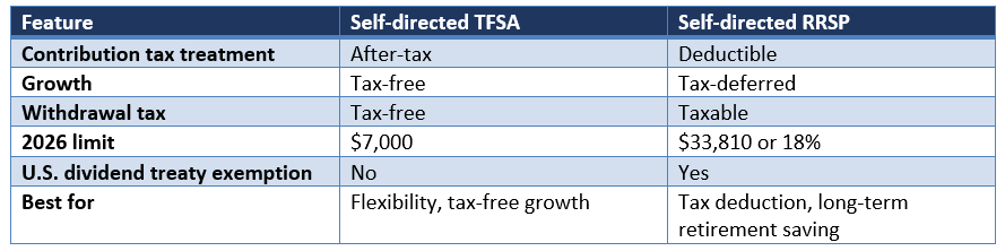
Tax on contributions: RRSP contributions are deductible; TFSA contributions are not.
Tax on withdrawals: TFSA withdrawals are tax-free; RRSP withdrawals are taxable as income.
Contribution limits: TFSA $7,000 in 2026; RRSP up to $33,810 in 2026 (or 18% of Earned income).
Treaty treatment of U.S. dividends: exempt in RRSPs, not in TFSAs.
Withdrawal mechanics
TFSA withdrawals are flexible, tax-free and restore room the following calendar year. RRSP withdrawals are taxable, generally subject to Withholding tax, and reduce room (except for HBP/LLP repayments).
Strategic asset location
Many investors hold U.S. dividend-paying ETFs in their RRSP to take advantage of treaty-based withholding exemptions, and hold higher-growth Canadian Equity in their TFSA where capital gains stay tax-free.
This is general practice, not personal advice.
Choosing the mix
Lower-income earners often prioritise TFSAs because the RRSP deduction is less valuable. Higher-income earners often prioritise RRSPs for the deduction. Most use both.
Self-directed TFSA vs self-directed RRSP
Key takeaways
- Investment control is similar inside both accounts.
- Tax treatment is the major difference.
- TFSAs are flexible on withdrawals; RRSPs offer larger contribution room for higher earners.
- Asset location strategies can use both accounts together.
- Most Canadians benefit from using both.


 Nov 22, 2026





 Please wait processing your request...