
 NZ
 UK
 US
 AU
 IND

 CA

 Share
 X (Formerly Twitter)
 Whatsapp
 Facebook
 LinkedIn
 Telegram
 Email This Article
 Copy Link
 Summarize with AI
 Chat GPT
 Perplexity

Summary
- A self-directed RRSP is a personal tax-deferred account; a LIRA holds money transferred from an employer pension.
- Both can be self-directed at a brokerage, allowing the holder to choose qualified investments.
- RRSPs allow flexible contributions and withdrawals; LIRAs do not allow contributions and have strict Withdrawal rules.
- LIRA rules vary by province and must be confirmed with the appropriate pension regulator.
- Investment control inside the account is similar — what differs is access to the money.
What readers need to know
RRSPs and LIRAs serve different roles. RRSPs accumulate voluntary savings; LIRAs preserve pension money.
Investment control inside either account can be similar, but the rules around withdrawals, conversions and tax differ.
Introduction
Canadians often discover LIRAs the moment they leave a Job with a defined-benefit or defined-contribution pension. The pension administrator offers a choice — leave the money in the plan, transfer to a LIRA, or other Options. For investors used to running their own RRSP, the LIRA can feel familiar in some ways and very different in others.
This article compares the self-directed RRSP and the LIRA, focusing on investment control and the rules around access.
What a self-directed RRSP is
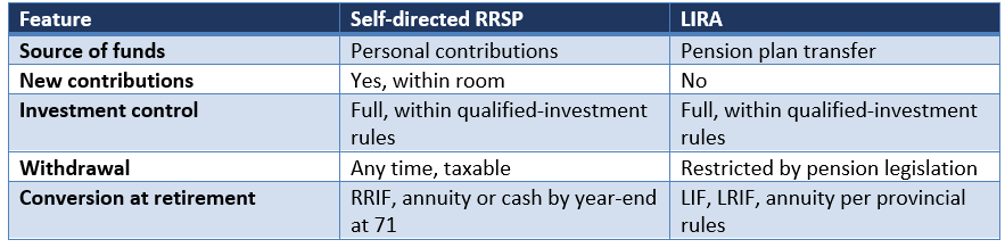
A self-directed RRSP is a Registered Retirement Savings Plan held at a brokerage that allows the holder to choose qualified investments. The 2026 dollar limit is $33,810, with personal room based on 18 per cent of prior-year Earned income.
Funds can generally be withdrawn at any time, although withdrawals are taxable.
What a LIRA is
A Locked-In Retirement Account holds pension money transferred out of an employer pension plan. Because the money originated in a pension intended to provide retirement income, it cannot generally be withdrawn until retirement age.
LIRAs do not accept new contributions. The balance grows from investment returns alone.
Investment control inside each account
Both accounts can be self-directed at a brokerage. The list of qualified investments is largely the same as for an RRSP.
What differs is timing. RRSP holders can sell investments and withdraw the cash; LIRA holders can sell investments but must usually keep the proceeds inside the locked-in structure.
Withdrawal rules — the major difference
RRSP withdrawals are flexible and taxable. LIRA withdrawals are restricted. Generally, LIRA money must be converted to a Life Income Fund, Locked-In Retirement Income Fund or Annuity at retirement, with minimum and (in many provinces) maximum annual withdrawals.
Some provinces allow partial unlocking, small balance unlocking, financial hardship unlocking, shortened-life-expectancy unlocking, or non-residency unlocking. The 2026 small balance threshold in many jurisdictions sits near $29,840, but always confirm the rule with the relevant pension regulator.
Provincial variation
Pension rules differ across federal, Ontario, Alberta, British Columbia, Manitoba, Saskatchewan, New Brunswick, Nova Scotia, Newfoundland and Labrador, Prince Edward Island and Quebec jurisdictions. Always check the rules for the Jurisdiction under which the original pension was registered, not necessarily your current province of residence.
Self-directed RRSP vs LIRA
Key takeaways
- Investment control inside each account is comparable; access to funds is very different.
- LIRA rules vary by province and federal jurisdiction.
- RRSPs accept contributions; LIRAs do not.
- Both accounts must eventually be converted to income-paying counterparts.
- Professional advice is recommended for LIRA-related decisions.


 Nov 22, 2026





 Please wait processing your request...