
 NZ
 UK
 US
 AU
 IND

 CA

 Share
 X (Formerly Twitter)
 Whatsapp
 Facebook
 LinkedIn
 Telegram
 Email This Article
 Copy Link
 Summarize with AI
 Chat GPT
 Perplexity

Summary
- An IPP is a registered defined-benefit pension typically sponsored by a corporation for an incorporated Business owner.
- Contributions are calculated by an actuary and are fully tax-deductible to the corporation.
- IPPs can allow larger tax-deferred contributions than an RRSP for members aged 38+ with high T4 income.
- Setup and ongoing administration involve professional fees and regulatory filings.
- Specialist actuarial, tax and pension advice is essential.
What readers need to know
IPPs are sophisticated pension structures and not appropriate for every business owner.
Provincial pension legislation, CRA registration rules and tax law all apply.
Introduction
Canadian business owners who pay themselves a T4 salary from their corporation have Options that go beyond the RRSP. The Individual Pension Plan, or IPP, is one of the most powerful — and most misunderstood — of these options.
An IPP is a defined-benefit pension plan, registered with the CRA and often regulated by provincial pension authorities, that allows a corporation to fund a targeted retirement benefit for a single member.
How an IPP works
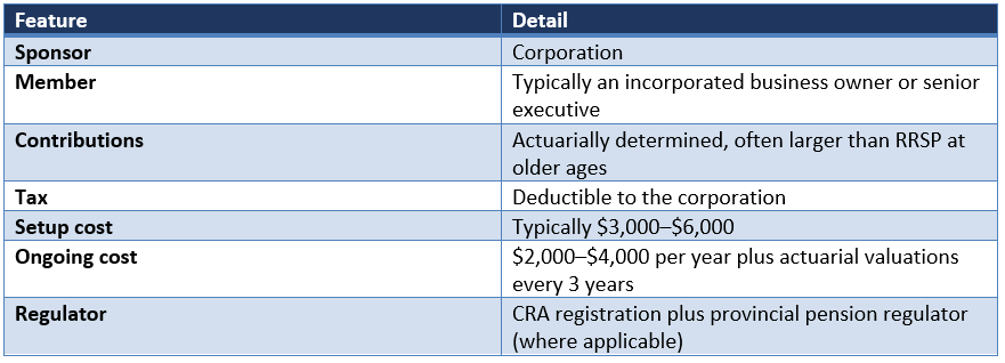
The corporation sponsors the plan and contributes to it on behalf of the member, who is typically the owner-manager. An actuary calculates the contributions required to fund the targeted retirement benefit, based on T4 salary, years of service and assumed rates of return.
Contributions are 100 per cent tax-deductible to the corporation. They are not reported as Taxable Income to the member.
Who qualifies
IPPs are most often set up for incorporated business owners, incorporated professionals and senior executives. Members generally need to earn T4 income from the sponsoring corporation. The financial case is usually strongest for members aged 38 or older.
Past-service contributions can cover service back to 1991, often producing a substantial one-time Tax deduction.
Benefits
Larger tax-deductible contributions than an RRSP at older ages, defined-benefit pension structure, often strong creditor protection under pension legislation, the ability to make past-service contributions, and the potential for plan-administration fees to be deductible to the corporation.
Trade-offs and risks
IPPs are complex. Setup costs are typically several thousand dollars. Actuarial valuations are required every three years. Annual administration and regulator filings add ongoing costs. If the plan is underfunded, the corporation may need to top it up.
Selling the business or winding up the plan can be complicated. Get specialist advice before setting up an IPP.
Investment considerations
IPP Assets are held in a pension trust and must be invested prudently within the plan's investment policy. Members can have meaningful input, but the formal pension governance is different from a self-directed RRSP.
Investment performance affects whether the plan is fully funded. Underfunding triggers top-up contributions; overfunding may reduce future contributions.
IPP — key features
Key takeaways
- IPPs are defined-benefit pensions for incorporated members.
- They can allow larger tax-deductible contributions than an RRSP at older ages.
- Setup and administration are complex and require professional advice.
- Investment governance is different from a self-directed RRSP.
- IPPs are not appropriate for every business owner.


 Nov 22, 2026





 Please wait processing your request...