
 NZ
 UK
 US
 AU
 IND

 CA

 Share
 X (Formerly Twitter)
 Whatsapp
 Facebook
 LinkedIn
 Telegram
 Email This Article
 Copy Link
 Summarize with AI
 Chat GPT
 Perplexity

Summary
- A self-directed TFSA is a Tax-Free Savings Account held at a brokerage that allows the holder to choose investments.
- Investments grow tax-free and withdrawals are tax-free, with room restored the following calendar year.
- The 2026 TFSA limit is $7,000, plus any unused room.
- Holding a non-qualified or prohibited Investment can trigger severe CRA taxes.
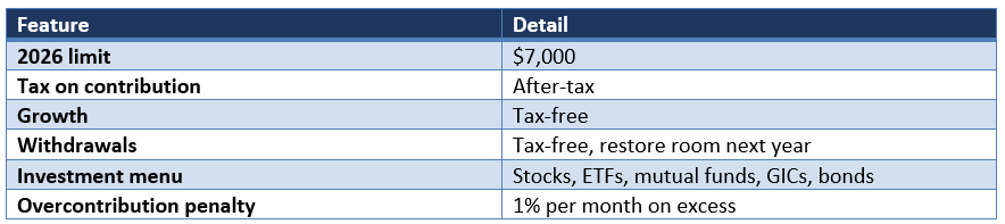
- Overcontributions are taxed at 1 per cent per month on the excess.
What readers need to know
TFSA contribution room is the same for every eligible Canadian. Unused room carries forward indefinitely.
Tax-free withdrawals are a powerful feature but should not encourage frequent in-and-out trading without planning.
Introduction
The Tax-Free Savings Account has become one of the most popular accounts in Canadian Personal Finance, and for good reason. Tax-free growth, flexible tax-free withdrawals and contribution room that does not scale with income make it an effective tool for everyone from new graduates to retirees.
When held in a brokerage as a self-directed account, the TFSA gains the same investment flexibility as a self-directed RRSP.
How a self-directed TFSA works
Open a TFSA at a Canadian brokerage. Contribute up to your room. Choose qualified investments — stocks, ETFs, mutual funds, GICs, bonds.
Growth is tax-free. Withdrawals are tax-free and restore room the following calendar year.
Contribution room
Annual room is set by the federal government and is the same for every eligible Canadian. The 2026 limit is $7,000.
Unused room carries forward. Eligible Canadians who never contributed since 2009 may have substantial accumulated room. Check CRA My Account.
Qualified investments
Largely the same as for a self-directed RRSP. Listed stocks on designated exchanges, ETFs, mutual funds, GICs and bonds are typically qualified.
Holding a non-qualified investment can trigger a 50 per cent CRA tax. Prohibited investments — those in which the holder has a significant interest — carry additional penalties.
Costs
Brokerage commissions, ETF MERs, FX spreads and account-administration fees apply.
U.S. Dividend Withholding tax is not exempt inside a TFSA, unlike the RRSP treatment under the Canada–U.S. treaty. This is one reason some investors hold U.S. dividend-paying ETFs in their RRSP rather than their TFSA.
Common uses
Long-term tax-free growth, short-term and medium-term savings, emergency funds, retirement savings supplement, estate planning. The flexibility is the appeal.
Self-directed TFSA at a glance
Key takeaways
- Self-directed TFSAs combine tax-free growth with broad investment choice.
- Contribution room is the same for every eligible Canadian.
- Withdrawals are tax-free and restore room the next year.
- Qualified-investment rules still apply.
- Use the TFSA strategically alongside RRSPs and other accounts.


 Nov 22, 2026





 Please wait processing your request...