
 NZ
 UK
 US
 AU
 IND

 CA

 Share
 X (Formerly Twitter)
 Whatsapp
 Facebook
 LinkedIn
 Telegram
 Email This Article
 Copy Link
 Summarize with AI
 Chat GPT
 Perplexity

Summary
- A self-directed RRSP lets Canadians choose the investments inside their Registered Retirement Savings Plan, rather than buying packaged mutual funds.
- An Individual Pension Plan (IPP) is a defined-benefit pension typically used by incorporated Business owners and senior employees aged 38 and over.
- A LIRA, or Locked-In Retirement Account, holds money transferred out of an employer pension and cannot generally be withdrawn as cash before retirement age.
- The 2026 RRSP dollar limit is $33,810, and the TFSA limit is $7,000, according to the Canada Revenue Agency.
- Rules for IPPs and LIRAs vary by province and require professional advice from actuaries, pension specialists and tax advisers.
What readers need to know
There is no single 'Canadian self-directed retirement account.' Instead, the term covers several registered structures — most commonly the self-directed RRSP, the Individual Pension Plan, and the Locked-In Retirement Account — that let investors take more direct control of how their retirement savings are invested.
Canada's registered system is not the same as Australian Superannuation. Australian super is a compulsory, employer-funded workplace pension. Canadian RRSPs, TFSAs and LIRAs are voluntary or pension-derived accounts, each with their own contribution rules, tax treatment and Withdrawal restrictions set by the Canada Revenue Agency and provincial pension regulators.
The right account, or combination of accounts, depends on income, employment status, age, pension entitlements and personal goals. This article explains what each account does. It does not recommend one over another.
Introduction
Canadians who want more say over how their retirement money is invested are increasingly looking past the standard menu of mutual funds offered by their bank. They want to choose individual stocks, Exchange-traded funds, bonds, guaranteed Investment certificates, and in some cases more complex Assets — all inside a tax-sheltered account. That ambition has put a spotlight on the family of accounts often grouped as 'self-directed' retirement vehicles.
Three of the most discussed Options are the self-directed Registered Retirement Savings Plan, the Individual Pension Plan and the Locked-In Retirement Account. Each carries its own contribution rules, withdrawal restrictions and tax consequences, and each is regulated differently. The Canada Revenue Agency administers contribution limits and qualified-investment rules. The Office of the Superintendent of Financial Institutions and provincial pension regulators oversee how locked-in money and pension plans must behave.
This guide walks through what each account is, how it differs from the others, and the practical considerations Canadian investors should weigh before choosing any of them.
What 'self-directed' actually means in Canada
In Canadian financial terminology, a self-directed account is a registered plan held at a brokerage where the account holder — not a Fund Manager — chooses each investment. The legal structure of the RRSP, TFSA or LIRA does not change. What changes is who picks the holdings.
Within a self-directed RRSP, an investor can typically hold cash, GICs, Canadian and U.S. listed stocks, exchange-traded funds, mutual funds, bonds, and certain other CRA-qualified investments. The plan's qualified-investment list comes from the Income Tax Act and is administered by the Canada Revenue Agency. Holding a non-qualified or prohibited investment can trigger a tax equal to 50 per cent of the fair Market Value of the investment.
Why investors choose self-directed plans
Cost and control are the two most common reasons. index ETFs typically charge much lower management fees than traditional Canadian mutual funds. A self-directed plan also lets investors build a custom mix of assets — for example, blending low-cost global Equity ETFs with Canadian Dividend stocks and bonds.
Self-directed does not mean unsupervised. The brokerage acts as the plan Trustee and is responsible for confirming that investments meet CRA rules. The account holder, however, makes the buy and sell decisions.
The self-directed RRSP
A Registered Retirement Savings Plan is a tax-deferred account designed to encourage long-term retirement saving. Contributions are deductible against Earned income, investments grow tax-sheltered, and withdrawals are taxable as ordinary income.
For 2026, the CRA's RRSP dollar limit is $33,810. Individual contribution room equals 18 per cent of the previous year's earned income, up to that dollar cap, minus any pension adjustments and plus any unused room carried forward. The full limit applies only to those who earned roughly $187,833 or more in 2025.
The self-directed version simply means the RRSP is held at a discount or full-service brokerage that allows the holder to buy and sell investments. There is no additional tax benefit — just additional choice. Overcontributing by more than the $2,000 lifetime buffer triggers a tax of 1 per cent per month on the excess.
The Individual Pension Plan (IPP)
An Individual Pension Plan is a defined-benefit pension established by a corporation, usually for an incorporated business owner, a senior executive or an incorporated professional such as a physician, dentist or lawyer. The corporation sponsors and funds the plan, and the contributions are tax-deductible to the company.
IPPs are generally most attractive to plan members aged 38 and older with high T4 employment income from their corporation. Because the contribution is based on actuarial assumptions about the targeted retirement benefit, an IPP can permit larger annual tax-deferred contributions than an RRSP at older ages.
IPPs are complex. They require an actuarial valuation, registration with the Canada Revenue Agency, ongoing administration and, in some cases, oversight by provincial pension regulators. Setup costs are typically several thousand dollars, and ongoing administration adds further annual costs. Professional pension, tax and actuarial advice is generally essential.
The Locked-In Retirement Account (LIRA)
A Locked-In Retirement Account holds pension money that an employee has earned in a registered pension plan and chosen to transfer out when leaving an employer. Because the money originated in a pension intended to provide retirement income, withdrawal rules are stricter than for an RRSP.
Generally, money in a LIRA cannot be withdrawn as cash before retirement age. At retirement, it must be converted into a Life Income Fund (LIF), a Locked-In Retirement Income Fund (LRIF), or an Annuity. Some provinces allow partial unlocking, small balance unlocking, financial hardship unlocking, or unlocking based on shortened life expectancy or non-residency.
Rules vary by Jurisdiction. Ontario's pension benefits standards differ from Alberta's, British Columbia's, Quebec's or the federal regime. The 2026 small balance threshold for many jurisdictions sits near $29,840, but readers should always confirm the rule for the pension's home jurisdiction.
How the three accounts compare in practice
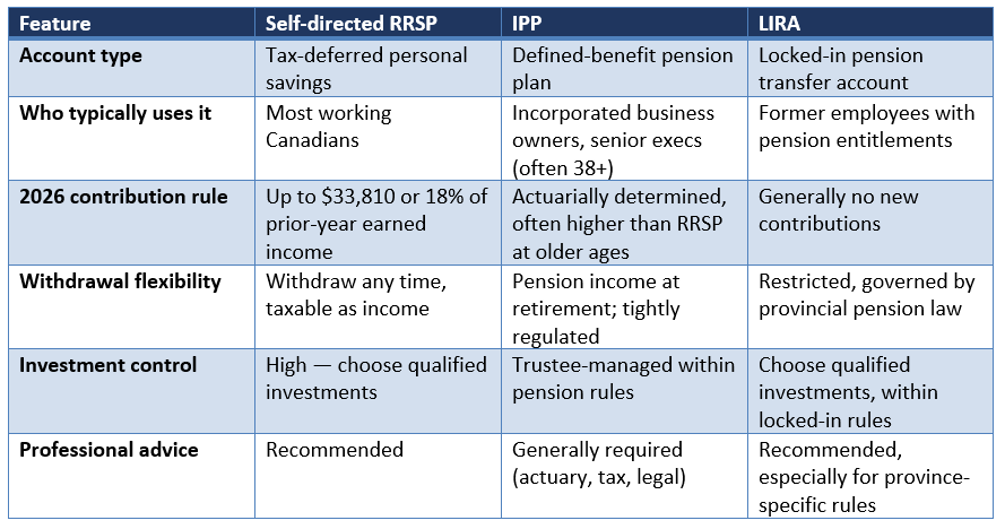
For most Canadians, the self-directed RRSP is the most flexible option. The IPP suits a narrower group — typically incorporated business owners with higher salaries who want larger tax-deductible pension contributions and creditor protection. The LIRA is rarely an account you choose; it is typically created when pension money is moved out of an employer plan.
Each account has trade-offs. Self-directed RRSPs offer maximum investment control but require the holder to manage their own portfolio. IPPs offer larger contributions and a defined-benefit structure but bring administration costs and complexity. LIRAs preserve pension money but restrict access until retirement.
RRSP, IPP and LIRA at a glance (2026)
Key takeaways
- Self-directed RRSPs, IPPs and LIRAs are distinct Canadian accounts with different rules, not interchangeable products.
- The 2026 RRSP dollar limit is $33,810 and the TFSA limit is $7,000, both confirmed by the Canada Revenue Agency.
- IPPs are sophisticated pension structures designed mostly for incorporated business owners and require professional advice.
- LIRA rules differ by province and federally; always check the rules for the jurisdiction where the original pension was registered.
- No single account is automatically best. The right mix depends on income, employment, age, pension entitlements and personal goals.


 Nov 22, 2026





 Please wait processing your request...