
 NZ
 UK
 US
 AU
 IND

 CA

 Share
 X (Formerly Twitter)
 Whatsapp
 Facebook
 LinkedIn
 Telegram
 Email This Article
 Copy Link
 Summarize with AI
 Chat GPT
 Perplexity

Snapshot: key VITA trading data
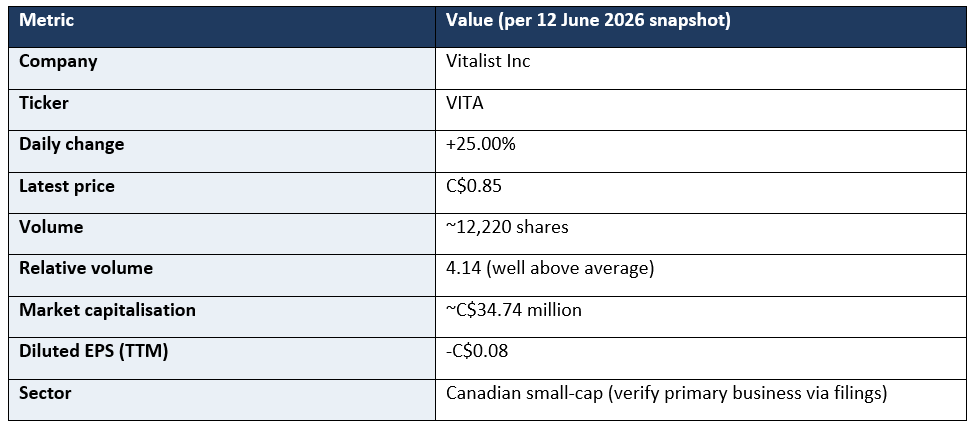
Vitalist Inc (TSXV:VITA) featured prominently on the Canadian top-gainers screen on 12 June 2026, with a clean double-digit advance that put it among the day’s standout small-cap movers. According to the TradingView market-movers snapshot, VITA stock rose 25.00% to a quoted price of C$0.85, on volume of roughly 12,220 shares and a market capitalisation of approximately C$34.74 million.
What makes the VITA entry more interesting than a simple price tick is the relative-volume reading of 4.14 — meaning the day’s activity was several times the stock’s typical level. Elevated relative volume alongside a sharp percentage gain is the classic signature of a momentum or speculative move, though it does not, on its own, tell us the cause. This article sets out what the snapshot confirms, what may be driving interest, and the risks and watch-points that come with a small, low-priced Canadian name.
Why did VITA stock rise 25%?
The precise catalyst for the VITA move is not confirmed by the snapshot, and investors should treat any single explanation with caution. In small-capitalisation Canadian equities, a one-day gain of this size frequently reflects a mix of factors rather than a single confirmed event. These can include company-specific news that should be verified through filings, broader market or sector momentum, speculative and technical buying, short-covering, a sudden improvement in liquidity, or simply renewed retail interest in a low-priced ticker.
The standout data point is relative volume of 4.14. Because relative volume compares the session’s trading with the stock’s normal level, a reading above four indicates that materially more shares changed hands than usual. That is consistent with the headline framing that traders were chasing fresh momentum, but elevated volume can be driven by buyers, sellers or both, so it is best read as evidence of heightened attention rather than proof of a durable up-trend.
In plain terms: VITA stock rose on noticeably heavier-than-usual activity, and while that points to genuine interest, the underlying reason should be confirmed against the company’s disclosures before any conclusion is drawn.
Vitalist Inc: company background and context
Vitalist Inc is a small Canadian-listed company with a market capitalisation of roughly C$34.74 million as shown in the snapshot, placing it firmly in micro-cap territory. At that size, individual news items, financings or shifts in sentiment can have an outsised effect on the share price, and trading can be thinner and more volatile than in larger, more widely followed names.
Because Vitalist is a niche small-cap, investors should not assume detailed knowledge of its operations from a market-movers screen alone. The responsible approach is to consult the company’s profile and filings on SEDAR+ (the Canadian regulatory disclosure system) and its investor materials to confirm what the business actually does, its financial position and any recent announcements. The diluted EPS figure of -C$0.08 on a trailing-twelve-month basis indicates the company was reporting a loss over the relevant period, which is common for early-stage or growth-focused micro-caps.
Verifying the core business and balance sheet is especially important before interpreting a sharp price move, because the same headline gain can mean very different things depending on the company’s underlying situation.
Putting the VITA move in context
A 25% gain to C$0.85 is significant in percentage terms but modest in absolute dollar terms, which is typical of low-priced shares where small price changes translate into large percentage moves. The roughly 12,220 shares traded is a low absolute figure, yet the relative-volume reading of 4.14 shows that this was still well above the stock’s norm — a reminder that what counts as “active” depends on the individual security.
Low-priced micro-caps with elevated relative volume can move quickly in either direction, and the TradingView screen itself cautions that there is always a risk of retracement and that users should consider all statistics, including share price and market cap. For VITA, the combination of a low nominal price and a small float means liquidity and volatility are central considerations rather than afterthoughts.
The sensible framing is that the move reflects a burst of attention in a small name, the durability of which will only become clear over subsequent sessions.
Canadian small-cap sentiment: the broader backdrop
Canadian small-cap and micro-cap equities, many of which trade on the TSX Venture Exchange and Cboe Canada, are highly sensitive to shifts in risk appetite. When sentiment improves, speculative capital tends to rotate quickly into low-priced names, and momentum can feed on itself as traders chase the day’s best performers. When sentiment cools, the same names can give back gains rapidly.
This dynamic helps explain why a stock like VITA can appear on a top-gainers list on heavy relative volume without a single confirmed catalyst: broad-based momentum, liquidity and technical buying can be enough to drive a sharp one-day advance in a micro-cap. It also explains why such moves warrant caution — they can be as much about market mood as about company fundamentals.
What are the risks for VITA investors?
The risks here are characteristic of low-priced small-caps. Liquidity can be thin, spreads can be wide, and prices can be volatile, all of which can make it difficult to transact near the quoted level. Without a confirmed catalyst, there is also the risk that the move is driven by short-term momentum that fades. And because the company reports a loss on a trailing basis, its trajectory may depend on future financings or operational milestones that carry their own uncertainty.
- Liquidity and volatility risk inherent to low-priced micro-caps.
- Unconfirmed-catalyst risk: momentum-driven gains can reverse quickly.
- Financing risk: loss-making small-caps may need to raise capital.
- Information risk: limited analyst coverage means investors must rely on primary filings.
What does VITA’s relative volume tell investors?
Relative volume is one of the more informative fields on a market-movers screen, and for VITA it reads 4.14 — meaning roughly four times the stock’s normal turnover changed hands. For a micro-cap, that is a meaningful signal of heightened attention. Unlike some names on the same list that posted gains on unusually thin trading, VITA’s advance was accompanied by genuinely elevated participation.
It is important, however, not to over-interpret the figure. Elevated volume tells us that more market participants were active, but it does not reveal whether they were predominantly buyers or sellers, nor whether the interest is durable. High relative volume can mark the start of a sustained move, but it can equally accompany a short-lived spike that fades once the initial activity passes.
For VITA, the constructive reading is that the 25% gain was backed by real engagement rather than a single thin print. The cautious reading is that engagement alone does not guarantee follow-through, and the next few sessions will be more telling than any single day.
How does VITA fit among the day’s Canadian gainers?
VITA’s 25% advance placed it second on the Canadian top-gainers screen for 12 June 2026, behind only an anomalous reading in a much larger name. That ranking is notable because, unlike the mining-heavy remainder of the list, VITA is not obviously a resource play, which suggests its move was more company- or sentiment-specific than the product of a commodity-driven sector wave.
Standing apart from the dominant theme of the day can cut both ways. On one hand, it means VITA’s move is less easily explained by a broad tailwind, so company-specific verification matters more. On the other, it means the stock was attracting attention on its own merits or on its own speculative narrative, independent of the metals complex that lifted much of the rest of the list.
Either way, the ranking underscores that VITA was a genuine focal point of the session rather than a passenger in a sector-wide rally.
How should investors approach a low-priced momentum name like VITA?
Low-priced shares with sudden momentum require a particular discipline. The first principle is to size any interest in proportion to the risk, recognising that micro-caps can be volatile and illiquid. The second is to anchor expectations to verifiable information rather than to the excitement of a single day’s move. The third is to be clear-eyed about liquidity: in a stock that normally trades modestly, the ability to transact near the quoted price can change quickly.
For VITA specifically, the combination of a low nominal price, a small market value and elevated relative volume is exactly the profile that can produce rapid swings. That is neither inherently good nor bad — it simply means the stock belongs to a category where risk management and primary-source verification carry extra weight. The disciplined investor treats the move as information, not instruction.
Key considerations for VITA going forward
Drawing the threads together, the VITA story has several distinct strands that investors can monitor independently. The confirmed facts are a 25% gain to C$0.85 and relative volume of 4.14 in a company valued at roughly C$34.74 million. The open questions are the catalyst behind the move, the nature of the company’s business and finances, and whether the elevated interest proves durable. Keeping these strands separate helps avoid conflating a single day’s excitement with a confirmed change in the company’s prospects.
A balanced view recognises both sides. On the constructive side, the move was backed by genuinely heavy volume rather than a thin print, and the stock stood out on the day on its own narrative rather than a sector wave. On the cautious side, micro-caps are volatile and information-scarce, the company was loss-making on a trailing basis, and momentum can fade as quickly as it appears. For VITA, the sensible path is to let verifiable developments — confirmed through the company’s filings — rather than price action alone, shape any longer-term assessment.
What should investors watch next?
For those monitoring VITA, the key watch-points are whether the company issues any news that would explain the move, whether the elevated volume persists or fades, and how the share price behaves once the initial momentum cools. Confirming the business model and financial position through SEDAR+ filings is an essential first step, given the limited coverage typical of micro-caps.
To summarise, VITA stock rose 25% to C$0.85 on relative volume more than four times its norm, a move consistent with traders chasing fresh momentum. Whether that interest is sustained will depend on company-specific developments and broader small-cap sentiment, both of which should be watched closely and verified independently.


 Nov 24, 2026





 Please wait processing your request...