
 NZ
 UK
 US
 AU
 IND

 CA

 Share
 X (Formerly Twitter)
 Whatsapp
 Facebook
 LinkedIn
 Telegram
 Email This Article
 Copy Link
 Summarize with AI
 Chat GPT
 Perplexity

Comprehensive 2026 dividend analysis of AirBoss of America (TSX:BOS), including dividend yield, payout sustainability, financial outlook, and portfolio strategy for income-focused investors.
Quick Facts at a Glance
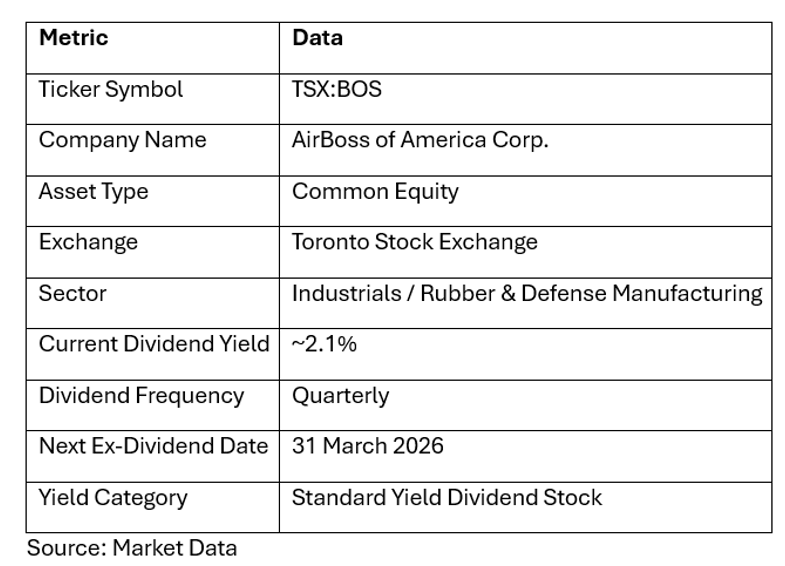
Introduction and Investment Thesis
AirBoss of America (TSX:BOS) is a Canadian industrial manufacturing company known for producing high-performance rubber products, defense equipment, and protective gear. The company has attracted dividend investors due to its combination of steady distributions, industrial exposure, and niche defense contracts.
For investors seeking balanced income and growth, TSX:BOS sits in the moderate yield category, offering roughly 2.1% dividend yield while retaining capital to fund expansion and innovation.
The investment thesis around AirBoss revolves around three pillars:
- Industrial manufacturing demand across automotive and defense sectors
• Specialized defense and PPE contracts that generate higher-margin revenue
• Stable dividend payments supported by operating cash flow
This analysis explores BOS from a dividend investor perspective, covering yield sustainability, risk factors, financial fundamentals, sector context, and portfolio allocation strategy for 2026.
Company Overview and Business Model
AirBoss of America Corp. is headquartered in Ontario and operates through several key divisions that manufacture engineered rubber compounds and specialized defense products.
The company primarily operates across three segments:
- AirBoss Rubber Solutions
This division manufactures custom rubber compounds used in:
- automotive components
- industrial machinery
- infrastructure applications
These materials are essential inputs for manufacturers requiring high-durability rubber compounds.
- AirBoss Engineered Products
This segment focuses on anti-vibration systems, military vehicle components, and advanced molded rubber parts used in heavy industrial equipment.
- AirBoss Defense Group
The defense unit manufactures protective gear and chemical-biological protection equipment, including:
- military protective masks
- filtration systems
- personal protective equipment
Defense contracts often provide stable long-term revenue streams, particularly during periods of geopolitical tension.
Dividend Yield Analysis
AirBoss currently offers an annual dividend yield of approximately 2.144%, positioning the stock in the standard yield category among TSX dividend equities.
Dividend yield is calculated as:
Dividend Yield = Annual Dividend / Share Price
For investors, this means every $10,000 invested in BOS generates roughly $214 in annual dividend income before taxes.
Compared with other Canadian dividend sectors:
|
Yield Category |
Range |
|
Low Yield |
<1.5% |
|
Standard Yield |
1.5%–3.5% |
|
High Yield |
3.5%–6% |
|
Ultra Yield |
>6% |
BOS fits comfortably in the standard yield bracket, typical of companies balancing growth investment and shareholder income.
Dividend History and Consistency
AirBoss has maintained a consistent quarterly dividend program over recent years, though dividend growth has been modest compared with major Canadian dividend aristocrats.
Key characteristics of BOS dividends include:
- Quarterly payment schedule
• Historically stable distributions
• Moderate payout ratio
• Dividend supported by operating cash flow
For income investors, the key consideration is dividend sustainability rather than high yield.
Companies in industrial sectors often maintain lower payout ratios in order to reinvest capital into manufacturing capacity and R&D.
Dividend Sustainability and Payout Ratio
Dividend sustainability depends on how much of a company’s earnings are paid out to shareholders.
Key metrics investors should monitor include:
Payout Ratio
The payout ratio measures how much profit is distributed as dividends.
Lower payout ratios typically indicate higher dividend safety.
Free Cash Flow Coverage
Dividends funded by free cash flow rather than debt are generally considered more reliable.
Balance Sheet Strength
A manageable debt level ensures the company can maintain dividends during economic downturns.
For BOS, maintaining a moderate payout policy allows management to balance shareholder returns and growth investment.
Tax Considerations for Canadian Investors
Dividends from AirBoss of America are generally considered eligible dividends for Canadian residents.
Eligible dividends benefit from the Canadian Dividend Tax Credit, which reduces the effective tax rate compared with interest income.
Account Type Impact
TFSA
Dividends and capital gains are completely tax-free.
RRSP
Taxes are deferred until withdrawal.
Taxable Account
Dividends qualify for the dividend tax credit, lowering the effective tax rate.
Because of this favorable treatment, Canadian dividend stocks like BOS are often attractive in income-focused portfolios.
Key Risk Factors
Every equity investment carries risks, and BOS is no exception.
- Industrial Cyclicality
Demand for rubber compounds and engineered components can decline during economic slowdowns.
- Defense Contract Volatility
Defense contracts can fluctuate based on government spending priorities.
- Commodity Price Risk
Rubber manufacturing relies on raw materials whose costs may fluctuate.
- Interest Rate Sensitivity
Higher interest rates can make fixed income investments more attractive than dividend stocks.
- Company-Specific Execution Risk
Operational challenges or contract losses could affect profitability.
Investors should monitor quarterly earnings reports and sector developments closely.
Sector Outlook: Industrial and Defense Manufacturing
AirBoss operates in a sector influenced by several macroeconomic drivers.
Key industry trends include:
- Increased defense spending globally
• Growth in industrial automation
• Infrastructure investment
• Supply chain reshoring in North America
These trends may create long-term demand tailwinds for companies specializing in engineered materials and defense equipment.
Portfolio Strategy for Dividend Investors
When incorporating TSX:BOS into a dividend portfolio, investors should consider diversification and allocation strategy.
Possible roles within a portfolio include:
Complementary Dividend Holding
BOS can complement high-yield sectors such as utilities, pipelines, and telecom.
Industrial Sector Exposure
It provides exposure to industrial manufacturing, which many dividend portfolios lack.
Dividend Reinvestment Strategy
Reinvesting dividends through a DRIP can significantly increase long-term returns.
Dollar-cost averaging combined with dividend reinvestment allows investors to build positions gradually during market volatility.
Dividend Reinvestment Strategy (DRIP)
Dividend Reinvestment Plans allow investors to automatically use dividends to purchase additional shares.
Benefits include:
- automatic compounding
• increased share ownership over time
• no manual reinvestment required
• potential brokerage DRIP discounts
Over a 10- to 20-year horizon, reinvesting dividends can significantly increase total return.
Peer Comparison
Investors evaluating BOS should compare it with similar Canadian industrial or diversified dividend stocks.
Key comparison metrics include:
- dividend yield
• earnings growth
• payout ratio
• balance sheet leverage
• total shareholder return
A balanced analysis considers income stability, financial strength, and long-term growth potential.
Long-Term Investment Outlook
AirBoss of America remains an interesting option for investors seeking:
- moderate dividend income
• industrial sector exposure
• participation in defense and manufacturing markets
While the yield is not exceptionally high, BOS may appeal to investors looking for balanced income and growth potential within the Canadian equity market.
Like all individual stocks, BOS should be evaluated as part of a diversified portfolio strategy rather than a concentrated position.
Final Verdict
AirBoss of America (TSX:BOS) offers a solid but moderate dividend yield, supported by a specialized industrial business model and exposure to defense markets.
For dividend investors, the stock may serve as:
- a supplementary dividend holding
• an industrial sector diversifier
• a DRIP-friendly long-term compounder
Investors should continue monitoring earnings growth, contract pipeline, and payout sustainability to assess the long-term viability of the dividend.


 Nov 25, 2026





 Please wait processing your request...