
 NZ
 UK
 US
 AU
 IND

 CA

 Share
 X (Formerly Twitter)
 Whatsapp
 Facebook
 LinkedIn
 Telegram
 Email This Article
 Copy Link
 Summarize with AI
 Chat GPT
 Perplexity

Quick Facts at a Glance
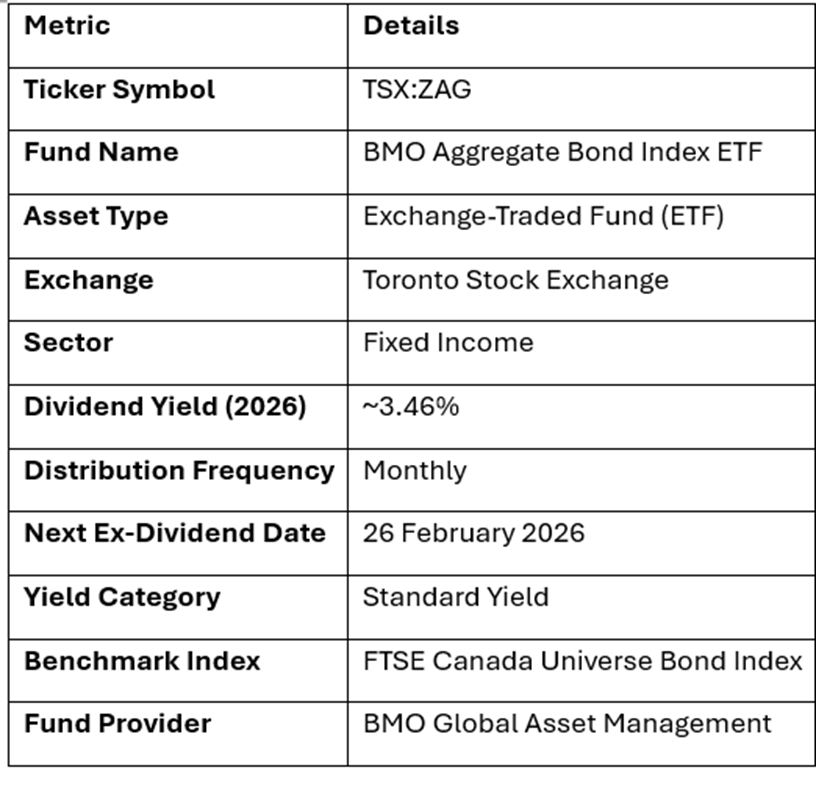
Source: Market Data
Introduction: Why TSX:ZAG Matters for Income Investors
The BMO Aggregate Bond Index ETF (TSX:ZAG) has established itself as one of the cornerstone fixed-income ETFs available on the Toronto Stock Exchange. Designed to track the FTSE Canada Universe Bond Index, the fund provides diversified exposure to Canadian government and investment-grade corporate bonds.
For Canadian investors seeking consistent income with lower volatility than equities, TSX:ZAG serves as a widely used core bond allocation. With a dividend yield of approximately 3.46%, the ETF delivers steady monthly distributions while maintaining broad diversification across the Canadian bond market.
In 2026, investors increasingly rely on bond ETFs like ZAG for several reasons:
- Portfolio stability during equity market volatility
- Reliable monthly income distributions
- Broad exposure to government and corporate bonds
- Low management fees relative to traditional bond funds
This guide explores ZAG’s dividend profile, distribution sustainability, portfolio structure, and risk outlook to help investors determine whether it deserves a place in their income strategy.
ETF Structure and Investment Objective
TSX:ZAG operates as a passively managed bond ETF, designed to replicate the performance of the FTSE Canada Universe Bond Index.
The fund invests across a wide spectrum of fixed-income securities including:
- Federal government bonds
- Provincial government bonds
- Investment-grade corporate bonds
- Asset-backed securities
This diversified structure allows ZAG to represent the entire Canadian investment-grade bond market, making it one of the most comprehensive fixed-income ETFs in Canada.
Portfolio Allocation Overview (Typical Composition)
|
Bond Type |
Approximate Allocation |
|
Government Bonds |
~40–45% |
|
Provincial Bonds |
~30–35% |
|
Corporate Bonds |
~20–25% |
|
Other Securities |
Small allocation |
Because of this diversification, ZAG reduces single-issuer risk, which is a key advantage compared with purchasing individual bonds.
Dividend Yield and Distribution Profile
Income generation is the primary reason investors hold TSX:ZAG.
Current Dividend Yield
Approximate yield (2026): 3.462%
The yield fluctuates depending on:
- Interest rate levels
- Bond coupon income
- ETF unit price
- Portfolio turnover
Unlike dividend stocks, bond ETFs typically distribute interest income, which results in monthly distributions.
Monthly Distribution Model
ZAG pays monthly cash distributions, making it attractive for investors seeking predictable income streams.
Benefits include:
- Regular income for retirees
- Reinvestment opportunities through DRIP
- Portfolio cash flow stability
Historically, ZAG’s distribution levels have remained relatively stable because the ETF holds a diversified portfolio of investment-grade bonds.
Historical Distribution Trends
While distributions may fluctuate slightly based on interest rates and bond yields, ZAG has maintained a consistent payout structure over time.
Key observations from historical trends:
- Monthly distributions have remained stable over long periods
- Rising interest rates can gradually increase income potential
- Falling interest rates may compress yields
Over multi-year periods, reinvested distributions have contributed significantly to total returns.
Interest Rate Sensitivity
Bond ETFs like TSX:ZAG are highly influenced by interest rate movements.
When Interest Rates Rise
- Bond prices generally fall
- ETF net asset value may decline
- Yield gradually increases as new bonds are purchased
When Interest Rates Fall
- Bond prices typically rise
- Capital appreciation potential increases
- Yield may decline over time
The Bank of Canada’s monetary policy plays a critical role in determining ZAG’s performance.
Tax Treatment for Canadian Investors
Understanding the tax implications of bond ETF distributions is essential.
ZAG distributions may include:
- Interest income
- Capital gains
- Return of capital (occasionally)
Unlike Canadian stock dividends, interest income does not qualify for the dividend tax credit.
Best Accounts for Holding ZAG
|
Account Type |
Tax Treatment |
|
TFSA |
Tax-free distributions and capital gains |
|
RRSP |
Tax deferred until withdrawal |
|
Taxable Account |
Interest income taxed at marginal rate |
For many investors, TFSA or RRSP accounts are the most tax-efficient locations for holding bond ETFs like ZAG.
Key Risks Investors Should Consider
Although ZAG offers diversification and stability, it is not risk-free.
Interest Rate Risk
Bond prices decline when interest rates rise, which can impact the ETF’s market value.
Inflation Risk
High inflation erodes the real purchasing power of bond income.
Credit Risk
While most holdings are investment-grade, corporate bonds still carry some credit risk.
Liquidity Risk
During market stress, bond market liquidity can temporarily tighten.
Peer Comparison: How ZAG Stacks Up
ZAG competes with several other Canadian bond ETFs.
Key evaluation metrics include:
- Management expense ratio
- Assets under management
- Tracking accuracy
- Distribution consistency
Advantages of ZAG:
- Large asset base and liquidity
- Broad market coverage
- Low management fees
- Established track record
These factors have made ZAG one of the most widely used core bond ETFs in Canada.
Portfolio Strategy: How Investors Use TSX:ZAG
Investors typically allocate ZAG in several ways:
Core Portfolio Stabilizer
Many portfolios include 20–40% bond exposure to balance equity risk.
Retirement Income Strategy
Monthly distributions provide consistent cash flow.
Diversification Tool
ZAG can reduce portfolio volatility when combined with equity ETFs.
Dividend Reinvestment Strategy (DRIP)
A Dividend Reinvestment Plan (DRIP) allows investors to automatically reinvest distributions into additional ETF units.
Benefits of DRIP:
- Compounding returns over time
- Automatic investment discipline
- Increased long-term income potential
Over long investment horizons, reinvested distributions can dramatically increase total returns.
Long-Term Outlook for TSX:ZAG
The outlook for ZAG in 2026 and beyond depends largely on macroeconomic conditions.
Key factors to monitor include:
- Bank of Canada interest rate policy
- Inflation trends
- Government bond issuance
- Corporate credit markets
As interest rates stabilize or decline, bond ETFs like ZAG may benefit from both income and capital appreciation potential.
Final Investment Perspective
The BMO Aggregate Bond Index ETF (TSX:ZAG) remains one of Canada’s most important fixed-income ETFs for investors seeking stability and income.
Key takeaways:
- Approximate 3.46% yield with monthly distributions
- Broad exposure to Canadian investment-grade bonds
- Low-cost diversified bond market access
- Useful for portfolio diversification and risk management
For long-term investors building balanced portfolios, ZAG can serve as a core bond allocation that complements equity investments and supports income generation.


 Nov 24, 2026





 Please wait processing your request...