
 NZ
 UK
 US
 AU
 IND

 CA

 Share
 X (Formerly Twitter)
 Whatsapp
 Facebook
 LinkedIn
 Telegram
 Email This Article
 Copy Link
 Summarize with AI
 Chat GPT
 Perplexity

Quick Facts at a Glance
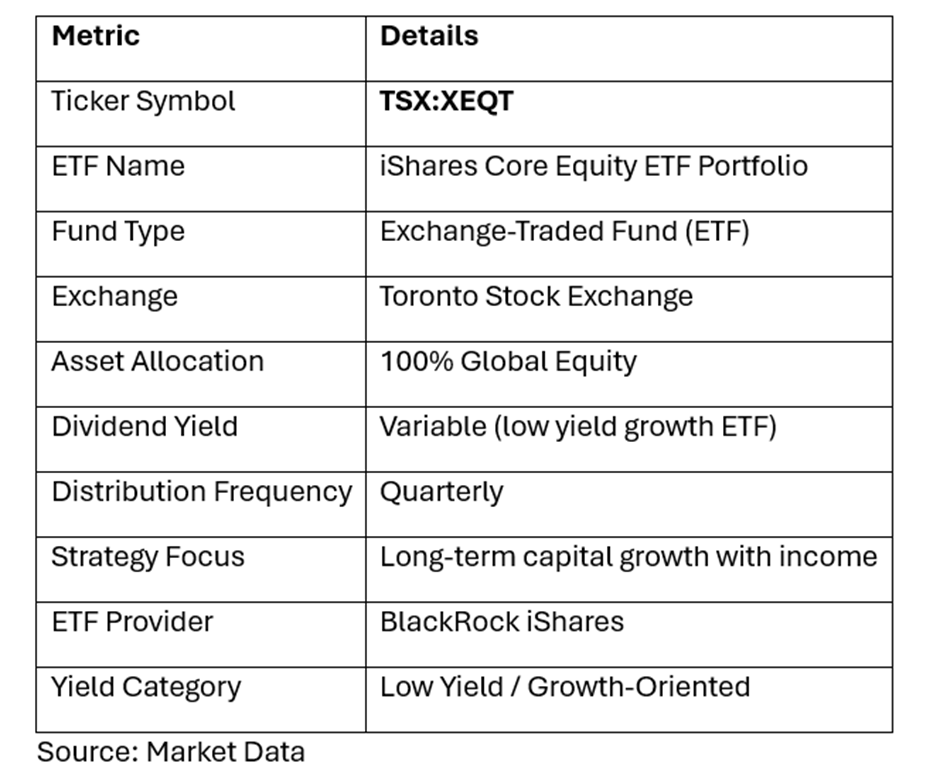
Introduction: Why TSX:XEQT Is Popular Among Canadian Investors
The iShares Core Equity ETF Portfolio (TSX:XEQT) has become one of the most widely used all-in-one ETFs for Canadian investors seeking diversified global equity exposure. Designed as a single-ticket portfolio solution, XEQT holds thousands of stocks worldwide and distributes income generated from its underlying holdings.
While TSX:XEQT is not primarily a high-yield dividend ETF, it offers a compelling combination of:
- Global diversification
• Long-term capital appreciation potential
• Periodic income distributions
• Low-cost passive investment structure
In 2026, many investors are increasingly prioritizing total return investing, where capital growth and reinvested dividends together drive long-term portfolio performance. XEQT fits neatly into this strategy by combining global equities with automated diversification.
This guide provides a comprehensive dividend and portfolio analysis of TSX:XEQT, covering distribution patterns, risk factors, taxation, portfolio allocation, and how the ETF fits within modern investment strategies.
What Is TSX:XEQT?
TSX:XEQT is an asset-allocation ETF that invests exclusively in equities across multiple geographic regions. Rather than holding individual stocks directly, the fund invests in a group of underlying iShares ETFs that track major global markets.
The ETF provides exposure to:
- Canadian equities
• U.S. equities
• International developed markets
• Emerging market stocks
Because of this structure, investors purchasing TSX:XEQT instantly gain exposure to thousands of global companies through a single ETF purchase.
Key advantages include:
- automatic diversification
• low management costs
• simplified portfolio management
• global exposure without currency trading complexity
For long-term investors who prefer a buy-and-hold strategy, XEQT is often used as a core portfolio holding.
Portfolio Allocation and Global Diversification
A defining characteristic of TSX:XEQT is its diversified global allocation. The ETF invests through four major underlying iShares funds.
Typical allocation structure:
|
Region |
Approximate Allocation |
|
United States |
~45% |
|
Canada |
~25% |
|
International Developed Markets |
~20% |
|
Emerging Markets |
~10% |
This geographic diversification allows the ETF to capture growth opportunities across multiple economies while reducing dependence on any single market.
The largest sectors represented include:
- technology
• financials
• healthcare
• consumer discretionary
• industrials
This diversified sector exposure helps reduce concentration risk compared to holding individual stocks.
Dividend Yield and Distribution Structure
Unlike income-focused ETFs, TSX:XEQT prioritizes growth over high yield. The dividend distributions reflect the income generated by the underlying holdings.
Typical characteristics include:
- variable dividend yield
• quarterly distributions
• income derived from global equities
The yield fluctuates depending on:
- underlying company dividends
• exchange rates
• portfolio rebalancing
• market conditions
Although the yield is modest compared with high-income ETFs, investors benefit from dividend growth potential and capital appreciation over long investment horizons.
Dividend History and Payout Trends
TSX:XEQT has maintained consistent quarterly distributions since launch, reflecting the income streams generated from its underlying equity holdings.
Distribution stability is supported by:
- diversified global companies
• exposure to dividend-paying blue-chip firms
• multiple regional markets
Investors tracking the distribution pattern should monitor:
- ex-dividend dates
• record dates
• payment dates
Owning the ETF before the ex-dividend date ensures eligibility for the next distribution.
Total Return vs High Yield Strategy
Investors sometimes compare XEQT to high-yield ETFs, but the investment objectives differ significantly.
TSX:XEQT focuses on total return, which includes:
- capital appreciation
- dividend reinvestment
- long-term compounding
This approach historically generates stronger long-term returns than focusing solely on yield.
For younger investors or those with a long time horizon, total return strategies often outperform high-yield income portfolios.
Tax Considerations for Canadian Investors
Distributions from TSX:XEQT may include several tax components:
- Canadian eligible dividends
• foreign dividends
• capital gains distributions
• return of capital
The tax treatment varies depending on the type of income.
TFSA
All income and capital gains are tax-free.
RRSP
Taxes are deferred until withdrawal.
Non-Registered Accounts
Investors must report income annually but may benefit from the Canadian dividend tax credit for eligible dividends.
Understanding these tax implications helps optimize after-tax returns.
Key Risks Investors Should Consider
Despite its diversification, TSX:XEQT carries several important risks.
Market Risk
Since the ETF holds 100% equities, its value fluctuates with global stock markets.
Currency Risk
Foreign holdings expose investors to currency fluctuations relative to the Canadian dollar.
Global Economic Risk
International economic slowdowns can affect returns.
Interest Rate Environment
Higher interest rates may shift capital toward bonds or fixed-income assets.
Despite these risks, diversification across thousands of companies significantly reduces individual company risk.
Dividend Reinvestment Strategy (DRIP)
A powerful strategy for long-term investors holding TSX:XEQT is Dividend Reinvestment (DRIP).
Through DRIP:
- dividends automatically purchase additional ETF units
• compounding accelerates portfolio growth
• no manual reinvestment is required
Over long time periods, reinvested dividends contribute a significant portion of total returns.
Many Canadian brokerages offer synthetic DRIP programs with no commission fees, making this strategy accessible for investors of all portfolio sizes.
How TSX:XEQT Fits in a Long-Term Portfolio
TSX:XEQT is frequently used as a core portfolio foundation because it provides instant global diversification.
It can serve as:
- a complete portfolio solution
• the equity core of a diversified portfolio
• a long-term retirement investment
• a passive investing strategy
Investors seeking additional income sometimes complement XEQT with:
- dividend ETFs
• REIT ETFs
• fixed-income funds
This combination balances growth, income, and risk management.
Peer Comparison: XEQT vs Other Asset Allocation ETFs
Several asset allocation ETFs compete with TSX:XEQT in Canada.
Key differentiators include:
- management fees
• global allocation structure
• dividend distribution frequency
• underlying ETF composition
XEQT remains popular due to:
- competitive expense ratio
• broad diversification
• strong liquidity on the Toronto Stock Exchange
• backing from a major global asset manager
Investment Outlook for 2026
Looking ahead to 2026 and beyond, the long-term outlook for global equities remains supported by several macro trends:
- technological innovation
• global economic expansion
• population growth
• rising middle classes in emerging markets
As a globally diversified ETF, TSX:XEQT is positioned to capture these trends across multiple regions and industries.
For investors seeking a simple, diversified, and long-term growth vehicle, XEQT continues to be one of the most compelling ETF choices listed on the Toronto Stock Exchange.
Final Thoughts
The iShares Core Equity ETF Portfolio (TSX:XEQT) stands out as a powerful investment tool for Canadian investors who want global diversification in a single ETF.
Although it offers a relatively modest dividend yield, its real strength lies in:
- long-term growth potential
• global diversification
• disciplined passive investing
• low-cost portfolio management
For investors focused on building wealth over decades rather than maximizing immediate income, TSX:XEQT remains one of the most effective core ETFs available in Canada.


 Nov 25, 2026





 Please wait processing your request...