
 NZ
 UK
 US
 AU
 IND

 CA

 Share
 X (Formerly Twitter)
 Whatsapp
 Facebook
 LinkedIn
 Telegram
 Email This Article
 Copy Link
 Summarize with AI
 Chat GPT
 Perplexity

Snapshot: key SEND trading data
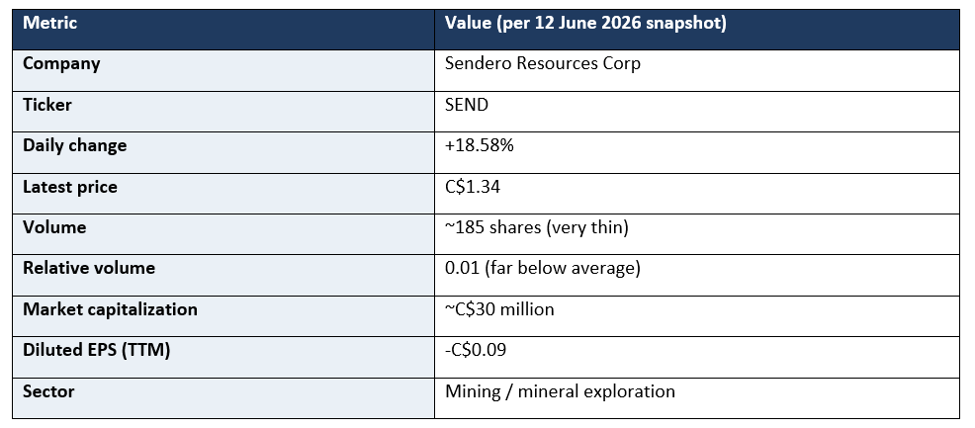
Sendero Resources Corp (TSXV:SEND) appeared on the Canadian top-gainers screen on 12 June 2026 with a striking double-digit percentage advance. According to the TradingView market-movers snapshot, SEND stock rose 18.58% to a quoted price of C$1.34, with a market capitalisation of approximately C$30 million. Crucially, however, the move was recorded on volume of only about 185 shares — an exceptionally thin level of trading.
That volume figure is the most important detail in the SEND entry, and it reframes the entire story. A near-19% gain achieved on fewer than 200 shares, with a relative-volume reading of just 0.01, is far more a reflection of illiquidity than of broad investor demand. This article explains what the snapshot shows, why thin trading matters so much for interpreting the move, and what investors should verify before reading anything into the figure.
Why did SEND stock rise about 19%?
The exact reason for the SEND move is not confirmed by the snapshot, and the dominant factor to keep in mind is liquidity rather than any single catalyst. When only around 185 shares change hands, a small number of trades at a higher price can move the calculated percentage change substantially. In other words, the headline gain may say more about the thinness of the order book than about a wave of fresh buying.
Possible contributing factors that investors should verify include company-specific exploration news, broader junior-mining momentum on a day when several resource names were higher, speculative or technical buying, or simply a low-liquidity print. The relative-volume reading of 0.01 — far below the stock’s norm — strongly reinforces the liquidity interpretation.
So while SEND stock rose 18.58% on the screen, the responsible reading is that the move was generated in a very thin market and should be confirmed against the company’s disclosures and a second data source before being treated as meaningful.
Sendero Resources: company background and context
Sendero Resources is a junior mineral-exploration company with a market capitalisation of roughly C$30 million as shown in the snapshot, placing it at the smaller end of the Canadian resource sector. Junior explorers at this size are typically pre-revenue, with value tied to the perceived prospectivity of their projects rather than to current earnings; the negative trailing EPS of -C$0.09 is consistent with that profile.
Because Sendero is a small and specialised explorer, investors should not assume detailed knowledge of its projects from a market-movers screen. The company’s filings on SEDAR+, its technical reports and its news releases are the appropriate sources for confirming what assets it holds, where they are located, and what its recent exploration and financing activity has been.
Verifying these basics is particularly important given the thin trading, because in illiquid names the gap between a quoted price and an achievable price can be wide.
Putting the SEND move in context
The context here is dominated by liquidity. A volume of about 185 shares is among the lowest on the entire gainers list, and relative volume of 0.01 indicates the session was extraordinarily quiet by the stock’s own standards. In such conditions, percentage moves can be large and yet economically thin — that is, they may not be repeatable at scale because there simply are not enough shares trading to absorb meaningful buying or selling near the quoted price.
This is why the SEND figure should be treated with particular care. The TradingView screen itself warns of retracement risk and urges users to weigh all statistics, including share price and market cap. For a name trading fewer than 200 shares, that caution is especially pertinent: the quoted C$1.34 may not reflect a price at which a typical investor could realistically transact in size.
None of this means the company lacks merit; it simply means the day’s move is not strong evidence of a durable trend.
Junior mining sentiment: the broader backdrop
Sendero appeared on the gainers list on a day when junior miners and resource names were broadly well bid, and that backdrop matters. When sentiment toward exploration stocks improves — often alongside firmer commodity prices or rising risk appetite — even very small and thinly traded names can be marked higher. Momentum, liquidity gaps and technical buying can all amplify moves in this part of the market.
The flip side is that the same characteristics make junior explorers prone to rapid reversals. A sector-wide improvement in sentiment can lift a name like SEND without any company-specific catalyst, and that sentiment can fade just as quickly. For thinly traded stocks, the swings can be especially pronounced because of the limited float.
What are the risks for SEND investors?
The risks attached to SEND are led by liquidity. Very low volume can mean wide bid-ask spreads and difficulty transacting near the quoted price, and it can exaggerate both gains and losses. Beyond liquidity, the company faces the standard risks of junior exploration: results may disappoint, projects face technical and permitting hurdles, and a pre-revenue explorer may need to raise capital, potentially diluting shareholders.
- Liquidity risk: ~185 shares traded means thin, potentially unrepresentative pricing.
- Exploration risk: results and resource potential are uncertain.
- Financing and dilution risk for a pre-revenue junior.
- Volatility risk: thinly traded names can reverse sharply.
Why does the SEND volume figure dominate the story?
It is worth dwelling on the SEND volume figure because it is so unusual. Roughly 185 shares traded is among the very lowest on the entire gainers list, and relative volume of 0.01 indicates the session was extraordinarily quiet by the stock’s own standards. In a market this thin, the gap between the headline percentage and economic reality can be wide.
Consider the mechanics: if only a handful of trades occur, a single transaction at a higher price can lift the calculated change dramatically, even though almost no capital actually changed hands. This is why experienced market participants treat large percentage moves on tiny volume with scepticism — the number is technically accurate but may not be representative of a price at which a meaningful position could be bought or sold.
For SEND, this means the 18.58% gain should be read first and foremost as a liquidity event. It does not, on its own, indicate a wave of demand, and it would be a mistake to extrapolate a trend from a near-empty order book.
How can investors assess thinly traded explorers like SEND?
Assessing a thinly traded junior requires a different toolkit from analysing a liquid large-cap. Price action on a single day carries little information when volume is negligible, so the focus should shift to the company’s fundamentals: the quality and location of its projects, the strength of its balance sheet, its share structure, and the credibility of its recent exploration work. These are found in primary filings rather than on a price screen.
Liquidity itself is also a key consideration. For names that trade only a few hundred shares on a quiet day, the practical ability to enter or exit a position near the quoted price can be limited, and bid-ask spreads can be wide. Investors should weigh that reality alongside any interest in the underlying story.
In short, for a name like SEND, the company’s disclosures matter far more than a single thin-market print, and liquidity is a first-order risk rather than a footnote.
What role does junior-mining sentiment play for SEND?
Even for a very thinly traded name, the broader mood toward junior miners provides important context. SEND rose on a day when resource and exploration names were broadly higher across the Canadian screen, suggesting that improved sector sentiment may have drawn at least some incremental attention to smaller names like Sendero.
Sector sentiment can lift the entire group together, but its effect on the smallest and least liquid names is uneven and unpredictable. A rising tide may nudge a thin stock higher on minimal volume, yet that same illiquidity means the move can reverse with equal ease once attention moves elsewhere. For SEND, sentiment is best viewed as a backdrop that can amplify thin-market swings in both directions, not as a reliable driver of sustained performance.
Liquidity and floats: why they matter so much for SEND
The SEND example is a useful case study in why liquidity and share structure deserve close attention in junior mining. A stock’s float — the number of shares readily available to trade — and its typical turnover determine how much a given amount of buying or selling moves the price. For a name that trades only a few hundred shares on a quiet day, even small orders can have an exaggerated effect, which is exactly what the 18.58% gain on about 185 shares illustrates.
This has practical consequences. In thinly traded names, the quoted price may not reflect a level achievable for a meaningful position, bid-ask spreads can be wide, and both entering and exiting can be difficult. It also means single-day percentage moves carry little reliable information about demand. For Sendero, the balanced takeaway is that the company should be judged on its fundamentals and disclosures rather than on a thin-market print, and that liquidity itself is a central risk to weigh — not an afterthought — before forming any view.
What should investors watch next?
For anyone monitoring SEND, the priority is to watch whether trading volume normalises and whether the price holds once more shares change hands. Any company exploration news or financing announcement would help explain the move, and confirming the project portfolio and balance sheet via SEDAR+ is an essential first step. Broader junior-mining sentiment and commodity prices will also shape how the stock behaves.
In summary, SEND stock rose 18.58% to C$1.34, but on only around 185 shares — a move best understood as a thin-market print rather than confirmation of strong demand. Until volume and price are corroborated over subsequent sessions and against primary sources, the figure should be treated as provisional.


 Nov 25, 2026





 Please wait processing your request...