
 NZ
 UK
 US
 AU
 IND

 CA

 Share
 X (Formerly Twitter)
 Whatsapp
 Facebook
 LinkedIn
 Telegram
 Email This Article
 Copy Link
 Summarize with AI
 Chat GPT
 Perplexity

Snapshot: key ZNG trading data
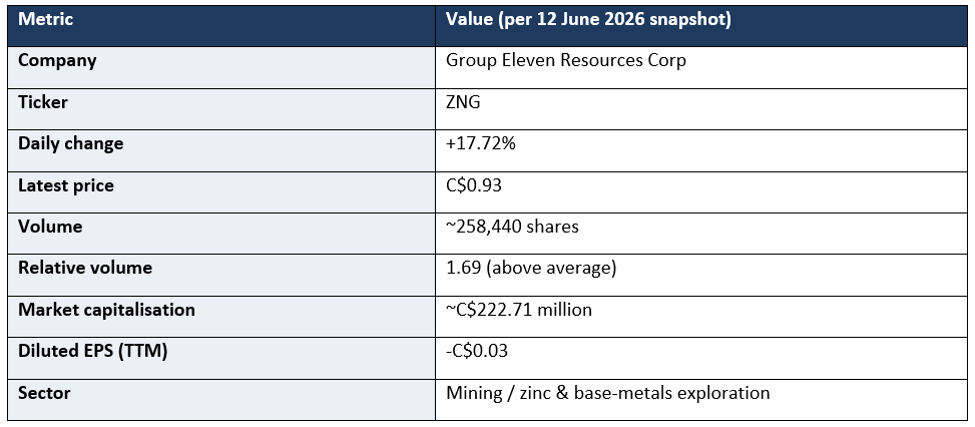
Group Eleven Resources Corp (TSXV:ZNG) was a notable mover on the Canadian top-gainers screen on 12 June 2026, advancing solidly on heavier-than-usual turnover. According to the TradingView market-movers snapshot, ZNG stock rose 17.72% to a quoted price of C$0.93, on volume of roughly 258,440 shares and a market capitalisation of approximately C$222.71 million.
Unlike some of the thinly traded names on the same list, ZNG’s advance came with a relative-volume reading of 1.69 — meaning the day’s activity ran well above the stock’s typical level. That combination of a sharp gain and elevated volume is consistent with the headline framing of warming metals sentiment, though it does not on its own confirm the cause. This article reviews what the snapshot shows, the cautious range of explanations, and the risks and watch-points for a base-metals explorer.
Why did ZNG stock rise 18%?
The exact catalyst for the Group Eleven move is not confirmed by the snapshot, and investors should resist attributing it to a single cause without verification. For a base-metals exploration company, a sharp one-day gain can reflect company-specific exploration news that should be confirmed through filings, strength in zinc or other base-metal prices, broader momentum across the mining sector, speculative and technical buying, or improved investor sentiment toward resource equities.
What distinguishes ZNG from several other names on the list is the relative-volume reading of 1.69, indicating that the gain was supported by meaningfully heavier trading than usual. That is a constructive nuance, because moves backed by elevated volume are sometimes regarded as carrying more conviction than those achieved on thin turnover — though elevated volume can reflect both buying and selling, so it is not proof of a durable trend.
On balance, ZNG stock rose on a day of broad strength in metals names, and the firm volume suggests genuine engagement. The underlying reason, however, should still be confirmed against the company’s disclosures.
Group Eleven Resources: company background and context
Group Eleven Resources is a base-metals exploration company most closely associated with zinc, a metal used heavily in galvanising steel and in batteries and alloys. The company has been linked to zinc exploration in Ireland, a recognised European base-metals district, and investors should confirm its current project portfolio, ownership interests and exploration results through its corporate filings, as these evolve over time.
With a market capitalisation of roughly C$222.71 million, Group Eleven sits among the more substantial junior explorers, though its negative trailing EPS of -C$0.03 reflects the pre-revenue nature typical of the exploration stage. For such companies, value is driven by the perceived quality and scale of mineral assets and by base-metal price expectations, rather than by current earnings.
As with any explorer, the company’s technical reports, news releases and financial statements — available via SEDAR+ and its investor channel — should be treated as the authoritative source on its projects and finances.
Putting the ZNG move in context
A 17.72% gain to C$0.93 on about 258,440 shares, with relative volume of 1.69, points to an active session by the stock’s standards. For a low-priced explorer, that level of turnover indicates genuine participation rather than a thin-market artefact, which sets ZNG apart from some of the lower-volume names that also featured on the gainers list.
The broader context is that ZNG was one of numerous mining and metals names higher on the same day. That clustering often signals a sector-wide tailwind — in this case, warming sentiment toward metals — rather than a purely company-specific story. When base-metal prices firm or sentiment improves, the explorers leveraged to those metals tend to be re-rated together.
The TradingView screen’s standard caution still applies: there is a risk of retracement, and all statistics, including share price and market cap, should be weighed before drawing conclusions.
Base-metals sentiment: the broader backdrop
Zinc and other base metals are cyclical, with prices driven by global industrial demand, supply developments and macroeconomic expectations. When sentiment toward base metals improves, junior explorers with credible projects often benefit as investors seek leverage to rising or firming prices through earlier-stage companies. The appearance of multiple metals names among the day’s gainers is consistent with exactly this kind of broad improvement.
Base-metals exploration is a high-beta area of the market: it can rally strongly when commodity prices and risk appetite align, and retrace quickly when they do not. For ZNG, this means the share price is likely to remain sensitive both to company newsflow and to the wider base-metals backdrop.
What are the risks for ZNG investors?
Group Eleven faces the standard risks of a junior explorer. Exploration results can fall short of expectations, projects face technical and permitting hurdles, and the lack of current revenue means the company may need to raise capital, which can dilute existing shareholders. The share price is also exposed to base-metal prices, which are influenced by global growth and supply factors beyond the company’s control.
- Exploration risk: results and resource estimates may disappoint.
- Commodity risk: leverage to zinc and base-metal prices.
- Financing and dilution risk as a pre-revenue explorer.
- Volatility risk: junior miners can retrace gains quickly.
What does ZNG’s above-average volume signal?
Group Eleven’s 17.72% gain stands out partly because of its relative-volume reading of 1.69, well above the stock’s norm. Among the day’s movers, ZNG was one of the names where a sharp advance was clearly accompanied by heavier participation rather than a thin-market print. For a low-priced explorer, that level of turnover suggests the move reflected genuine engagement from market participants.
As with any volume signal, the caveat is that elevated turnover captures both buyers and sellers, and a busy session does not by itself confirm that a trend will persist. Still, a volume-supported move is generally regarded as carrying more information than one achieved on negligible trading. For ZNG, the firm volume lends some credibility to the idea that warming metals sentiment translated into real demand, though follow-through over subsequent sessions remains the key test.
Investors should watch whether the elevated volume is sustained, since fading turnover after a sharp move can be an early sign that momentum is cooling.
Why is zinc a distinctive base-metals exposure?
Zinc occupies a particular niche within the base-metals complex. Its largest single use is in galvanising steel to prevent corrosion, which ties demand closely to construction and infrastructure activity, and it is also used in alloys and batteries. Supply comes from a relatively concentrated set of mines globally, so the zinc price can be sensitive to developments at major operations as well as to broad industrial demand.
For an explorer like Group Eleven, this means the investment case rests not only on discovery success but also on the outlook for a metal with its own distinct supply-and-demand dynamics. When zinc and base metals are in favour, explorers with credible projects can attract renewed attention; when the cycle turns, sentiment can cool quickly. Understanding zinc’s specific drivers helps investors interpret why a name like ZNG might move alongside the broader metals complex on a given day.
How does ZNG fit within the day’s metals rally?
ZNG was one of a broad cluster of mining and metals names higher on the Canadian gainers screen on 12 June 2026. That clustering is significant: when many resource stocks rise together, it usually points to a sector-wide improvement in sentiment rather than a series of unrelated company-specific events. Group Eleven appears to have participated in, and arguably stood out within, that broader move thanks to its firm volume.
Being part of a sector rally has implications for how the move should be read. A stock lifted primarily by sector sentiment can be vulnerable if that sentiment reverses, even if its own fundamentals are unchanged. For ZNG, the combination of a sector tailwind and above-average volume is encouraging, but the durability of the advance will ultimately depend on base-metal prices and on the company’s own verifiable progress.
Balancing the bull and bear case for ZNG
A balanced assessment of Group Eleven weighs the supportive factors against the risks. On the supportive side, the 17.72% gain to C$0.93 came on above-average volume of about 258,440 shares, suggesting genuine engagement rather than a thin print; the company carries a reasonably substantial market value of roughly C$222.71 million for a junior; and it offers exposure to zinc, a base metal with its own distinct demand drivers in galvanising, alloys and batteries.
On the cautionary side, ZNG remains a pre-revenue explorer with a negative trailing EPS of -C$0.03, its fortunes are tied to volatile base-metal prices, and a move supported by sector sentiment can unwind if that sentiment reverses. Exploration outcomes are inherently uncertain, and financing needs can lead to dilution. The reasonable conclusion is that ZNG stock rose on a constructive combination of volume and sector strength, but that a durable judgement requires watching base-metal prices and the company’s verifiable progress over time rather than extrapolating from one strong session.
What should investors watch next?
For those following ZNG, the key watch-points are company exploration news, the direction of zinc and base-metal prices, and whether the elevated volume and price strength persist over subsequent sessions. Broader resource-sector sentiment and risk appetite will also influence the stock’s trajectory.
In summary, ZNG stock rose 17.72% to C$0.93 on above-average volume, a move consistent with warming metals sentiment and broad strength across the mining sector. The durability of the advance will depend on base-metal prices and on verifiable company developments, which should be monitored closely and confirmed through primary sources.
Top of Form
Bottom of Form


 Nov 25, 2026





 Please wait processing your request...