
 NZ
 UK
 US
 AU
 IND

 CA

 Share
 X (Formerly Twitter)
 Whatsapp
 Facebook
 LinkedIn
 Telegram
 Email This Article
 Copy Link
 Summarize with AI
 Chat GPT
 Perplexity
Views Expressed Disclaimer:
You are reading a free article with opinions that may differ from the recommendation given by Kalkine in its paid research reports. Become a Kalkine member today to get access to our research reports, in-depth technical and fundamental research.
Breaking China’s Supply Dominance: A Major Opportunity for Western Investors (February 2026)
Rare Earth Metals: The Strategic Resources Powering the Future Economy
Rare earth elements are among the most critical yet underappreciated resources shaping the modern world. This group of 17 metals — including neodymium, dysprosium, praseodymium, and terbium — forms the technological backbone of industries ranging from electric vehicles and renewable energy to aerospace, defence systems, and advanced medical equipment.
Without reliable access to these materials, the global energy transition would slow dramatically, next-generation defence technologies would face supply risks, and the electronics industry could encounter significant disruption. Rare earths are not simply commodities — they are strategic enablers of economic and national security.
The investment opportunity stems from a structural imbalance: China currently accounts for roughly 60–70% of global rare earth mining and as much as 85–90% of processing and refining capacity. This dominance is the result of decades of coordinated industrial policy, government subsidies, and relaxed environmental regulations that allowed China to build an overwhelming competitive advantage.
However, geopolitical tensions have fundamentally changed the landscape.
Geopolitics Is Reshaping the Rare Earth Market
The escalating trade conflict between the United States and China has pushed rare earth supply chains into the geopolitical spotlight. Since 2025, China has tightened export controls on several critical rare earth materials, reinforcing concerns among Western governments about supply security.
In response, the United States, Canada, Europe, Australia, and Japan have launched aggressive policies aimed at creating independent or allied-nation supply chains. These initiatives include:
- Government funding and tax incentives
- Strategic procurement programs
- Infrastructure and processing subsidies
- Defence-related supply mandates
For investors, this shift represents a rare structural opportunity. Companies capable of supplying rare earth materials outside China are increasingly viewed as strategic assets, not just mining businesses.
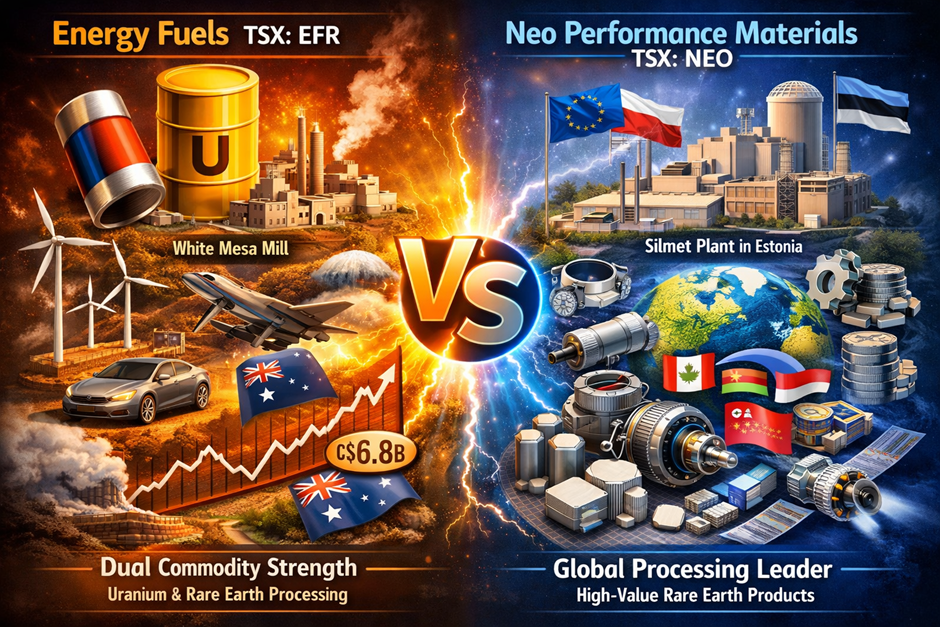
Among TSX-listed companies, two stand out as particularly compelling long-term opportunities.
Source: Kalkine Group
Energy Fuels has undergone one of the most notable strategic transformations among North American resource companies. Historically recognised as the largest conventional uranium producer in the United States, the company has rapidly expanded into rare earth production and processing, positioning itself as a potential Western supply chain leader.
Vertical Integration Strategy
The company’s rare earth expansion is anchored by its White Mesa Mill in Utah, which is being upgraded to process rare earth concentrates into separated oxides, metals, and alloys.
This vertical integration is crucial because the main bottleneck in Western rare earth supply chains is not mining — it is downstream processing and separation. By developing capabilities across the value chain, Energy Fuels aims to supply materials used in:
- Electric vehicle motors
- Wind turbine generators
- Defence technologies
- High-performance electronics
The company is also working toward producing neodymium-iron-boron (NdFeB) alloys, essential for permanent magnets used in clean energy and transportation technologies.
Strong Market Momentum
Investor enthusiasm has been significant. Energy Fuels shares surged more than 50% in January 2026, pushing its market capitalisation close to C$6.8 billion by mid-February.
Despite the rally, many analysts believe the company’s long-term valuation potential remains substantial due to:
- Strategic importance of non-Chinese supply
- Government policy tailwinds
- Growing clean energy demand
- Dual exposure to uranium and rare earth markets
Strategic Acquisition Expansion
The proposed acquisition of Australian Strategic Materials could further strengthen Energy Fuels’ supply chain by adding additional feedstock sources and expanding processing capabilities across allied nations.
Unique Dual Commodity Advantage
Energy Fuels benefits from a structural advantage rarely seen in the sector — an established uranium business that generates revenue and operational synergies while funding rare earth growth initiatives.
With both uranium and rare earth demand rising globally, this combination provides diversified exposure to two major energy transition themes.
Key Risks
Investors should also consider potential challenges:
- Technical complexity of large-scale rare earth processing
- Commodity price volatility across individual elements
- Potential Chinese market intervention through price competition
However, current geopolitical priorities suggest Western governments would likely support domestic producers if competitive pressures intensify.
For investors seeking a rare earth company already producing and processing materials — rather than a speculative developer — Energy Fuels offers one of the strongest TSX opportunities.
Neo Performance Materials occupies a unique and strategically important position in the global rare earth ecosystem. Unlike traditional miners, Neo focuses on processing and advanced materials manufacturing, converting raw rare earth inputs into high-value products used directly by industrial customers.
Strategic Processing Assets
The company’s flagship asset is its Silmet processing facility in Estonia, one of only a few operational rare earth separation plants in Europe. This facility provides manufacturers with a non-Chinese supply option — an increasingly valuable capability in today’s geopolitical environment.
Neo’s global operations span multiple jurisdictions, including:
- Canada (headquarters)
- Estonia
- Germany
- South Korea
- Thailand
- China
This diversified footprint allows flexibility in sourcing and routing materials.
High-Value Product Portfolio
Neo produces a wide range of advanced materials, including:
- Magnetic powders for EV motors and wind turbines
- Rare earth chemicals for automotive catalysts
- Zirconium and hafnium products for aerospace and nuclear industries
- Specialty materials for water treatment applications
This diversification provides revenue stability and reduces dependence on commodity price swings.
Financial Position and Growth Drivers
As of early 2026, Neo had a market capitalisation near C$1.2 billion, supported by positive operating cash flow and established relationships with major industrial customers.
The company’s investment thesis rests on three major factors:
- Strategic importance of non-Chinese processing capacity
- Higher margins from downstream value-added products
- Direct exposure to long-term EV and renewable energy growth
Risks to Consider
Potential risks include:
- Partial reliance on Chinese feedstock supply
- Emerging competition from government-funded Western projects
- Supply chain transition timelines
However, building rare earth separation facilities typically requires five to seven years, giving Neo a significant first-mover advantage.
For investors seeking exposure to the high-margin downstream segment of the rare earth market, Neo offers a differentiated opportunity.
Understanding Rare Earth Investing
The rare earth sector differs significantly from traditional commodities like gold or copper. Prices vary widely among individual elements, and supply-demand dynamics are complex. As a result, company-specific analysis — including product mix, processing capabilities, and end-market exposure — is critical.
Many rare earth companies remain early-stage developers with limited revenue visibility. Energy Fuels and Neo Performance Materials stand out because both are:
- Operational
- Revenue-generating
- Strategically positioned within Western supply chains
The Long-Term Investment Outlook
Government policies worldwide continue to prioritise supply chain independence for critical minerals. Initiatives such as:
- US critical mineral executive programs
- European Critical Raw Materials Act
- Canada’s Critical Minerals Strategy
all point toward sustained support for non-Chinese rare earth producers.
Companies capable of delivering reliable supply within allied nations could command premium valuations as strategic infrastructure providers rather than conventional mining businesses.
The Bottom Line
Rare earth metals may become one of the defining investment themes of the decade as geopolitical tensions and clean energy demand reshape global supply chains.
For TSX investors, Energy Fuels and Neo Performance Materials provide complementary exposure:
- Energy Fuels — vertically integrated producer with uranium upside
- Neo Performance Materials — downstream processor with global operations
Together, they represent two of the most credible publicly traded opportunities to participate in the Western rare earth supply chain transformation.
Important Notice: This article is for informational and educational purposes only and does not constitute financial advice. Always conduct your own research and consult a licensed financial adviser before making any investment decisions. Past performance is not indicative of future results. The information in this article is general in nature and does not take into account your personal financial situation, objectives, or needs. It should not be relied upon as a substitute for professional financial advice. Stock prices, analyst targets, and market conditions referenced herein are subject to change. Investing in equities involves risk, including the potential loss of principal. Always do your own research.


 Nov 20, 2026





 Please wait processing your request...