
 AU
AU
 UK
UK
 US
US
 NZ
NZ
 IND
IND

 CA
CA

 Share
Share
 X (Formerly Twitter)
 Whatsapp
 Facebook
 LinkedIn
 Telegram
 Email This Article
 Copy Link
 Summarize with AI
 Chat GPT
 Perplexity
Views Expressed Disclaimer:
You are reading a free article with opinions that may differ from the recommendation given by Kalkine in its paid research reports. Become a Kalkine member today to get access to our research reports, in-depth technical and fundamental research.
Key Takeaways — February 2026
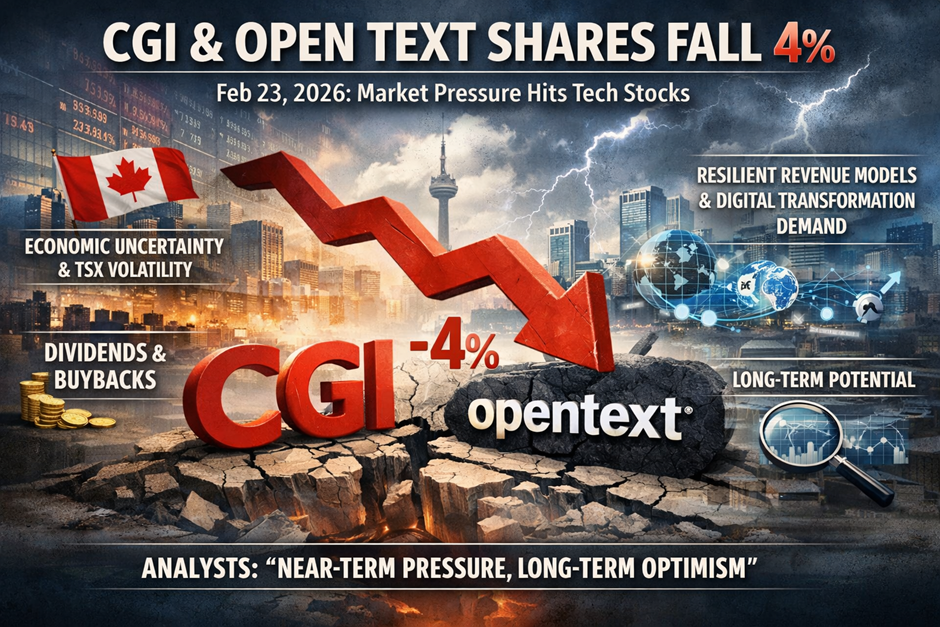
- CGI and Open Text shares fell approximately 4% on 23 February 2026 primarily due to macroeconomic and sector-wide pressures rather than company-specific deterioration.
• Canada economic uncertainty, interest rate expectations, and TSX Composite volatility are influencing investor sentiment toward technology stocks.
• Both companies maintain resilient recurring revenue models, strong enterprise demand exposure, and long-term digital transformation tailwinds.
• Open Text continues to provide dividend income potential, while CGI focuses on share buybacks and acquisitions for capital returns.
• Analysts remain broadly constructive long term despite near-term valuation sensitivity and macro risks.
Source: Kalkine Group
Why Are CGI and Open Text Stocks Falling Despite Strong Long-Term Technology Demand in February 2026?
CGI stock, Open Text stock, TSX tech stocks, Canada technology sector outlook 2026, TSX Composite analysis, CAD currency forecast, enterprise software growth, AI adoption trends, and digital transformation demand are among the most searched investment topics globally — and the recent 4% decline in both stocks on 23 February 2026 has intensified investor curiosity.
The pullback appears largely linked to global market dynamics rather than deterioration in company fundamentals. February 2026 has seen heightened volatility across global equities, particularly growth-oriented technology companies, as investors reassess interest rate expectations, inflation trajectories, and economic growth outlooks.
Technology stocks, especially those with international revenue exposure like CGI and Open Text, often react strongly to changes in bond yields and currency movements. As a result, even fundamentally strong companies can experience short-term price weakness during periods of macro uncertainty.
Could Canada’s Economic Outlook and TSX Composite Volatility Be Pressuring Technology Stocks?
Canada’s macroeconomic environment in early 2026 is characterized by mixed signals:
- Moderating economic growth expectations
• Inflation remaining above central bank comfort levels
• Uncertainty regarding the timing of interest rate cuts
• Global trade and geopolitical risks affecting sentiment
The TSX Composite Index has experienced fluctuations as investors rotate between sectors, with financials, energy, and defensive industries sometimes outperforming technology during uncertain periods.
Higher interest rates typically reduce valuation multiples for growth companies because future earnings are discounted more heavily. This dynamic has contributed to the short-term weakness seen in Canadian technology stocks.
How Is the Canadian Dollar Influencing Investor Sentiment Toward CGI and Open Text?
Both companies generate significant revenue internationally, particularly in the United States and Europe.
Currency movements affect:
- Reported earnings translation
• Revenue growth visibility
• Profit margin expectations
• Investor risk perception
Volatility in the Canadian dollar relative to the U.S. dollar can therefore create additional uncertainty, influencing short-term share price movements even when operational performance remains stable.
What Are the Latest Business Fundamentals Supporting Long-Term Confidence?
CGI Operational Strength
CGI operates one of the largest IT consulting and outsourcing businesses globally, serving governments, financial institutions, healthcare providers, and telecommunications companies.
Key strengths include:
- Long-term client contracts and strong backlog visibility (company filings)
• High client retention rates
• Consistent margin discipline
• Strong free cash flow generation supporting acquisitions and buybacks
CGI’s strategy emphasizes disciplined growth, operational efficiency, and shareholder returns through capital allocation rather than dividends.
Open Text Operational Strength
Open Text focuses on enterprise information management, cybersecurity, cloud platforms, and AI-driven data solutions.
Recent operational themes include:
- Recurring subscription and cloud revenue expansion (company disclosures)
• Integration progress from past acquisitions
• Enterprise demand stability
• Cost optimization initiatives
Open Text provides dividend income supported by recurring cash flow, making it attractive for income-oriented investors seeking exposure to technology.
How Do Global Industry Trends Support Future Growth Potential?
The long-term outlook for enterprise technology remains supported by powerful structural drivers:
- Artificial intelligence adoption across industries
• Cloud computing migration
• Cybersecurity investment growth
• Automation and digital workflows
• Government IT modernization spending
• Data analytics and compliance requirements
These trends provide multi-year demand visibility for both CGI and Open Text.
How Do CGI and Open Text Compare With Global Peers?
Compared with global competitors such as Accenture, IBM, SAP, and ServiceNow:
CGI Competitive Position
- Strong operating margins relative to IT services peers
• Conservative financial management
• Government contract exposure offering stability
Open Text Competitive Position
- High recurring revenue proportion
• Mission-critical enterprise software positioning
• Dividend yield advantage versus many software companies
However, Canadian tech stocks sometimes trade at valuation discounts compared with U.S. peers due to perceived growth differentials and market size factors.
What Is the Outlook for the Technology Sector Across Different Time Horizons?
Short-Term Outlook (3–6 Months)
- Continued volatility possible due to macro uncertainty
• Interest rate expectations influencing valuations
• Earnings announcements acting as catalysts
Medium-Term Outlook (6–18 Months)
- Potential stabilization as monetary policy clarity improves
• Enterprise spending normalization
• Margin improvement from efficiency initiatives
Long-Term Outlook (2–5 Years)
- Structural digital transformation demand remains intact
• AI monetization opportunities expanding
• Recurring revenue models supporting resilience
What Forward-Looking Strategies Could Investors Consider?
Short-Term Considerations
- Monitoring macroeconomic indicators and interest rate signals
• Watching earnings guidance and sector sentiment
• Evaluating volatility-driven valuation changes
Medium-Term Considerations
- Assessing integration execution and cost efficiencies
• Tracking enterprise IT spending cycles
• Monitoring competitive positioning in AI and cloud markets
Long-Term Considerations
- Evaluating recurring revenue durability
• Dividend sustainability (Open Text)
• Market share expansion opportunities
Are CGI and Open Text Stocks Bullish, Bearish, or Neutral Based on Current Conditions?
Short-Term View
- Neutral to mildly bearish due to macro uncertainty and sector rotation
Long-Term View
- Moderately bullish based on structural growth drivers, resilient business models, and cash flow generation
Short-term volatility does not necessarily contradict long-term growth potential.
What Do Analysts and Brokers Indicate About Valuation and Forecasts?
Consensus expectations from major financial institutions indicate:
CGI
- Predominantly positive ratings such as Buy or Outperform
• Stable earnings growth outlook
• Confidence in long-term margin expansion
Open Text
- Mixed Buy and Hold ratings
• Focus on debt reduction and acquisition integration
• Dividend attractiveness supporting valuation
(Sources: Bloomberg consensus, Reuters analyst data, broker research reports)
Scenario Analysis Matrix
Bull Scenario
- Accelerating enterprise technology spending
• Successful AI product monetization
• Margin expansion through efficiency programs
• Interest rate cuts improving valuations
Base Scenario
- Stable revenue growth
• Recurring revenue resilience
• Gradual valuation normalization
Bear Scenario
- Economic slowdown reducing IT budgets
• Integration execution challenges
• Currency volatility
• Persistently high interest rates
What Key Risks Should Investors Monitor?
- Global economic slowdown
• Enterprise IT spending reductions
• Currency fluctuations
• Competitive pressure from large technology firms
• Integration and debt management risks (Open Text)
• Interest rate sensitivity
Frequently Asked Questions
Why did CGI and Open Text stocks fall in February 2026?
The decline appears primarily driven by macroeconomic volatility, interest rate expectations, and sector-wide technology weakness rather than company-specific problems.
Do both companies pay dividends?
Open Text pays a dividend supported by recurring cash flow, while CGI focuses on share repurchases and acquisitions.
Are Canadian technology stocks attractive long term?
Structural trends such as AI adoption, cloud migration, and cybersecurity spending support long-term growth potential, though short-term volatility can occur.
What factors could drive future upside?
Improved economic conditions, interest rate cuts, enterprise IT spending growth, and successful execution of company strategies could support performance.
What Is the Overall Investment Conclusion Based on Current Data?
CGI and Open Text remain fundamentally solid Canadian technology companies with durable enterprise demand exposure and long-term structural growth drivers. The February 2026 share price decline appears primarily sentiment-driven rather than evidence of operational weakness.
While macroeconomic uncertainty may continue to create volatility in the short term, long-term industry tailwinds — including artificial intelligence adoption, cloud computing expansion, and digital modernization — remain supportive for both companies.
For investors evaluating TSX technology stocks, the key consideration is balancing short-term macro risks against long-term structural growth potential and valuation opportunities.


 Jun 24, 2026




 Please wait processing your request...