
 AU
AU
 UK
UK
 US
US
 NZ
NZ
 IND
IND

 CA
CA

 Share
Share
 X (Formerly Twitter)
 Whatsapp
 Facebook
 LinkedIn
 Telegram
 Email This Article
 Copy Link
 Summarize with AI
 Chat GPT
 Perplexity
As the bedrock of the Canadian economy, the "Big Five" banks listed on the TSX - Royal Bank of Canada, TD Bank, BMO, Scotiabank, and CIBC - have historically served as reliable anchors for income-focused portfolios. In 2026, these institutions are navigating a complex intersection of easing monetary policies, shifting trade dynamics under new North American agreements, and a surge in digital transformation.
Despite broader economic headwinds, their fortress-like balance sheets and centuries-old track records of consistent dividend distributions continue to draw significant attention from domestic and international market participants seeking defensive positioning in a volatile global landscape.
Latest Drivers and Performance Surge

Source: Kalkine Group
The 2026 surge in Canadian financial stocks is primarily fueled by a stabilization in the interest rate environment. As the Bank of Canada and the U.S. Federal Reserve transitioned toward a neutral rate stance, the extreme pressure on mortgage renewals began to ease.
- Lower Credit Stress: Improved consumer sentiment and a cooling of the "mortgage cliff" anxiety have led to a stabilization in Provisions for Credit Losses (PCLs).
- Capital Markets Rebound: A resurgence in Mergers and Acquisitions (M&A) and initial public offerings (IPOs) has significantly boosted non-interest income for banks with large capital market arms, particularly RBC and BMO.
- Operational Efficiency: Aggressive cost-cutting measures and AI-driven automation implemented throughout 2025 are now materializing in improved efficiency ratios.
- Strategic Buybacks: Massive share repurchase programs—notably TD's $7 billion authorization—have tightened share counts and supported per-share earnings growth (TD Bank News Release, Jan 2026).
Current Business Models: A North American Hybrid
The Big Five have evolved beyond traditional domestic lending. Their 2026 business models are diversified across three key pillars:
- Personal & Commercial Banking: The bread-and-butter domestic segment, now heavily integrated with digital "super-apps" to capture younger demographics and gig-economy workers.
- Wealth Management & Insurance: A critical growth engine providing fee-based, recurring revenue that is less sensitive to interest rate fluctuations. RBC and BMO have notably expanded this footprint in the U.S.
- Capital Markets & Corporate Banking: Focused on global trading, advisory, and lending. This segment allows these banks to compete on a global stage, particularly in the U.S. and European markets.
Latest Financial, Operational, and Dividend Updates
Royal Bank of Canada (RY)
- Financials: Reported a record annual net income of $20.4 billion for fiscal 2025, a 25% year-over-year increase (RBC 2025 Annual Report).
- Dividends: Raised its quarterly dividend by 6% to $1.64 per share, payable in February 2026 (RBC Press Release, Dec 2025).
- Operations: Revised its ROE target to 17%+ for 2026, citing enhanced revenue productivity from its recent HSBC Canada acquisition.
Toronto-Dominion Bank (TD)
- Dividends: Transitioned to a semi-annual dividend review cycle to better align with earnings. Declared a dividend of $1.08 per share for the quarter ending Jan 2026 (TD News, Dec 2025).
- Operations: Launched a $7 billion share buyback program and redeemed $1.25 billion in subordinated notes to optimize its capital structure (TD Shareholder Update, Jan 2026).
Bank of Montreal (BMO)
- Financials: Saw a 30% adjusted earnings growth in its Wealth Management and Capital Markets segments during 2025 (Morningstar/BMO Filings).
- Dividends: Increased its quarterly dividend to $1.67 per share, marking a 5% increase over the prior year (BMO Financial Group, Dec 2025).
Bank of Nova Scotia (BNS)
- Financials: Completed the divestiture of non-core operations in Central America (Colombia, Costa Rica, Panama) to sharpen focus on the North American corridor (BNS Operational Update, Dec 2025).
- Dividends: Maintaining a quarterly dividend of $1.10 per share, offering one of the highest yields in the peer group at approximately 4.3% (Scotiabank Investor Relations, Jan 2026).
Canadian Imperial Bank of Commerce (CIBC)
- Dividends: Announced a significant $0.10 increase in its quarterly dividend to $1.07 per share for the quarter ending January 31, 2026 (CIBC Dividend Declaration, Dec 2025).
- Operations: Expanding digital reach into rural areas and prioritizing sustainable finance initiatives, targeting a larger share of the green bond market (CIBC Media Centre).
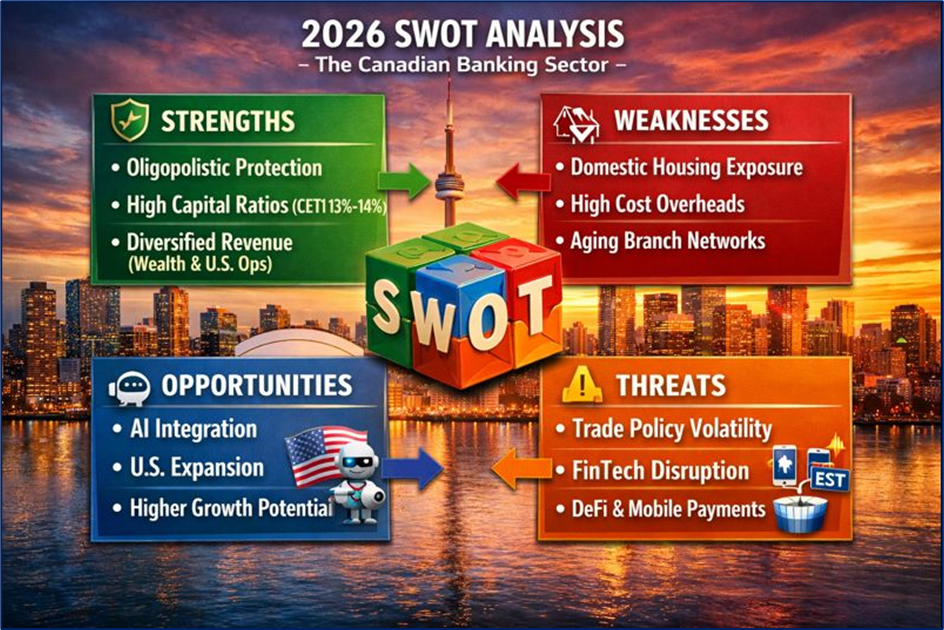
2026 SWOT Analysis: The Canadian Banking Sector
Source: Kalkine Group
Strengths
- Oligopolistic Protection: Limited competition within Canada provides a stable "moat" and consistent pricing power.
- High Capital Ratios: CET1 ratios across the Big Five remain well above regulatory requirements (averaging 13%–14%), providing a buffer against shocks.
- Diversified Revenue: Significant income from wealth management and U.S. operations offsets domestic slowdowns.
Weaknesses
- Domestic Concentration: High exposure to the Canadian housing market remains a structural vulnerability if unemployment rises.
- Cost Overheads: Maintaining massive physical branch networks is increasingly expensive compared to digital-only challengers.
Opportunities
- AI Integration: Implementing generative AI for personalized wealth advice and automated risk underwriting to drive efficiency.
- U.S. Expansion: Capitalizing on higher growth rates and larger market volumes south of the border.
Threats
- Trade Policy Volatility: Potential shifts in the Canada-United States-Mexico Agreement (CUSMA) could impact corporate lending and cross-border trade.
- FinTech Disruption: Rapidly evolving decentralized finance (DeFi) and mobile-first payment platforms are nibbling at traditional retail market share.
Outlook and Emerging Risks
The outlook for the TSX Big Five for the remainder of 2026 is cautiously optimistic. While the "hard landing" for the economy appears to have been avoided, banks are preparing for a year of "normalized" growth.
- The Credit Quality Peak: Analysts expect loan impairments and PCLs to peak in the second half of 2026 before trending downward in 2027 (Morningstar DBRS Outlook, Jan 2026).
- Regulatory Landscape: The Office of the Superintendent of Financial Institutions (OSFI) is maintaining a close watch on household debt levels, which remain at historic highs (OSFI Risk Outlook 2025-2026).
- Geopolitical Pressure: Rising global trade tensions and the "remilitarization" of global economies are forcing banks to re-evaluate their international exposure and corporate lending portfolios.
Compelling Conclusion
In 2026, the Canadian Big Five stand as a testament to the endurance of disciplined, regulated financial models. While each bank follows a distinct strategic path—whether it be RBC’s dominance in capital markets, TD’s focus on capital efficiency, or Scotiabank’s North American refocus—they remain united by a common commitment to shareholder returns. As the global financial landscape shifts toward a new era of digital integration and geopolitical realignment, these TSX-listed giants continue to demonstrate why they are often considered the premier choice for stability and income in the North American financial sector.


 Jun 24, 2026




 Please wait processing your request...