
 AU
AU
 UK
UK
 US
US
 NZ
NZ
 IND
IND

 CA
CA

 Share
Share
 X (Formerly Twitter)
 Whatsapp
 Facebook
 LinkedIn
 Telegram
 Email This Article
 Copy Link
 Summarize with AI
 Chat GPT
 Perplexity
The Explosive Catalyst: U.S. Regulatory Firestorm
The jaw-dropping, single-day surge in Canopy Growth's stock—up an incredible 52% on the Toronto Stock Exchange (TSX: WEED)—was not a victory lap for recent earnings, but a seismic reaction to external forces: a game-changing regulatory news flash from the United States.
- The Unverified Report: Multiple, high-profile media outlets reported on Friday that the U.S. White House and the Department of Justice were on the cusp of a major policy shift regarding cannabis.
- The Big Plan: Rescheduling: The expected action involves moving marijuana from its current classification as a Schedule I drug (alongside substances with no accepted medical use and high abuse potential) to a Schedule III drug under the Controlled Substances Act (alongside substances like Tylenol with codeine).
Why This News Sent Cannabis Stocks Into Orbit
This shift, while NOT full federal legalization, is financially transformative for the entire North American cannabis sector.
- Tax Freedom (The $1 Billion Impact): The most critical immediate effect is the expected removal of IRS Section 280E. This arcane tax code currently forces U.S. cannabis companies to pay taxes on their gross income because they cannot deduct standard business expenses (like rent, salaries, and utilities).
- Overnight Profitability: Moving to Schedule III eliminates 280E, allowing U.S. operators to suddenly deduct their costs. This change could mean the difference between massive losses and immediate, substantial profitability for the entire industry.
- Banking Breakthrough: The reclassification could significantly reduce the legal risk for large financial institutions, potentially opening up easier access to loans, standard banking services, and credit for companies currently operating largely as cash businesses.
- The Global Domino Effect: For Canadian LPs like Canopy Growth, which have been patiently waiting to enter the lucrative U.S. market, this news signals that the regulatory floodgates may finally be creaking open.

Source: Kalkine Group
Decoded: Canopy Growth's Business Model & Strategy Pivot
Canopy Growth, once the standard-bearer for aggressive cannabis expansion, has dramatically restructured its strategy, focusing on financial stability and U.S. preparedness.
1. The Asset-Light, Profit-Focused Model
The company has pivoted sharply away from its original "cultivate and conquer" approach to an "asset-light" strategy aimed squarely at achieving positive cash flow.
- Cost Rationalization: Canopy has aggressively reduced its manufacturing footprint, streamlined its workforce, and sold off non-core assets to conserve capital.
- Focus on High-Margin Segments: The strategy concentrates resources on its most profitable Canadian segments, including premium adult-use brands and the specialized medical cannabis market, where margins are stronger.
- The EBITDA Race: The overarching goal is to hit positive Adjusted EBITDA (a key measure of operating profitability) by demonstrating discipline over growth volume.
2. The Canopy USA Power Play
Canopy's most potent weapon and the core reason for its outsized rally is its sophisticated structure designed specifically for this moment: Canopy USA, LLC.
- Strategic Holdings: This non-consolidated entity holds the company's rights to major U.S. cannabis assets, including its rights to acquire Acreage Holdings, Inc. and other U.S. operators upon a qualifying federal change.
- The Trigger Event: The anticipated Schedule III reclassification makes the company's predefined "Triggering Event" for these U.S. acquisitions seem imminent. Canopy is positioned to immediately become a major multi-state U.S. operator the moment federal regulations permit it, making it the highest-leverage stock for this regulatory bet.
The Financial Reality: Fundamentals vs. Hype
While the stock chart is exhilarating, it is crucial to separate the speculative excitement from the current underlying financial health of the company. The 52% surge is a bet on the future, not a reflection of current performance.
- Persisting Negative Profitability: Canopy Growth still struggles with massive net losses and negative cash flow. The company has historically incinerated cash to fund its expansion.
- The Debt Load: Despite recent improvements, the company still maintains a high debt-to-equity ratio, which places ongoing pressure on its balance sheet and liquidity.
- Dilution Risk: To shore up finances and fund operations, the company has had to resort to capital raises, which often involve issuing new shares and diluting the value of existing shareholders.
The Critical Risks: What Could Stop the Rally?
This rally is built on the potential for regulatory change, which carries its own unique set of risks that investors must acknowledge.
- Execution Risk: The Schedule III reclassification is not yet finalized. Bureaucratic delays, political resistance, or unexpected changes to the final rule could stall the process, leading to a massive correction in the stock price.
- State vs. Federal Conflict: Even under Schedule III, cannabis remains illegal at the federal level. This continued federal-state conflict will keep the industry complex, expensive, and subject to intense scrutiny.
- Competitive Landscape: When the U.S. market opens up, Canopy will face brutal competition, not only from established U.S. multi-state operators (MSOs) but potentially from cash-rich, non-cannabis giants (alcohol, tobacco) looking to enter the market.
- Uncertainty of Acquisitions: The value of the U.S. assets Canopy has rights to (via Canopy USA) depends heavily on the structure and timing of the final deal, which may not be as simple as an immediate takeover.
The Takeaway: A High-Stakes Regulatory Bet
Canopy Growth's dramatic rise is the market's way of saying it believes the U.S. is about to fundamentally change the financial landscape for cannabis. The stock is currently serving as the ultimate high-leverage proxy for federal reform. Investors piling into WEED are explicitly betting on the successful and timely implementation of the Schedule III designation, with its transformative tax benefits. This makes it a volatile, high-risk, high-reward situation driven by macro politics rather than incremental business improvements.
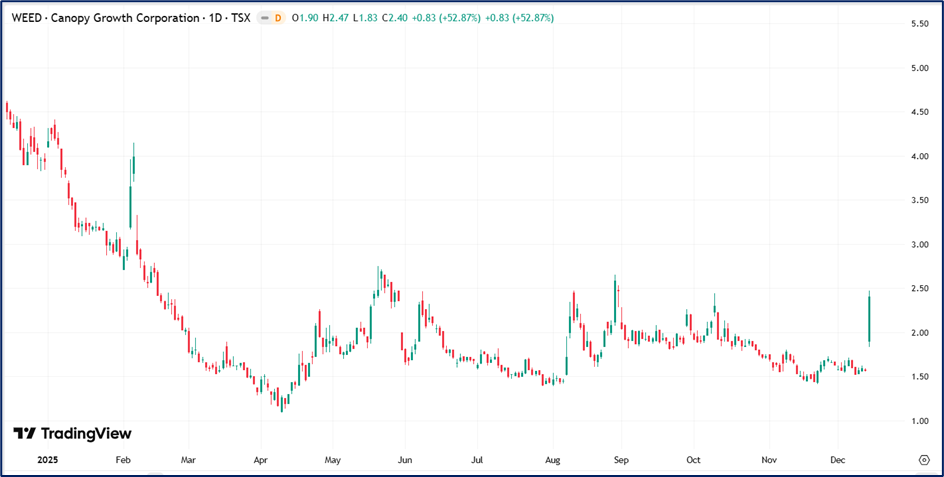
Source: Trading View, 12 December 2025


 Jun 24, 2026




 Please wait processing your request...