
 AU
AU
 UK
UK
 US
US
 NZ
NZ
 IND
IND

 CA
CA

 Share
Share
 X (Formerly Twitter)
 Whatsapp
 Facebook
 LinkedIn
 Telegram
 Email This Article
 Copy Link
 Summarize with AI
 Chat GPT
 Perplexity
Canadian equities faced a decisive risk-off moment on Thursday, 5 February 2026, as the S&P/TSX Composite Index suffered its steepest single-day percentage decline in recent sessions. The index fell 1.77% to 31,994.60, snapping a short-term winning streak and reigniting concerns about volatility, global macro pressure, and commodity-linked fragility.
This move was not isolated—it reflected global equity weakness, collapsing precious metals prices, and a resurgent U.S. dollar, all of which disproportionately affect Canada’s resource-heavy market structure.
What Triggered the TSX Composite’s -1.77% Drop on 5 February 2026?
The sell-off was driven by a confluence of macro, currency, and sector-specific shocks, rather than a single catalyst.
Primary Market Drivers
- Silver prices collapsed ~17%, while gold slid sharply, triggering a rout across precious-metal equities.
- U.S. dollar strength pressured commodity pricing and reduced CAD-denominated earnings leverage.
- Wall Street declines, led by tech selling and risk-off positioning, spilled into Canadian markets.
- Investor caution intensified amid U.S. earnings uncertainty, economic data risk, and renewed debate around AI capital expenditure sustainability.
Together, these forces created a textbook risk-off trading session for Canadian equities.
Which TSX Sectors Managed to Close Higher Despite the Sell-Off?
Only a narrow slice of the market escaped the downturn.
Sectors Ending in the Green
- Technology – lifted by selective stock-specific strength and relative insulation from commodity volatility.
Sectors Leading the Declines
- Materials – hardest hit as gold and silver prices collapsed.
- Energy – pressured by softer oil prices and broader commodity weakness.
- Financials – dragged lower by equity-market volatility and sentiment deterioration.
The session underscored how materials and energy dominance amplifies downside risk for the TSX during commodity shocks.
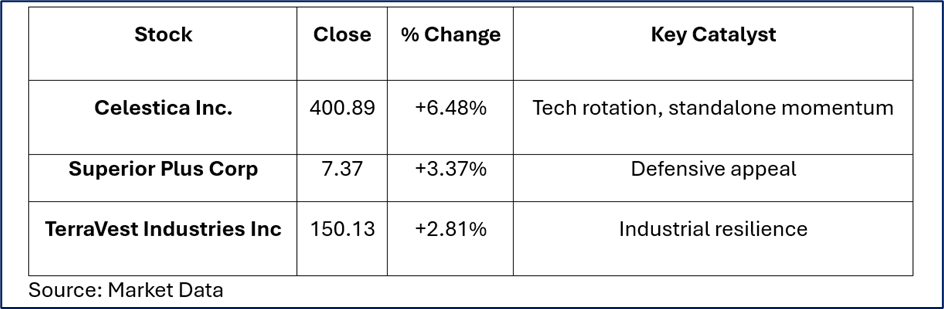
Who Were the Top-Performing TSX Stocks on 5 February 2026?
Despite broad selling, several names posted meaningful gains due to sector rotation and defensive positioning.
Top TSX Gainers (CAD)
Which TSX Stocks Suffered the Largest Losses?
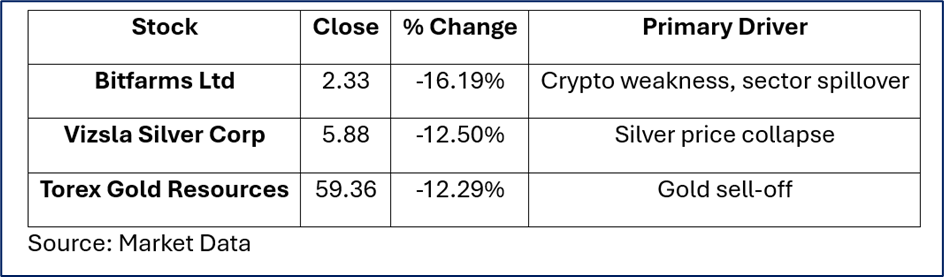
Losses were heavily concentrated in crypto-linked and precious-metal equities.
Biggest TSX Losers (CAD)
What Macro and Global Forces Defined Trading Conditions?
Global Market Backdrop
- Major U.S. indices (Dow, S&P 500, Nasdaq) closed lower.
- Global equities reflected risk-off positioning and declining growth confidence.
- Precious metals were hit by USD strength and liquidation flows.
Currency Impact
- A stronger USD vs CAD compressed commodity valuations.
- Currency moves amplified downside pressure on export- and resource-linked TSX stocks.
Commodities
- Oil prices weakened, dragging energy equities.
- Metals volatility dominated Canadian market performance.
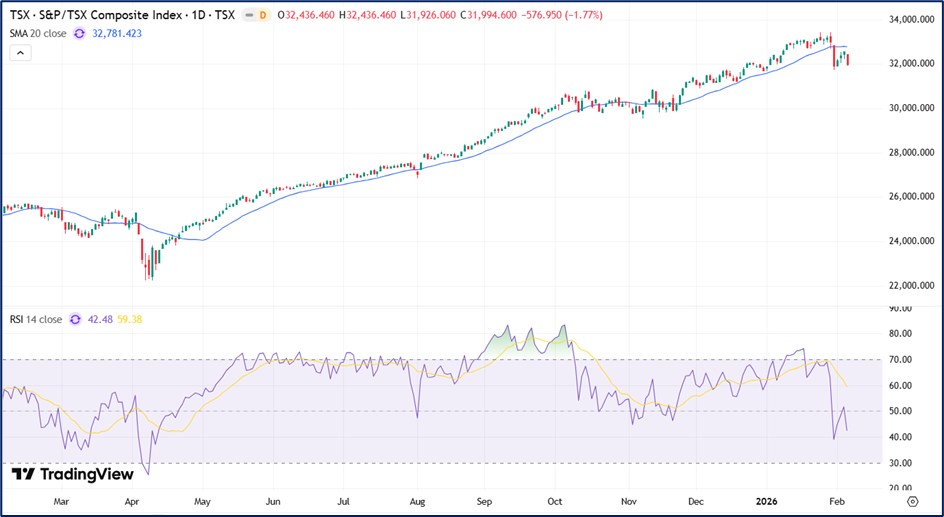
What Does the Technical Picture Show After the TSX Drop?
Source: Trading View
Technical Analysis Snapshot (as of 5 Feb 2026)
- The TSX Composite broke short-term technical support after early-week gains.
- Volatility indicators (TSX-linked VIX) moved higher.
- Momentum indicators flipped decisively bearish, signalling near-term instability.
Bull vs Bear Scenarios for the TSX Composite
Bull Case
- Stabilisation or rebound in oil and metals.
- Strong earnings from banks and technology leaders.
- Improved global risk appetite.
Bear Case
- Prolonged precious-metals weakness.
- Continued U.S. equity market pressure.
- Sustained USD strength weighing on commodities and CAD assets.
TSX Market Outlook: What Comes Next?
Short Term (1–4 Weeks)
- Elevated volatility likely to persist.
- Key support zone: 31,800–31,900.
Medium Term (1–6 Months)
- Sector rotation opportunities if commodities stabilise.
- Earnings season becomes the primary directional catalyst.
Long Term (6+ Months)
- Structural support from energy and financials.
- Performance tied to global growth and commodity cycles.
What Strategies Should Investors Consider Now?
Short-Term Traders
- Prioritise risk management and hedging.
- Focus on relative-strength names and defensives.
Medium-Term Investors
- Selective positioning in financials and technology.
- Monitor earnings and macro inflection points.
Long-Term Allocators
- Maintain sector diversification.
- Accumulate high-quality Canadian equities during volatility.
Analyst & Broker Sentiment (As of 5 Feb 2026)
- Broad analyst interest in materials and financials for potential rebound value.
- Stock-specific targets remain dynamic ahead of earnings updates.
Frequently Asked Questions (SEO-Optimised)
Q: Why did the TSX fall sharply on 5 February 2026?
A: A collapse in precious metals, a stronger U.S. dollar, and global equity weakness triggered risk-off selling.
Q: Which TSX sector outperformed?
A: Technology was the only sector to close higher.
Q: Is TSX volatility likely to continue?
A: Yes—near-term volatility remains elevated, with direction tied to commodities and earnings.
Final Takeaway
The 1.77% plunge in the S&P/TSX Composite Index on 5 February 2026 marked a clear shift toward risk-off sentiment, driven by commodity shocks, currency pressure, and global equity weakness. While isolated tech and defensive names showed resilience, the broader Canadian market remains sensitive to metals prices, oil trends, and U.S. macro signals.
Short-term caution is warranted—but for medium- and long-term investors, volatility may also be creating selective entry opportunities as markets recalibrate.


 Jun 24, 2026




 Please wait processing your request...