
 AU
AU
 UK
UK
 US
US
 NZ
NZ
 IND
IND

 CA
CA

 Share
Share
 X (Formerly Twitter)
 Whatsapp
 Facebook
 LinkedIn
 Telegram
 Email This Article
 Copy Link
 Summarize with AI
 Chat GPT
 Perplexity
Key Takeaways (Latest — March 2026)
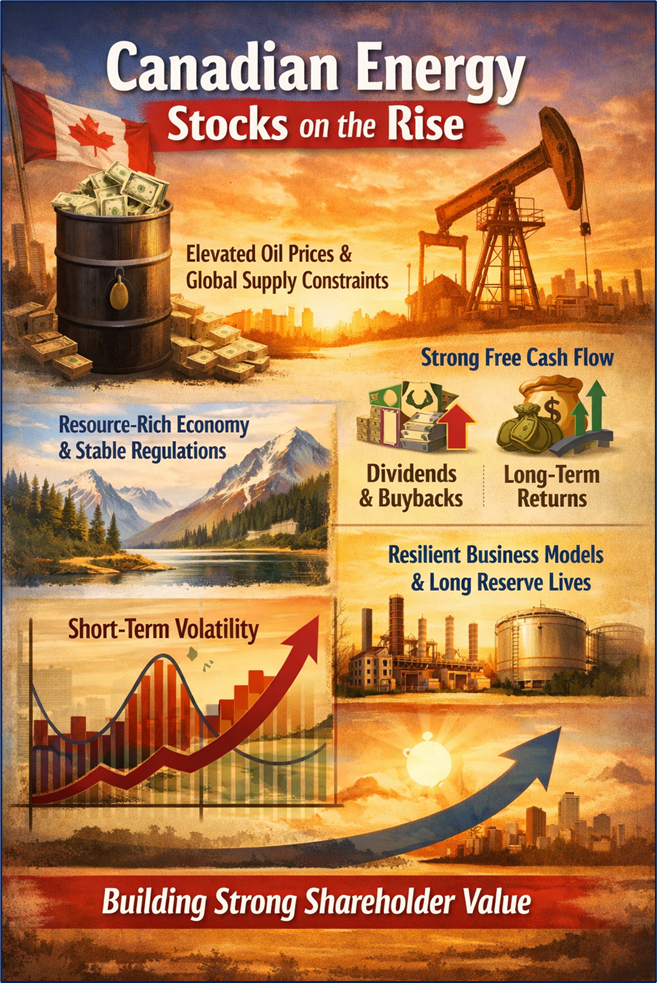
- Canadian energy stocks remain among the strongest sectors on the TSX due to elevated crude oil prices and global supply constraints
• Strong free cash flow generation supports dividend growth, share buybacks, and long-term shareholder returns
• Canada’s resource-driven economy and stable regulatory environment strengthen investment confidence
• Both companies analyzed have resilient business models and long reserve lives
• Short-term volatility possible, but medium- and long-term outlook remains structurally positive
Source: Kalkine Group
Why Are TSX Energy Stocks Dominating Investor Attention in March 2026?
The global investment landscape in March 2026 has seen a major resurgence of interest in TSX energy stocks, Canadian oil companies, dividend-paying commodity stocks, passive income investments, inflation hedge equities, and high free cash flow businesses. Investors across North America, Europe, and Asia are increasingly searching for opportunities in Canada’s energy sector due to strong oil price fundamentals, geopolitical supply uncertainty, and persistent global energy demand growth.
The TSX Composite Index continues to benefit from its heavy exposure to natural resources, banking, and energy companies. Compared to many global indices, Canada’s stock market has demonstrated resilience during periods of inflation and interest rate volatility because commodity producers often benefit from rising prices.
From a macroeconomic standpoint, the Canadian economy remains closely tied to energy exports. Higher oil prices improve trade balances, strengthen fiscal revenues, and support corporate earnings across the energy sector. Meanwhile, the Canadian dollar (CAD) maintains a partial correlation with oil prices, creating an additional tailwind for international investors allocating capital into Canadian equities.
This environment creates a compelling case for investors looking for best TSX dividend stocks in 2026, high-yield energy stocks, long-term commodity exposure, and capital appreciation potential.
Which 2 TSX Energy Stocks Stand Out as Potential Buys in March 2026?
Two large-cap Canadian energy leaders continue to attract strong investor attention:
Both companies operate large-scale oil sands assets, generate significant free cash flow, and maintain shareholder-friendly capital allocation strategies focused on dividends and buybacks.
What Makes Suncor Energy a Compelling Investment Opportunity in 2026?
Suncor Energy operates a diversified and integrated energy model that includes upstream production, refining operations, and fuel distribution networks. This integration provides earnings stability across commodity cycles.
Recent operational and financial highlights include:
- Improved operational reliability and efficiency initiatives (Company filings and investor updates)
• Strong refining margins supporting profitability during oil price fluctuations
• Continued share repurchase programs returning capital to shareholders
• Sustainable dividend supported by robust free cash flow
The integrated structure reduces risk compared to pure exploration companies, making Suncor attractive for investors seeking stable dividends with cyclical upside potential.
Future Dividend Outlook
Suncor’s dividend capacity remains supported by strong operating cash flow and disciplined capital spending. If oil prices remain favorable, additional dividend growth and buybacks remain likely over the coming years.
Why Is Canadian Natural Resources Viewed as a Long-Term Dividend Leader?
Canadian Natural Resources is widely considered one of the highest-quality oil producers globally due to its large reserve base, low production costs, and operational scale.
Key strengths include:
- Industry-leading low breakeven costs across multiple production assets
• Long-life reserves providing decades of production visibility
• Consistent free cash flow generation across commodity cycles
• Proven dividend growth history with multiple increases over time (Company disclosures)
The company’s disciplined approach to capital allocation and debt management has positioned it as a core holding for dividend-focused investors.
Future Dividend Outlook
Canadian Natural Resources has demonstrated a strong commitment to increasing dividends when financial conditions allow, supported by predictable cash flows and efficient operations.
How Are Global Oil Market Dynamics Shaping the Energy Sector in 2026?
Several structural drivers continue to support oil markets:
- OPEC+ supply management strategies
• Underinvestment in global exploration projects over the past decade
• Growing energy demand from emerging economies
• Geopolitical supply risks and regional conflicts
• Declining spare production capacity globally
These dynamics create a favorable long-term pricing environment for large, low-cost producers such as Canadian oil sands companies.
How Does the Canadian Economy and TSX Composite Influence Energy Stock Performance?
Canada’s economic performance is closely connected to natural resource exports. Energy sector strength contributes to:
- Government revenues and fiscal stability
• Employment growth across provinces
• Corporate earnings expansion
• Currency stability and capital inflows
Because of this relationship, the TSX often performs strongly during commodity upcycles, with energy companies acting as major index drivers.
How Do These Companies Compare With Global Energy Peers?
Compared with international oil majors, Canadian producers offer several advantages:
- Competitive dividend yields
• Large proven reserves with long production life
• Political stability compared with emerging-market producers
• Strong environmental regulatory frameworks
• Attractive valuations relative to cash flow generation
These factors attract institutional investors seeking diversified global energy exposure.
What Is the Outlook for the Energy Sector Across Time Horizons?
Short-Term Outlook (3–6 Months)
Oil price volatility driven by macroeconomic data, interest rates, and geopolitical developments may influence share prices. Overall sentiment remains neutral to moderately positive.
Medium-Term Outlook
Strong free cash flow, disciplined capital allocation, and shareholder returns support a bullish outlook for the sector.
Long-Term Outlook
Despite energy transition narratives, global oil demand is expected to remain substantial for decades, supporting long-term profitability for large producers.
What Forward-Looking Strategies Could Investors Consider?
Short-Term Perspective
• Monitor oil price trends and macroeconomic indicators
• Observe earnings releases for operational catalysts
• Evaluate dividend capture opportunities
Medium-Term Perspective
• Accumulate positions during market volatility
• Reinvest dividends for compounding returns
• Track capital allocation and debt reduction progress
Long-Term Perspective
• Focus on dividend growth and income generation
• Benefit from commodity cycle expansion
• Use energy exposure as an inflation hedge within diversified portfolios
Are These Stocks Bullish, Bearish, or Neutral Based on Current Conditions?
Suncor Energy
Short term: Neutral due to commodity price sensitivity
Long term: Bullish due to integration and capital returns
Canadian Natural Resources
Short term: Moderately bullish based on fundamentals
Long term: Strong bullish outlook due to reserves and cost advantages
What Are the Latest Drivers Behind Recent Energy Stock Performance?
- Elevated crude oil prices and strong demand outlook
• Significant free cash flow generation
• Share buyback programs reducing share count
• Dividend increases attracting income investors
• Institutional capital rotation into commodity sectors
What Do Analysts and Brokers Forecast for These Stocks?
Based on consensus estimates from major financial institutions such as RBC Capital Markets, TD Securities, BMO Capital Markets, Scotiabank, and CIBC:
Suncor Energy
• Consensus rating: Buy / Outperform
• Estimated valuation range: Approximately CAD 50–65 (Analyst consensus reports 2026)
Canadian Natural Resources
• Consensus rating: Buy / Strong Buy
• Estimated valuation range: Approximately CAD 95–115 (Broker consensus reports 2026)
Analysts highlight strong free cash flow yields, disciplined capital allocation, and dividend growth potential as primary valuation drivers.
What Risks Could Impact Investment Outcomes?
- Commodity price volatility
• Environmental and regulatory policy changes
• Carbon transition uncertainties
• Operational disruptions or cost inflation
• Currency fluctuations and global recession risks
What Does the Bull vs Bear Scenario Analysis Look Like?
Bull Scenario
• Sustained high oil prices
• Accelerated dividend growth and buybacks
• Strong global demand environment
• Improved profitability margins
Base Scenario
• Stable commodity prices
• Consistent production levels
• Moderate dividend increases
Bear Scenario
• Oil price decline due to economic slowdown
• Regulatory pressures increasing costs
• Margin compression from inflation
Frequently Asked Questions (FAQ Schema Style)
What makes Canadian energy stocks attractive in 2026?
Strong dividends, global energy demand growth, and favorable commodity pricing.
Are oil stocks suitable for long-term investing?
Large producers with strong reserves and cash flows can offer long-term income and growth potential.
How do oil prices affect dividends?
Higher oil prices typically increase cash flow, enabling dividend growth and share buybacks.
Is the TSX energy sector expected to grow?
The sector outlook remains positive due to structural supply constraints and ongoing demand.
Final Investment Perspective (Informational Only — No Advice)
Suncor Energy and Canadian Natural Resources represent two of the most financially robust and strategically positioned companies within the Canadian energy sector as of March 2026. Their combination of strong free cash flow generation, disciplined capital allocation, shareholder returns, and long-life reserves positions them favorably within the global energy landscape.
While short-term volatility remains inherent in commodity-linked sectors, the medium- and long-term structural outlook for large-scale oil producers remains supported by persistent energy demand and supply limitations.
For investors focused on dividend income, inflation protection, and commodity exposure, these companies continue to attract significant attention within diversified portfolios.


 Jun 24, 2026




 Please wait processing your request...