
 AU
AU
 UK
UK
 US
US
 NZ
NZ
 IND
IND

 CA
CA

 Share
Share
 X (Formerly Twitter)
 Whatsapp
 Facebook
 LinkedIn
 Telegram
 Email This Article
 Copy Link
 Summarize with AI
 Chat GPT
 Perplexity
_02_10_2026_15_41_30_137971.jpg)
Dividend-paying gold miners are increasingly scarce in today’s capital-intensive mining landscape. As macro uncertainty drives renewed interest in precious metals, investors are asking whether Alamos Gold could emerge as a dependable income-plus-growth option within the gold equity universe.
Is Alamos Gold (TSX: AGI) Stock Up in Early February 2026 and Beating the S&P/TSX Composite?
Alamos Gold (TSX: AGI) has delivered exceptional relative performance into early February 2026, significantly outperforming the TSX Composite on both a year-over-year total return basis and near-term price momentum.
AGI’s strong upside has been fuelled by:
- Sustained gold price strength
- Upward-revised production outlooks
- Expanding investor demand for defensive and real-asset equities
As of early February 2026, AGI’s 1-year trailing total returns exceed those of the TSX Composite by a wide margin, highlighting its role as a risk-off outperformer during periods of macroeconomic uncertainty.
This outperformance positions Alamos Gold as a compelling theme for trend-following investors seeking portfolio protection, inflation resilience, and long-term capital appreciation.
Why Has AGI Stock Shown Strong Price Momentum Recently?
AGI’s recent rally reflects a convergence of favourable commodity, operational, and valuation dynamics, including:
- Rising gold prices amid inflation and geopolitical uncertainty
- Expansion-driven production growth expectations through 2027–2030
- Portfolio re-rating as analysts model higher long-term output
Key projects, including the Island Gold expansion, underpin forecasts for higher volumes, improved margins, and lower unit costs over the next several years.
Historically, gold equities outperform when real interest rates decline, inflation expectations rise, or global risk appetite weakens—a macro backdrop that has remained supportive from late 2024 through early 2026.
What Is Alamos Gold’s Current Dividend Yield and Payout Trend?
Alamos Gold currently offers a modest but consistent dividend, with a forward yield of approximately 0.26% as of early February 2026, paid quarterly.
While the yield remains low relative to traditional income stocks, it reflects a capital-disciplined strategy:
- Dividends maintained without balance-sheet strain
- Priority placed on reinvestment, mine expansion, and long-term growth
- Optional upside for future dividend increases if free cash flow expands
AGI’s dividend profile is therefore best viewed as supplementary income, rather than a primary yield play.
How Do Global Macro Trends and Canada’s Economy Impact AGI Performance?
Global Market Drivers
Gold prices—and by extension gold equities—are highly sensitive to:
- Inflation expectations
- Central bank policy shifts
- Currency movements
- Geopolitical instability
These forces have remained constructive for gold into 2026.
Canadian Market Context
The TSX Composite is heavily weighted toward financials and resource stocks, making it particularly responsive to commodity cycles. Precious metals producers like AGI tend to outperform when gold prices rise relative to equities.
Currency Tailwinds
A stable or weakening Canadian dollar versus the US dollar often enhances margins for Canadian gold producers, as revenues are USD-linked while many costs remain CAD-denominated.
This currency dynamic has provided an additional earnings tailwind for AGI in early 2026.
Is the Gold Sector Strengthening in 2026?
The gold sector has entered a renewed uptrend, supported by:
- Sector rotation into defensive assets
- Safe-haven capital flows
- Improving production guidance across select miners
Alamos Gold stands out due to:
- Visible production growth into 2027
- Potential cost efficiency gains
- Lower geopolitical risk relative to peers
These factors enhance AGI’s competitive positioning within the global gold mining sector.
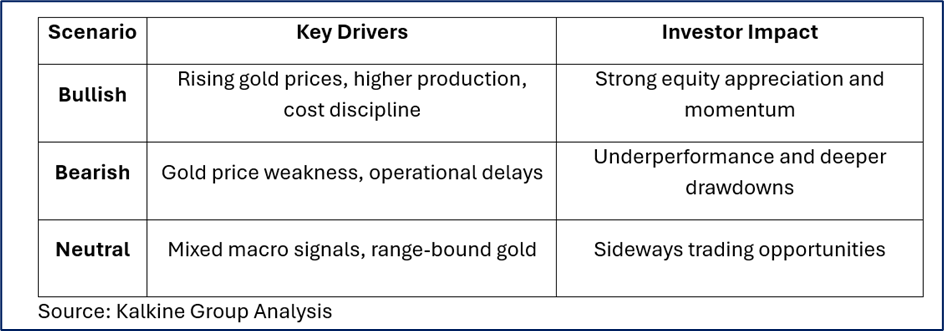
Is AGI Stock Bullish, Bearish, or Neutral in 2026?
Bullish Factors
- Production growth expected through 2028 with declining cost profiles
- Positive analyst sentiment and upward earnings revisions
- Gold’s continued relevance as an inflation hedge and portfolio diversifier
Bearish Factors
- Dividend yield remains modest for income-focused investors
- Elevated valuation multiples increase sensitivity to gold price pullbacks
Neutral Factors
- Execution risk balanced against favourable commodity pricing
- Near-term volatility offset by long-term structural growth
Bull vs Bear Scenario Matrix
Latest Analyst Ratings and Price Forecasts for AGI
- Majority Buy-leaning analyst consensus
- Average price targets above current trading levels (~C$64 range)
- Bull-case projections extending into the low-to-mid C$70s
- Downside estimates clustered around the mid-C$40s to mid-C$60s
Forecast dispersion reflects differing assumptions around gold prices, production execution, and sector sentiment.
Forward-Looking Strategy for Investors (Informational Only)
Short Term (3–6 Months)
- Track gold price trends and USD/CAD movements
- Monitor earnings releases and quarterly production updates
Medium Term (6–18 Months)
- Compare actual output versus guidance
- Watch inflation data, real rates, and sector rotation signals
Long Term (18+ Months)
- Evaluate execution of expansion projects into 2028–2030
- Assess long-term gold demand tied to monetary and geopolitical shifts
Frequently Asked Questions (SEO-Optimised)
Is Alamos Gold stock performing well in 2026?
Yes. AGI has significantly outperformed the TSX Composite on both a YTD and 1-year basis, driven by gold strength and growth expectations.
What is Alamos Gold’s dividend yield?
Approximately 0.26%, paid quarterly as of early February 2026.
What are analysts forecasting for AGI stock?
Consensus ratings skew positive, with average price targets above current market levels.
Final Investment Perspective (Informational Only)
Alamos Gold’s strong 2026 performance, visible production growth, and favourable gold-sector dynamics position it as a leading Canadian gold equity. While its dividend remains modest, AGI offers structural upside through earnings growth, operational expansion, and gold price leverage.
Investors should balance macroeconomic drivers, execution risk, and valuation sensitivity when assessing AGI’s role within a diversified portfolio.


 Jun 24, 2026




 Please wait processing your request...