
 AU
AU
 UK
UK
 US
US
 NZ
NZ
 IND
IND

 CA
CA

 Share
Share
 X (Formerly Twitter)
 Whatsapp
 Facebook
 LinkedIn
 Telegram
 Email This Article
 Copy Link
 Summarize with AI
 Chat GPT
 Perplexity
As global manufacturers accelerate automation, robotics, and digital transformation, ATS Corporation is emerging as one of Canada’s most closely watched industrial technology stocks. With strong momentum in early 2026, investors are asking a key question: Can ATS become a top-tier global automation play as manufacturing cycles recover?
Key Takeaways: ATS Corporation Stock Outlook (February 4, 2026)
- Why is ATS stock up ~7.5% in early February 2026?
The rally is driven by accelerating industrial automation demand, robust life sciences exposure, and renewed global manufacturing capex. ATS is significantly outperforming broader Canadian equity benchmarks. - Is ATS outperforming the TSX Composite in 2026?
Yes. ATS has delivered stronger recent monthly performance than the TSX Composite Index, reflecting sector-specific strength rather than broad market beta. - Macro & Canada economy impact:
Stabilizing inflation, recovering industrial investment, skilled-labour shortages, and favorable CAD dynamics are reinforcing the long-term automation thesis. - Bull vs Bear framework:
Structural automation demand and life sciences growth offset near-term risks tied to industrial capex pacing and macro uncertainty. - Analyst consensus:
Buy-leaning coverage with an average 12-month price target around C$48–49 and bullish estimates near C$57, suggesting meaningful upside. - Dividend policy:
ATS does not pay dividends, opting instead to reinvest aggressively into growth, innovation, and acquisitions.
What’s Powering ATS Corporation’s Stock Momentum in February 2026?
ATS Corporation’s share price strength in February 2026 reflects a broader re-rating of industrial automation leaders. As manufacturers modernize operations and digitize production lines, demand for custom automation systems has accelerated across multiple end markets.
The stock’s roughly 7.5% gain this month highlights growing institutional and retail confidence in automation as a resilient growth theme — even as broader Canadian equities experience volatility. Unlike traditional cyclical industrials, ATS benefits from diversified exposure to life sciences, medical devices, and data-enabled factory solutions.
While parts of the TSX have been pressured by technology and commodity fluctuations, automation-focused industrials like ATS have shown relative strength due to long-term secular demand.
How Are the Canadian Economy and TSX Trends Influencing ATS Stock?
Canada’s economic backdrop in early 2026 is characterized by cautious optimism. Supply chains are normalizing, inflation pressures are easing, and industrial activity is gradually rebounding. Against this backdrop, the TSX Composite has delivered uneven performance, with energy and precious metals driving volatility.
ATS operates in a more structurally supported niche. Government and private-sector investment in manufacturing modernization, robotics, and clean-tech production is benefiting automation providers. Additionally, a relatively stable Canadian dollar supports ATS’s export competitiveness and global customer base.
ATS Corporation Business Model: Why Automation Is the Core Growth Engine
Headquartered in Cambridge, Ontario, ATS Corporation designs, builds, and services custom automation systems for global manufacturers. Its solutions span high-growth and regulated industries, giving it both diversification and pricing power.
Core Growth Drivers:
- Global shift toward automation, robotics, and smart factories
- Expansion in life sciences and medical device manufacturing
- Recurring aftermarket services and long-term support contracts
- Data-enabled, digitally integrated factory solutions
- Exposure to labor-constrained industries seeking efficiency gains
This mix enhances revenue visibility while reducing reliance on any single industrial cycle.
ATS vs Industrial Peers: How Does It Stack Up?
Compared with traditional industrial machinery companies, ATS is positioned closer to the automation and robotics growth curve. Relative advantages include:
- Faster structural revenue growth than legacy capital-goods peers
- Stronger alignment with digital manufacturing trends
- Competitive analyst outlook versus broader industrial equipment names
While some peers prioritize dividends, ATS emphasizes reinvestment, innovation, and global expansion — a strategy often favored by long-term growth investors.
ATS Corporation Stock Outlook: Short, Medium, and Long Term
Short Term (Next 3–6 Months)
Bullish Catalysts
- Strong recent price momentum
- Continued automation-related capex
- Industrial sector resilience despite TSX volatility
Risks
- Broader equity market pullbacks
- Short-term currency fluctuations
Medium Term (6–18 Months)
Upside Drivers
- Scaling digital and service revenues
- Sustained life sciences automation demand
Challenges
- Global economic uncertainty affecting capex timing
Long Term (2–5 Years)
Structural Bull Case
- Automation as a global megatrend
- Expansion into advanced manufacturing and regulated sectors
- Increasing adoption of smart factories worldwide
Long-Term Risks
- Competitive intensity
- Cyclical industrial downturns
Bull, Base, and Bear Scenarios for ATS Stock
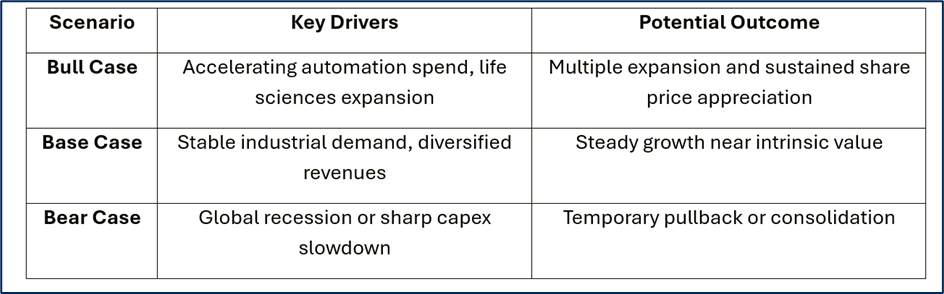
Source: Kalkine Group Analysis
Analyst Ratings and Price Targets (Latest Estimates)
- Average 12-month target: ~C$48.70
- High estimate: ~C$57.00
- Low estimate: ~C$39.90
- Consensus view: Buy-leaning, with expectations of above-market growth
Why ATS Corporation Doesn’t Pay Dividends — and Why Investors Still Care
ATS reinvests cash flow into R&D, automation innovation, and strategic acquisitions rather than paying dividends. For growth-focused investors, this approach signals confidence in long-term returns and market expansion — especially in fast-evolving industrial technology markets.
ATS Corporation Stock: Investor FAQs
Is ATS Corporation stock outperforming the TSX in 2026?
Yes. ATS has outpaced the TSX Composite on recent monthly performance, reflecting automation-sector leadership.
Is ATS a Buy or Sell according to analysts?
Consensus leans Buy, with attractive upside implied by current price targets.
Does ATS pay dividends?
No. The company prioritizes reinvestment over income distributions.
Which sectors drive ATS growth?
Life sciences, medical devices, food & beverage, advanced manufacturing, robotics, and digital automation services.
Final Investment Perspective (Informational Only)
ATS Corporation’s strong early-2026 performance highlights rising investor conviction in automation as a long-term structural growth theme. With diversified end markets, expanding services revenue, and supportive analyst sentiment, ATS stands out among Canadian industrial technology stocks.
That said, investors should balance this opportunity against macroeconomic uncertainty and cyclical industrial risks. For growth-oriented portfolios, ATS offers compelling exposure to the future of manufacturing. For more cautious investors, monitoring earnings execution, global capex trends, and currency dynamics remains essential.


 Jun 29, 2026




 Please wait processing your request...