
 AU
AU
 UK
UK
 US
US
 NZ
NZ
 IND
IND

 CA
CA

 Share
Share
 X (Formerly Twitter)
 Whatsapp
 Facebook
 LinkedIn
 Telegram
 Email This Article
 Copy Link
 Summarize with AI
 Chat GPT
 Perplexity
Views Expressed Disclaimer:
You are reading a free article with opinions that may differ from the recommendation given by Kalkine in its paid research reports. Become a Kalkine member today to get access to our research reports, in-depth technical and fundamental research.
Curaleaf shares remain volatile amid cannabis sector uncertainty. Explore growth potential, risks, and valuation before investing.
Key Takeaways — Latest February 2026
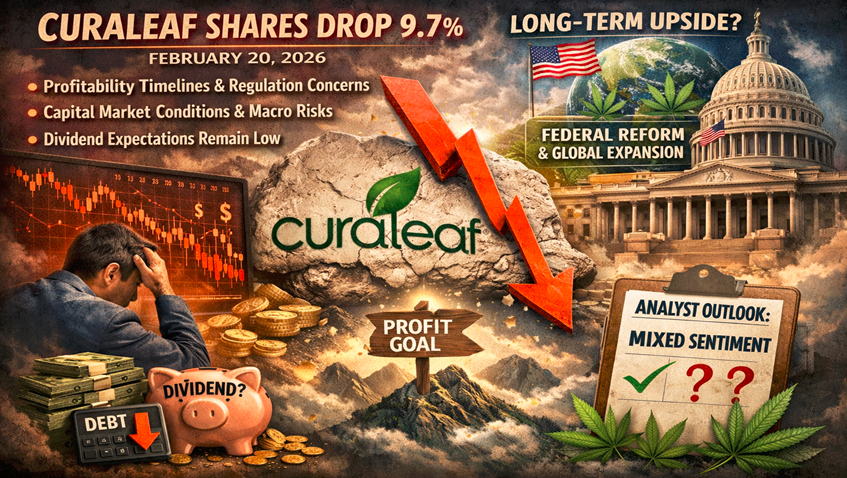
- Curaleaf Holdings shares fell approximately 9.7% on 20 February 2026 due to cannabis sector weakness, macro risk sentiment, and growth stock pressure.
• Investor focus remains on profitability timelines, regulatory catalysts, and capital market conditions.
• Long-term upside remains tied to US federal cannabis reform and global expansion opportunities.
• Dividend expectations remain low as reinvestment and balance sheet priorities dominate.
• Analyst sentiment is mixed but structurally constructive over the long term.
Source: Kalkine Group
Why Did Curaleaf Holdings Stock Drop 9.7% in February 2026?
Curaleaf Holdings stock decline has attracted significant attention among investors searching for Curaleaf stock forecast 2026, TSX cannabis stocks outlook, Curaleaf share price prediction, cannabis industry growth trends, is Curaleaf a good investment, and cannabis multibagger stocks. The sharp fall appears primarily driven by sector-wide weakness, macroeconomic uncertainty, rising interest rate expectations, and risk-off investor sentiment, rather than a major company-specific negative announcement.
Global financial markets in February 2026 experienced volatility across growth sectors, particularly companies with higher leverage and regulatory exposure. Cannabis equities historically behave as high-beta growth assets, meaning they tend to amplify broader market movements both upward and downward. As investor risk appetite weakened, capital rotated away from speculative growth sectors into defensive industries, placing downward pressure on cannabis names like Curaleaf.
Additionally, expectations around US federal cannabis legalisation progress in 2026 remain uncertain, creating periodic sentiment swings across the sector. Even minor shifts in policy outlook can trigger significant valuation changes for cannabis companies because regulatory clarity is one of the largest long-term catalysts.
How Are Global Market Dynamics Impacting Cannabis Stocks Right Now?
Global markets currently reflect several macro forces:
- Interest rate trajectory uncertainty across major economies
• Inflation moderation but still above historical norms
• Tight financial conditions affecting capital-intensive sectors
• Strong US dollar cycles impacting global liquidity
• Sector rotation toward profitable companies
Cannabis companies often require external funding for expansion, making them particularly sensitive to tightening financial conditions.
How Is the Canada Economy Influencing Curaleaf and TSX Cannabis Stocks?
Canada’s economic backdrop in early 2026 includes:
- Slower growth following prior monetary tightening cycles
• Consumer spending pressure from higher borrowing costs
• Housing market adjustments impacting confidence
• Commodity price volatility affecting currency and markets
The TSX Composite Index has also experienced volatility driven by energy sector fluctuations and global macro uncertainty. High-risk growth sectors such as cannabis tend to underperform when broader market sentiment weakens.
What Role Does the Canadian Dollar (CAD) Play in Curaleaf’s Performance?
Currency dynamics influence:
- Cross-border investment flows
• Relative valuation for international investors
• Financing conditions and cost structures
A volatile CAD environment can amplify investor uncertainty, particularly for companies operating across multiple jurisdictions.
What Is Curaleaf’s Current Business Model and Competitive Position?
Curaleaf operates a vertically integrated cannabis platform focused on:
- Cultivation and production
• Processing and branded product development
• Retail dispensary networks
• Medical and recreational cannabis markets
• International expansion opportunities
The company aims to leverage scale advantages, brand strength, and operational efficiency to drive long-term profitability (company filings and investor materials).
What Are the Latest Financial and Operational Trends Investors Should Know?
Recent disclosures highlight:
- Revenue growth supported by market presence expansion
• Cost control initiatives to improve margins
• Operational restructuring programs
• Focus on achieving sustainable cash flow generation
Investors are closely monitoring:
- EBITDA trajectory
• Operating margins
• Free cash flow trends
• Balance sheet leverage
These metrics are critical for valuation re-rating potential.
Does Curaleaf Offer Dividends or Income Potential?
Curaleaf currently does not pay dividends. Capital allocation priorities remain focused on:
- Expansion investments
• Debt management
• Profitability improvement
• Strategic positioning
Dividend potential could emerge in the longer term once the industry matures and cash flows stabilise.
How Does Curaleaf Compare With Cannabis Industry Peers?
Peer comparison suggests:
Strength Factors
- Large geographic footprint
• Established brand portfolio
• Scale leadership in key markets
Risk Factors
- Industry profitability challenges
• Competitive pricing pressure
• Regulatory complexity
Curaleaf is often viewed as a market leader with turnaround potential, but execution risk remains significant.
What Is the Short, Medium, and Long-Term Outlook for the Cannabis Sector?
Short Term Outlook
- Elevated volatility expected
• Macro sensitivity remains high
• Regulatory headlines driving sentiment
Medium Term Outlook
- Gradual profitability improvement possible
• Industry consolidation trends
• Margin expansion through efficiency gains
Long Term Outlook
- Significant structural growth potential
• Expanding global legalisation
• Institutional investor participation could increase
What Forward-Looking Strategies Could Investors Consider Across Time Horizons?
Short Term (3–6 Months)
- Monitoring macroeconomic signals and interest rate trends
• Tracking quarterly financial updates
• Watching regulatory developments
Medium Term
- Evaluating profitability progress
• Observing industry consolidation impacts
• Assessing balance sheet improvements
Long Term
- Monitoring global legalisation trends
• Tracking market share and brand growth
• Evaluating long-term operating leverage potential
These perspectives are informational only.
Is Curaleaf Stock Bullish, Bearish, or Neutral Right Now?
Short Term Sentiment: Neutral to Bearish
- Market volatility remains elevated
• Sector sentiment fragile
• Macro headwinds persist
Long Term Sentiment: Neutral to Bullish
- Structural industry growth intact
• Potential regulatory catalysts ahead
• Operational improvements could unlock value
What Key Catalysts Could Drive Curaleaf Stock Higher or Lower?
Positive Catalysts
- US federal reform progress
• Profitability improvements
• Institutional investment inflows
• Industry consolidation
Negative Catalysts
- Regulatory delays
• Capital market tightening
• Pricing pressure
• Execution risks
What Do Analysts Forecast for Curaleaf Stock?
Broker consensus indicates:
- Mixed recommendations from Hold to Buy
• Price targets generally above current levels
• Long-term optimism balanced with execution risk
Consensus valuation ranges vary across research firms (broker reports and market consensus data).
What Are the Main Risks Investors Should Watch?
- Regulatory uncertainty
• Profitability timeline risk
• Financing constraints
• Competitive dynamics
• Macroeconomic sensitivity
• Policy changes
What Could Bull, Base, and Bear Scenarios Look Like?
What Is the Overall Investment Perspective on Curaleaf in 2026?
Curaleaf remains a high-growth, high-volatility cannabis company positioned within an evolving global regulatory landscape. The February 2026 share price decline reflects macro and sector sentiment more than structural deterioration. Long-term opportunity depends heavily on execution, profitability, and regulatory progress, while short-term volatility is likely to continue.
This article is informational only and does not constitute financial advice.
FAQ Schema (SEO Optimised)
Why is Curaleaf stock down in February 2026?
The decline is mainly due to cannabis sector weakness, macroeconomic uncertainty, and investor risk-off sentiment.
Will Curaleaf stock recover?
Recovery potential depends on regulatory progress, profitability improvements, and broader market conditions.
Does Curaleaf pay dividends?
The company currently prioritises growth and balance sheet strength over dividends.
Is Curaleaf a long-term growth stock?
It may offer long-term growth potential, but risks remain high due to regulatory and financial uncertainty.


 Jun 24, 2026




 Please wait processing your request...