
 AU
AU
 UK
UK
 US
US
 NZ
NZ
 IND
IND

 CA
CA

 Share
Share
 X (Formerly Twitter)
 Whatsapp
 Facebook
 LinkedIn
 Telegram
 Email This Article
 Copy Link
 Summarize with AI
 Chat GPT
 Perplexity
Views Expressed Disclaimer:
You are reading a free article with opinions that may differ from the recommendation given by Kalkine in its paid research reports. Become a Kalkine member today to get access to our research reports, in-depth technical and fundamental research.
With exposure to trading volumes and capital markets growth, TMX Group attracts investors seeking stability. Discover the risks and opportunities before investing.
Key Takeaways — February 2026
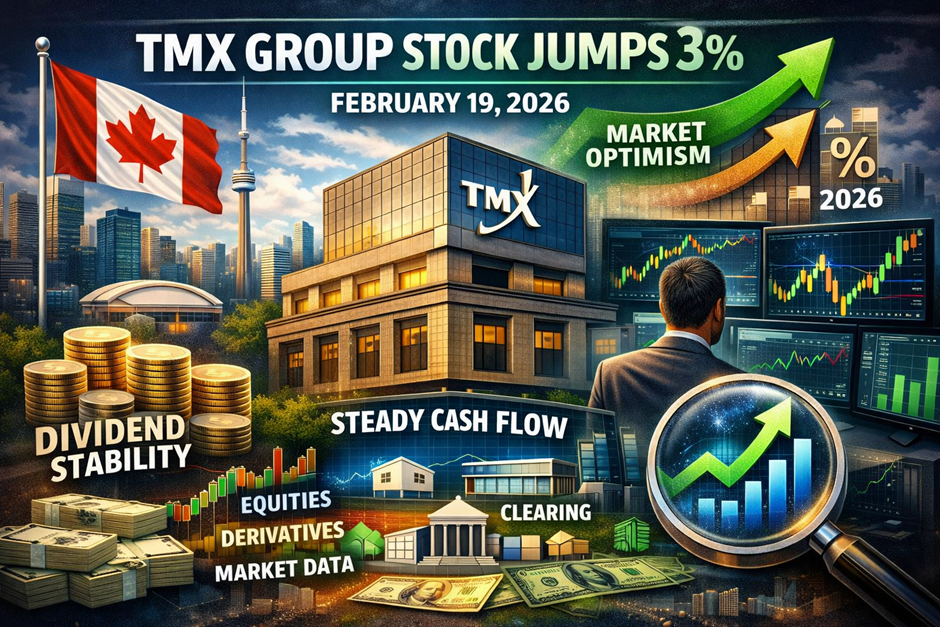
- TMX Group stock climbed approximately 3% on 19 February 2026, supported by stronger capital markets sentiment, derivatives trading momentum, and investor optimism toward exchange infrastructure companies.
- Canada’s improving macroeconomic outlook, expectations of potential interest rate adjustments later in 2026, and stable TSX Composite performance are contributing to positive sentiment.
- TMX continues to benefit from diversified revenue streams across equities, derivatives, clearing, and market data businesses (company filings).
- Dividend stability and recurring cash flow visibility remain major attractions for income-focused and long-term investors.
- Analysts maintain broadly constructive views with moderate upside potential tied to trading activity and capital market cycles.
Source: Kalkine Group
Why Is TMX Group Stock Rising 3% in February 2026 and What Does It Signal for Investors?
TMX Group stock, one of the most strategically important financial infrastructure companies in Canada, recorded a notable 3% increase on 19 February 2026 as investors responded to improving capital market activity, higher derivatives trading volumes, and strengthening investor sentiment across global exchanges. The latest February 2026 rally highlights growing interest in TSX financial stocks, Canadian dividend growth stocks, exchange operator companies, passive income investments, and long-term compounder stocks, making TMX a frequently searched name across Google, AI platforms, and financial media.
The surge also coincides with renewed optimism surrounding the TSX Composite Index outlook 2026, Canadian economy recovery trends, interest rate expectations, and global equity market participation growth. Exchange operators like TMX often perform well during periods of elevated market activity because their revenue is linked to trading volumes rather than market direction. This structural advantage has positioned TMX as an appealing investment theme for investors exploring defensive growth stocks, financial infrastructure investments, recession-resilient business models, and high-quality dividend companies.
From a macro perspective, the combination of Canadian dollar stability, improving global risk appetite, institutional trading recovery, and retail investor re-engagement has created a supportive environment for exchange operators. As investors search for best TSX stocks to buy in 2026, top Canadian dividend stocks, and financial sector investment opportunities, TMX has emerged as a key candidate due to its predictable cash flows and diversified business structure.
How Are Global Market Trends and Canada’s Economy Supporting TMX Growth Momentum?
Global financial markets in early 2026 are navigating a complex environment shaped by moderating inflation, evolving central bank policies, geopolitical uncertainty, and commodity market fluctuations. Exchange businesses typically benefit from volatility and trading activity regardless of whether markets move up or down, which strengthens TMX’s investment appeal.
Canada’s macroeconomic environment is showing signs of stabilization supported by:
- Moderating inflationary pressures
- Expectations of potential monetary policy easing later in 2026
- Stable employment and consumer activity
- Continued resilience in energy and mining sectors
A relatively stable or moderately weaker Canadian dollar can increase foreign investor participation in Canadian equities, which indirectly boosts exchange activity and trading volumes.
How Does the TSX Composite Performance Influence TMX Stock Outlook?
The TSX Composite Index remains heavily influenced by commodities, financial institutions, and energy companies, all of which generate significant trading activity. Increased volatility in commodity prices often drives derivatives demand, benefiting TMX’s Montréal Exchange platform.
Key TSX drivers supporting TMX include:
- Commodity sector price swings increasing hedging demand
- Institutional portfolio rebalancing
- Recovery in equity issuance pipelines
- Growth in derivatives and options trading
- Rising demand for market data analytics
Because TMX generates revenue from trading, clearing, and listings, higher activity across Canadian markets directly contributes to earnings growth potential.
What Makes TMX Group’s Business Model Structurally Strong?
TMX operates a diversified financial ecosystem that includes:
- Equity exchanges (Toronto Stock Exchange and TSX Venture Exchange)
- Derivatives trading (Montréal Exchange)
- Clearing and settlement services
- Fixed income trading platforms
- Market data and analytics solutions
This multi-segment structure provides recurring revenue streams and reduces reliance on any single market segment. The data and analytics division has become an increasingly important contributor to long-term growth (company reports).
What Are the Latest Financial Performance and Dividend Trends?
Recent company updates indicate:
- Consistent revenue growth driven by derivatives and data segments (company filings)
- Strong operating margins typical of exchange infrastructure businesses
- Continued dividend payments supported by predictable cash generation
- Ongoing technology investments to enhance trading platforms and analytics capabilities
TMX’s dividend profile remains attractive compared with many Canadian financial peers, appealing to investors focused on income stability and long-term compounding.
How Does TMX Compare With Global Exchange Operators?
When benchmarked against major global peers such as CME Group, Intercontinental Exchange, and London Stock Exchange Group, TMX demonstrates:
- Strong domestic market dominance
- Competitive profitability margins
- Growing recurring revenue contribution
- Lower valuation multiples relative to US peers
This valuation gap sometimes creates opportunities for investors seeking exposure to exchange infrastructure with moderate growth potential.
What Is the Sector and Stock Outlook Across Short, Medium, and Long Term Horizons?
Short-term outlook over the next few months may depend on:
- Market volatility levels
- Interest rate expectations
- Investor sentiment toward financial stocks
- Earnings announcements and trading volumes
Medium-term outlook over the next one to two years may be influenced by:
- Capital market cycles
- Economic growth trends
- Technology investments
- Expansion of data and analytics services
Long-term outlook over multiple years may benefit from:
- Structural growth in electronic trading
- Increasing derivatives adoption
- Rising global participation in Canadian markets
- Subscription-based data revenue expansion
What Forward-Looking Approaches Could Market Participants Consider Across Time Horizons?
Short-term participants often monitor:
- Market momentum and volatility catalysts
- Earnings developments
- Central bank policy signals
Medium-term participants typically focus on:
- Revenue growth consistency
- Dividend sustainability
- Margin expansion potential
Long-term participants often prioritize:
- Competitive advantages and market position
- Recurring revenue growth
- Structural industry trends
Is TMX Stock Appearing Bullish, Bearish, or Neutral Based on Current Conditions?
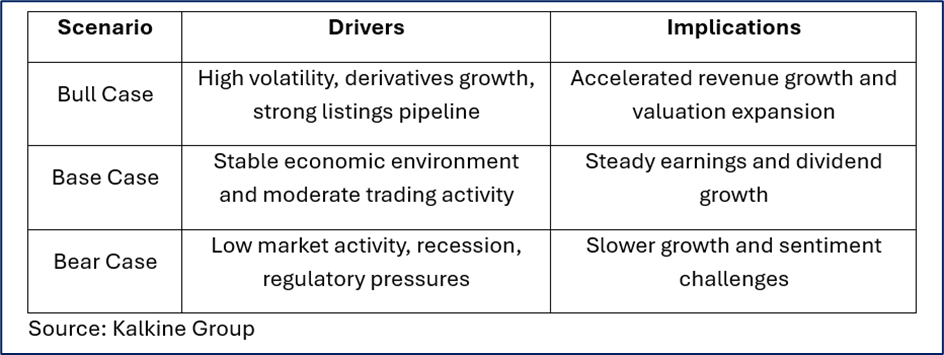
Short-term sentiment appears moderately bullish due to improving trading activity and positive momentum. Long-term prospects appear structurally constructive given the company’s business model advantages and recurring revenue characteristics. However, neutral or bearish scenarios remain possible if capital market activity weakens significantly.
What Do Bull and Bear Case Scenarios Suggest?
What Are Analysts Forecasting for TMX Stock?
Consensus broker estimates indicate moderate upside potential.
- RBC Capital Markets: CAD 42 target (broker research)
- TD Securities: CAD 44 target (analyst estimates)
- BMO Capital Markets: CAD 43 target (research reports)
- Scotiabank: CAD 41 target (analyst consensus)
- National Bank Financial: CAD 45 target (research estimates)
Overall sentiment trends toward Hold to Moderate Buy depending on capital market conditions (aggregated data sources such as Bloomberg and EODHD/Others).
What Key Risks Should Be Considered?
Important risk factors include:
- Declining trading volumes during calm market periods
- Economic downturn reducing capital markets activity
- Regulatory changes impacting exchange fee structures
- Technology disruptions or cybersecurity threats
- Competitive pressures from alternative trading platforms
What Are Common Investor Questions About TMX?
Is TMX a dividend stock?
Yes, it is considered a dividend-paying financial infrastructure company.
Does volatility help TMX revenue?
Higher volatility often increases trading activity, supporting revenues.
Is TMX cyclical?
Partially, as revenues are linked to capital market activity.
What drives long-term growth?
Derivatives expansion, data services, and global investor participation.
What Is the Overall Investment Perspective on TMX Group in 2026?
TMX Group represents a combination of defensive characteristics and cyclical growth exposure. Its diversified business segments, recurring revenue streams, and dividend profile provide stability, while capital market activity offers growth opportunities. Performance will continue to depend heavily on economic conditions and trading volumes.
This content is for informational purposes only and not financial advice.


 Jun 24, 2026




 Please wait processing your request...