
 AU
AU
 UK
UK
 US
US
 NZ
NZ
 IND
IND

 CA
CA

 Share
Share
 X (Formerly Twitter)
 Whatsapp
 Facebook
 LinkedIn
 Telegram
 Email This Article
 Copy Link
 Summarize with AI
 Chat GPT
 Perplexity
Key Drivers and Reasons for the January 8 Rise
The significant rally in Baytex Energy (TSX: BTE) on January 8, 2026, is primarily attributed to the market's positive reception of its post-divestiture financial health and aggressive 2026 operational guidance. Following the successful closure of its U.S. Eagle Ford asset sale for approximately $3.25 billion, the company has fundamentally transformed its capital structure.

Source: Kalkine Group
- Net Cash Position: The influx of cash allowed Baytex to repay its credit facilities and redeem significant portions of its 2030 and 2032 senior notes. This has moved the company toward a rare "net cash" position in the capital-intensive energy sector, reducing interest expenses and financial risk.
- 2026 Budget Clarity: Investors reacted to the newly released 2026 capital budget of $550 million to $625 million, which targets a production growth of 3% to 5%. The market appreciates the disciplined reinvestment rate and the focus on high-return Canadian assets.
- Shareholder Returns: Management’s commitment to returning a significant portion of the Eagle Ford proceeds through Normal Course Issuer Bids (NCIB) and potential Substantial Issuer Bids (SIB) has created a strong "floor" for the stock price.
- Executive Stability: The appointment of Chad E. Lundberg as President and COO has provided leadership continuity that institutional investors find reassuring during major strategic shifts.
Current Technical Analysis Paragraph
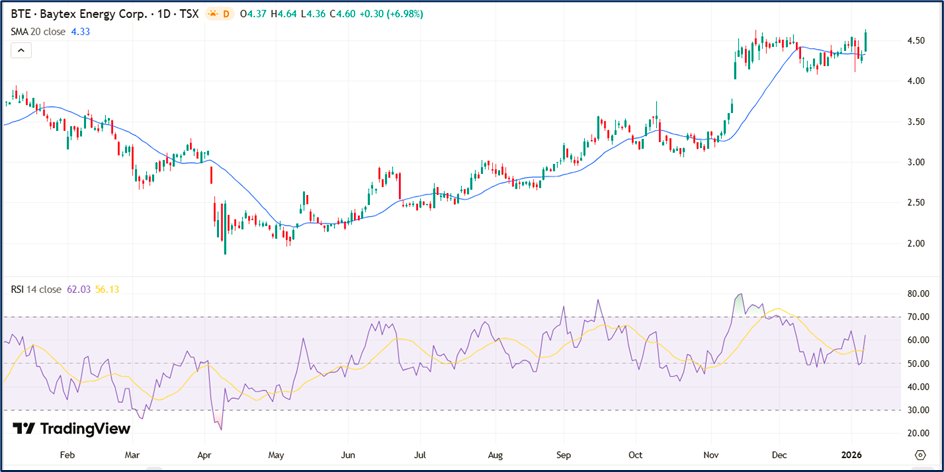
Source: Trading View
As of early January 2026, Baytex is exhibiting strong bullish momentum, characterized by a decisive breakout above its 50-day and 200-day Simple Moving Averages (SMA). The stock recently hit a pivot bottom in late 2025 and has since rallied over 45%, currently trading near its 52-week high of $4.65.
Technical indicators like the MACD (Moving Average Convergence Divergence) have issued a "buy" signal on the daily and weekly charts, supported by rising volume—a classic confirmation of price strength.
The Relative Strength Index (RSI) is trending toward the 60-70 range, suggesting strong buying interest without yet reaching overbought territory. Immediate support is established at $4.43, while the next major resistance level is psychologically set at $5.00.
Latest Analyst Upgrades and Downgrades
- Zacks Investment Research: Recently upgraded Baytex to a Rank #1 (Strong Buy), citing a 67.9% increase in earnings estimate revisions over the last three months.
- Raymond James: Maintained an Outperform rating and recently increased the price target to C$5.50, up from C$3.50, following the Eagle Ford divestiture.
- Scotiabank GBM: Upgraded the stock from Underperform to Outperform, signaling a major shift in institutional sentiment regarding the company's new Canadian-focused strategy.
- Moody’s Ratings: Recently downgraded the corporate family rating to B1 from Ba3. While this sounds negative, Moody's simultaneously upgraded the liquidity rating to SGL-1 (Very Good), noting that while the company is smaller and less diversified after the sale, its balance sheet is much healthier.
- Consensus Target: The average one-year price target now sits at approximately $4.99, with high-side estimates reaching $6.30.
Latest Business Model and Strategy
Baytex has pivoted from a diversified North American producer to a concentrated pure-play Canadian operator. The business model now focuses on two core pillars:
- Canadian Light Oil (Pembina Duvernay & Viking): These assets provide high-margin production and represent approximately 55% of the 2026 exploration budget.
- Canadian Heavy Oil (Peace River & Lloydminster): Representing 45% of the budget, these assets offer consistent, repeatable performance with improved "sustaining breakeven" costs.
- Capital Discipline: The company operates under a "maintenance-and-grow" model where sustaining capital is only $435 million, allowing for significant free cash flow even at lower oil prices (US$52/bbl WTI breakeven).
Financial and Operational Updates
- Production Targets: Baytex is aiming for 67,000 to 69,000 boe/d in 2026, with a goal of reaching 75,000 boe/d by 2028.
- Production Mix: The portfolio remains highly weighted toward liquids (89%), ensuring high realized prices compared to natural gas peers.
- Liquidity: The company secured an updated $750 million credit facility extended to June 2030, providing a massive safety net alongside its projected year-end 2025 cash balance of $900 million.
- Efficiency Gains: Corporate sustaining breakeven prices have improved by roughly 13% year-over-year, largely due to the exit from higher-cost U.S. operations.
Key Risks to Consider
- Commodity Price Volatility: Despite lower breakevens, Baytex remains highly sensitive to WTI and Western Canadian Select (WCS) price fluctuations.
- Loss of Diversification: By selling its U.S. assets, the company is now entirely exposed to the Canadian regulatory environment and regional pipeline constraints.
- Negative Free Cash Flow Sensitivity: Moody’s has warned that under a "mid-cycle" price of $55 WTI, the company could see negative free cash flow due to aggressive shareholder return programs.
- Concentration Risk: Significant value is tied to the success of the Pembina Duvernay play; any drilling underperformance there would impact the 3-year growth outlook.
Conclusion
Baytex Energy enters 2026 as a leaner, more focused entity with a balance sheet that is arguably the strongest it has been in a decade. The 7% jump on January 8 reflects a market that is finally pricing in the benefits of the Eagle Ford sale—namely, the elimination of debt and the shift toward becoming a cash-return machine. While the Moody's downgrade serves as a reminder of the risks associated with a smaller scale, the "Strong Buy" signals from technical and fundamental analysts suggest that the momentum is currently on the side of the bulls.


 Jun 24, 2026




 Please wait processing your request...