
 AU
AU
 UK
UK
 US
US
 NZ
NZ
 IND
IND

 CA
CA

 Share
Share
 X (Formerly Twitter)
 Whatsapp
 Facebook
 LinkedIn
 Telegram
 Email This Article
 Copy Link
 Summarize with AI
 Chat GPT
 Perplexity
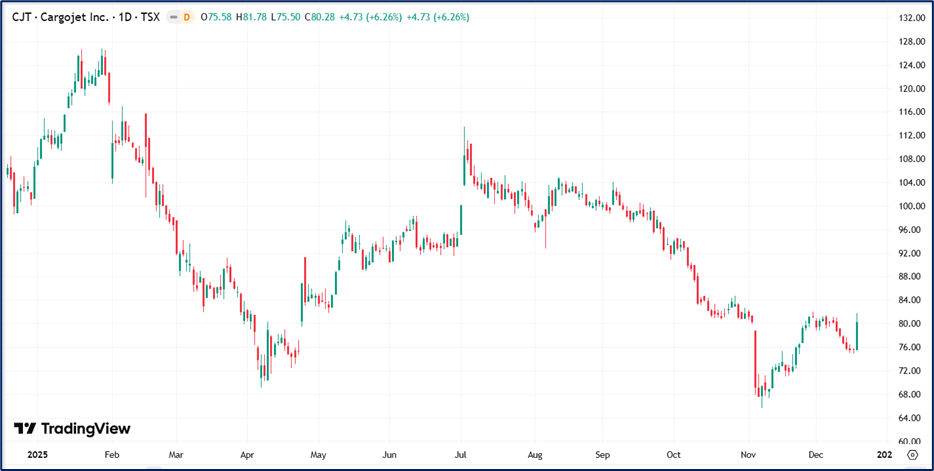
Cargojet Inc. (TSX: CJT) sent shockwaves through the TSX on December 17, 2025, with a powerful 6.26% jump, closing at CAD 80.28. After a volatile autumn characterized by trade tariff fears and a leadership shakeup, the "King of Canadian Skies" finally caught a tailwind.
This wasn't just a random spike—it was a convergence of technical "Buy" signals, dividend hunting, and a massive vote of confidence from the board. Here is the analytical breakdown of why Cargojet is suddenly the talk of the Bay Street retail crowd.
The "Big 3" Drivers Behind the Dec 17 Surge

Source: Kalkine Group
December 17 was the final major trading window before the December 19 ex-dividend date. Investors rushed into the stock to capture the $0.35 per share quarterly payout (payable January 5, 2026). For yield-hungry retail investors, the combination of a reliable dividend and a recovering share price proved irresistible.
Cargojet’s renewed Normal Course Issuer Bid (NCIB) is now in full swing. The company has authorization to repurchase up to 1,400,000 shares (roughly 9.5% of its public float). When a company aggressively buys its own stock, it creates a "floor" for the price and signals to the market that management believes the shares are deeply undervalued.
3. Technical "Golden Star" Momentum
Technically, the stock broke out of a bearish consolidation pattern. On Dec 17, volume surged alongside the price—a classic "strong hands" indicator. Moving averages crossed into a short-term "Buy" zone, triggering algorithmic trading bots to pile into the momentum.
Business Model: Why Cargojet Owns the Map
Cargojet doesn't just "fly planes"; it operates a monopolistic moat in Canadian e-commerce logistics.
- Domestic Overnight Network: Connects 16 major Canadian cities. Over 90% of Canada’s population is reachable overnight through their hub-and-spoke model.
- ACMI (Aircraft, Crew, Maintenance, Insurance): A "wet lease" model providing dedicated aircraft for global giants like Amazon and DHL.
- Strategic Partnerships: Its deal with DHL includes warrants, effectively making the world’s largest logistics company a vested partner in Cargojet’s success.
SWOT Analysis: The 2025 Strategic Landscape
Source: Kalkine Group
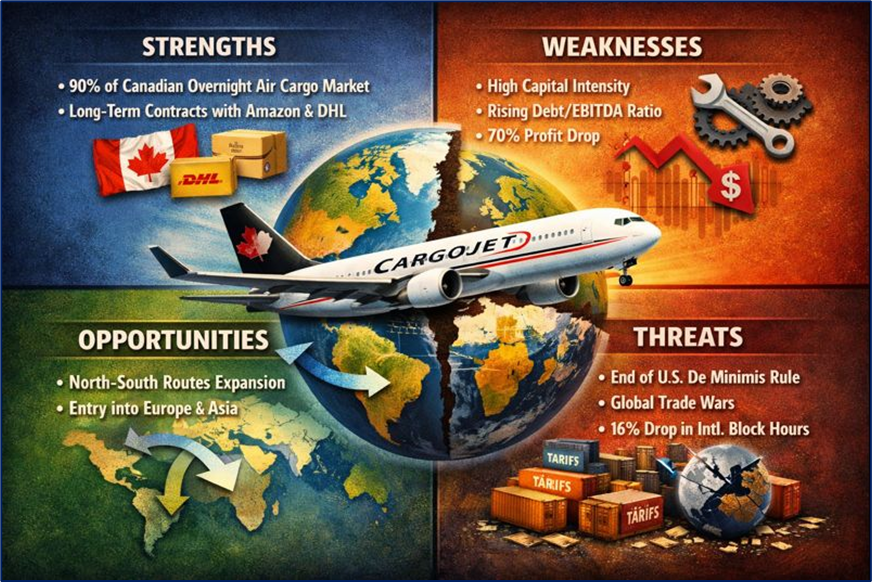
Cargojet’s competitive position is anchored by its strengths in domestic dominance, holding over 90% of the Canadian overnight air cargo market and maintaining long-term, inflation-indexed contracts with giants like Amazon and DHL. However, its weaknesses remain tied to high capital intensity and a sensitivity to debt-to-EBITDA ratios, particularly as it manages expensive fleet maintenance and a recent 70% drop in quarterly profits.
Opportunities for the firm lie in its pivot toward "North-South" routes within the Americas and a potential expansion into European and Asian trade corridors using more efficient Boeing 767-300s. Conversely, the company faces significant threats from a "new trade world order," specifically the removal of U.S. de minimis exemptions and ongoing global trade wars which have already triggered a 16% decline in international block hours.
Latest Business Updates: The New Guard
The most significant "under the hood" update is the leadership transition. Pauline Dhillon is set to take over as CEO on January 1, 2026, as founding member Jamie Porteous moves to a Strategic Advisor role.
The market initially viewed the departure of a founder with skepticism, but recent updates suggest a "stay the course" strategy focused on resilience and cost discipline. The company is also rationalizing its fleet, selling off older 767-200s and replacing them with more efficient 767-300 freighters to boost margins.
The Risks: Why It’s Not All Clear Skies
- The "De Minimis" Headwind: U.S. policy changes regarding duty-free small shipments (de minimis) have disrupted Trans-Pacific e-commerce flows, leading to a recent 16% drop in international "block hours."
- Economic Sensitivity: While e-commerce is resilient, a hard landing in the Canadian economy could dampen B2B cargo volumes, which are a major secondary revenue stream.
- Tariff Turbulence: As "trade barriers become the new normal," Cargojet must constantly pivot its routes to avoid low-margin, high-tariff corridors.
Conclusion: A Tactical Rebound?
The 6% jump on December 17 represents a "relief rally." Investors are cheering the company’s aggressive share buybacks and the stability of its 32% EBITDA margins despite a tough global trade environment.
While the international segment faces headwinds from shifting trade policies, the Domestic Network grew 6% year-over-year in Q3, proving that for Canadians, online shopping isn't going anywhere. Cargojet is currently a play on Canadian e-commerce dominance versus Global trade uncertainty.
Source: Trading View, 17 December 2025


 Jun 24, 2026




 Please wait processing your request...