
 AU
AU
 UK
UK
 US
US
 NZ
NZ
 IND
IND

 CA
CA

 Share
Share
 X (Formerly Twitter)
 Whatsapp
 Facebook
 LinkedIn
 Telegram
 Email This Article
 Copy Link
 Summarize with AI
 Chat GPT
 Perplexity
The significant 7.5% jump in Cargojet’s share price on January 8, 2026, was catalyzed by a convergence of leadership clarity, insider conviction, and broader market momentum.
- Leadership Handover Success: Investors reacted enthusiastically to the official commencement of Pauline Dhillon’s tenure as CEO, effective January 1, 2026. This transition from the long-standing leadership of Ajay Virmani and Jamie Porteous has been viewed as a move toward modernizing operations while maintaining the company's core "customer-first" culture.
- Massive Insider Buying: Positive sentiment was bolstered by reports that company insiders increased their holdings by approximately CA$2.58 million over the trailing 12 months. Such substantial "skin in the game" from the executive level is a powerful signal to the market that those closest to the operations believe the stock is undervalued.
- Sector-Wide Tailwinds: On January 8, the S&P/TSX Capped Industrials Index performed strongly, with Cargojet leading the charge. A sharp rise in crude oil prices (up nearly 5%) during the same period often pressures airlines, but Cargojet’s fuel surcharge mechanisms largely insulate its margins, allowing it to benefit from the general industrial optimism without the typical energy-related downside.

Source: Kalkine Group
Current Technical Analysis
Source: Trading View
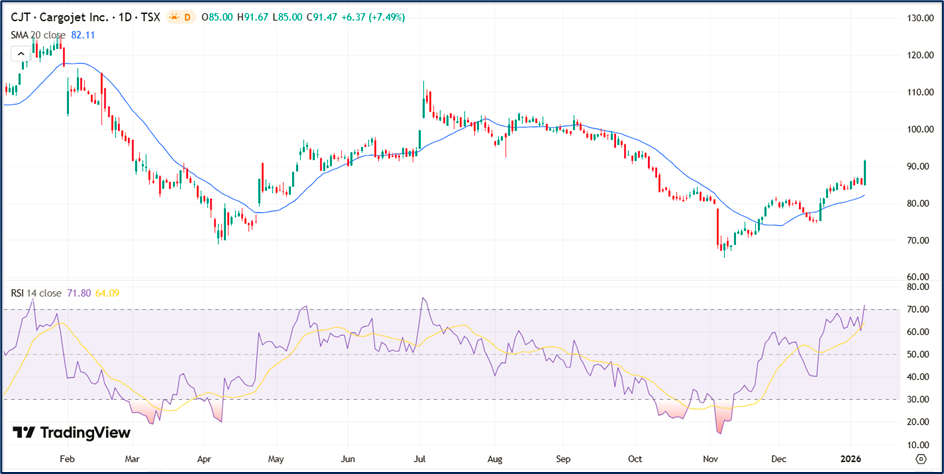
Cargojet’s technical profile shifted from "consolidating" to "bullish breakout" following the January 8 session. The stock successfully breached a key horizontal resistance level at approximately $86.71, which had capped gains throughout the previous quarter.
- Moving Average Convergence: The stock is currently trading above its 20-day and 50-day Simple Moving Averages (SMAs). A "Golden Cross" formation—where the short-term average crosses above the long-term average—is nearing completion, signaling sustained upward momentum.
- Volume Confirmation: The 7.5% rally was backed by above-average trading volume (over 190,000 shares), confirming that the move was driven by institutional interest rather than retail volatility.
- RSI and Momentum: The Relative Strength Index (RSI) is approaching the 72 level, suggesting the stock is entering overbought territory. While this indicates a potential minor pullback or consolidation in the near term, the MACD (Moving Average Convergence Divergence) remains firmly in positive territory, suggesting the path of least resistance is still higher.
Latest Analyst Ratings and Price Targets
Wall Street and Bay Street analysts maintain a generally bullish stance on Cargojet, though price targets were recently adjusted to reflect a more conservative global trade environment.
- Consensus Rating: The stock holds a "Strong Buy" or "Buy" consensus from 10 major research firms.
- Target Price Adjustments: While firms like RBC Capital maintain aggressive targets as high as $151.00, others like CIBC and Scotiabank have recently normalized their targets to the $105.00 - $135.00 range.
- Fair Value Estimates: Independent analytical platforms estimate the intrinsic "Fair Value" of the stock to be between $108.00 and $120.00, suggesting that even after the recent 7.5% jump, the stock may still be trading at a 15-20% discount to its long-term earnings potential.
Business Model and Operational Updates
Cargojet’s business model continues to evolve from a domestic-only provider to a global ACMI (Aircraft, Crew, Maintenance, and Insurance) powerhouse.
- Strategic Hub Expansion: The company recently launched a direct weekly service connecting Canadian hubs to Liege Airport in Belgium, a major European logistics gateway. This diversifies revenue away from purely North American e-commerce.
- The "Amazon-DHL" Moat: Cargojet’s competitive advantage remains its long-term, exclusive contracts with DHL (renewed until 2033) and Amazon. These contracts include warrants and equity incentives that align the interests of the shippers with the airline's success.
- Fleet Modernization: The company is focusing on "fleet rationalization," prioritizing the utilization of its current 40-aircraft fleet over aggressive new acquisitions to protect the balance sheet during periods of fluctuating global demand.
Financial Health and Strategic Risks
Cargojet’s latest financial reports highlight a period of "resilient discipline" as the company manages debt while sustaining high margins.
- Profitability Metrics: The company maintains a robust Adjusted EBITDA margin of approximately 32%, significantly higher than traditional passenger airlines.
- Capital Allocation: Management has renewed its Normal Course Issuer Bid (NCIB), intending to repurchase and cancel up to 1.4 million shares (9.5% of the public float) through November 2026, a move aimed at returning value to shareholders.
- Key Risks
- Customer Concentration: A significant portion of revenue is tied to a small group of major partners; any shift in their logistics strategies poses a risk.
- Global Trade Volatility: Reduced "block hours" in international routes due to shifting Trans-Pacific trade patterns remain a headwind.
- Leverage: With a debt-to-equity ratio nearing 98%, the company must carefully manage interest coverage if rates remains elevated or if earnings growth slows.
Conclusion
The rally on January 8, 2026, marks a potential turning point for Cargojet as it transitions into a new era of leadership under Pauline Dhillon. By combining aggressive share buybacks, strong insider confidence, and a pivot toward European routes, the company is attempting to decouple its stock performance from the general volatility of the logistics sector. While technical indicators suggest the stock may need to breathe after such a rapid ascent, the fundamental "Buy" case supported by analysts remains anchored in the company’s indispensable role in the Canadian supply chain.


 Jun 24, 2026




 Please wait processing your request...