
 AU
AU
 UK
UK
 US
US
 NZ
NZ
 IND
IND

 CA
CA

 Share
Share
 X (Formerly Twitter)
 Whatsapp
 Facebook
 LinkedIn
 Telegram
 Email This Article
 Copy Link
 Summarize with AI
 Chat GPT
 Perplexity
On January 21, 2026, the S&P/TSX Composite Index found its stride as a broader market recovery intersected with a powerful resurgence in the energy and materials sectors. While macro-geopolitical tensions eased following a de-escalation of trade rhetoric regarding Greenland and European tariffs, the spotlight shifted decisively to two Canadian heavyweights: Athabasca Oil and Cameco.
These entities didn't just participate in the rally; they led it, fueled by a perfect storm of structural supply deficits, aggressive capital return frameworks, and the relentless demand for energy security. As the world pivots toward a "dual-track" energy future—integrating reliable fossil fuels with a massive nuclear renaissance—these two stocks have emerged as the primary bellwethers for investors seeking exposure to North American resource sovereignty.
Core Drivers of the January 21 Surge
Source: Kalkine Group
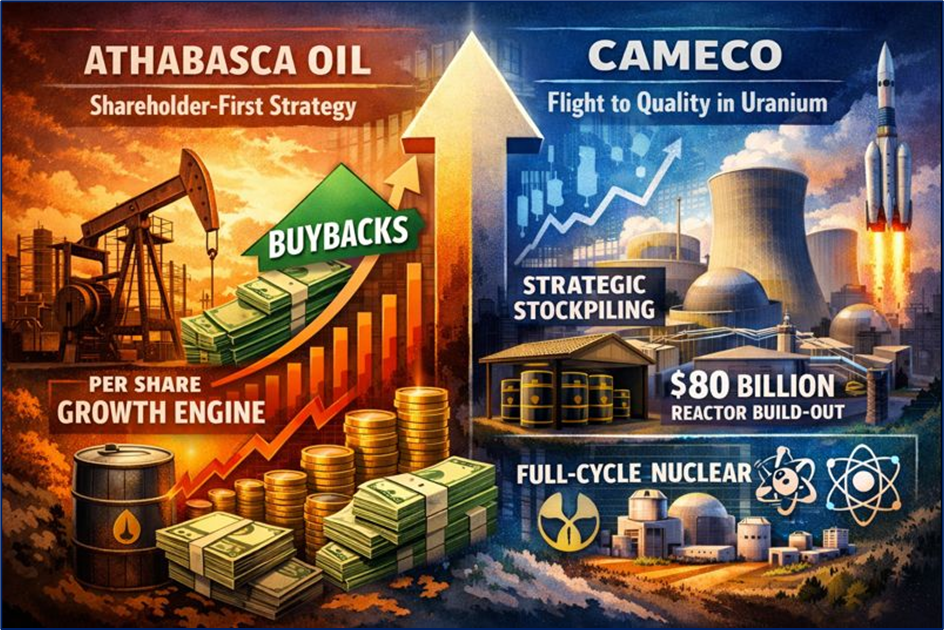
The sudden upward trajectory for both companies was precipitated by a confluence of sector-specific catalysts and broader market relief. For Athabasca Oil, the primary driver was the market's digestion of its 2026 budget guidance, which emphasized a "shareholder-first" capital allocation strategy. The company’s commitment to return 100% of Free Cash Flow from its thermal operations via buybacks has turned it into a per-share growth engine, regardless of minor fluctuations in crude prices.
Cameco’s surge was underpinned by a global "flight to quality" in the uranium space. Recent reports of Western utilities shifting from "just-in-time" to "strategic stockpiling" have created a demand vacuum. Additionally, news regarding the acceleration of the $80 billion Westinghouse reactor build-out—in which Cameco holds a 49% stake—has repositioned the company as a full-cycle nuclear services provider rather than just a miner.
Current Business Models and Strategic Focus
Athabasca Oil Corporation: Athabasca operates a two-pronged business model centered on "Thermal Oil" and "Light Oil" (via its Duvernay Energy subsidiary). Its core strength lies in its low-decline, long-life oil sands assets at Leismer and Hangingstone. The model is built on low break-evens—approximately US$40/bbl WTI—allowing it to generate significant cash flow even in mid-cycle price environments. The company has shifted from a growth-at-all-costs mandate to a "Value Creation" model, focusing on maximizing production from existing infrastructure while shielding income through massive tax pools.
Cameco Corporation: Cameco has evolved into a vertically integrated nuclear fuel giant. While its Tier-1 mining assets (McArthur River and Cigar Lake) provide the world’s highest-grade uranium, its ownership in Westinghouse and Global Laser Enrichment allows it to capture value across the entire nuclear fuel cycle. This "Mine-to-Market" model provides a hedge against commodity price volatility by generating steady service and maintenance revenue from the global reactor fleet.
Latest Financial and Operational Updates
Athabasca Oil (Source: GlobeNewswire, Dec 11, 2025 / TMX Money)
- 2026 Budget: Planned capital expenditures of approximately $310 million, targeting production of 37,000–39,000 boe/d.
- Cash Flow Guidance: Forecasted Adjusted Funds Flow between $425 – $450 million for 2026.
- Shareholder Returns: Reiteration of the policy to allocate 100% of Free Cash Flow from Thermal Oil to share buybacks; the company has already returned $1.1 billion to shareholders since 2021.
- Balance Sheet: Reported a pristine consolidated net cash position of $93 million, including $335 million in cash.
Cameco (Source: Q3 2025 Financial Report)
- Revenue Beat: Third-quarter revenue reached $615 million, exceeding analyst forecasts despite a temporary miss on earnings per share ($0.07 vs $0.23) due to operational timing.
- Contracting Momentum: As of late 2025, Cameco has commitments for average annual deliveries of 28 million pounds of U3O8 through 2029.
- Strategic Debt Management: Maintained a strong liquidity position with $779 million in cash and an undrawn $1.0 billion revolving credit facility.
- Westinghouse Synergy: Confirmed participation in a $80 billion framework with the U.S. government to support domestic and international reactor deployment.
SWOT Analysis: 2026 Outlook
Source: Kalkine Group
Athabasca Oil
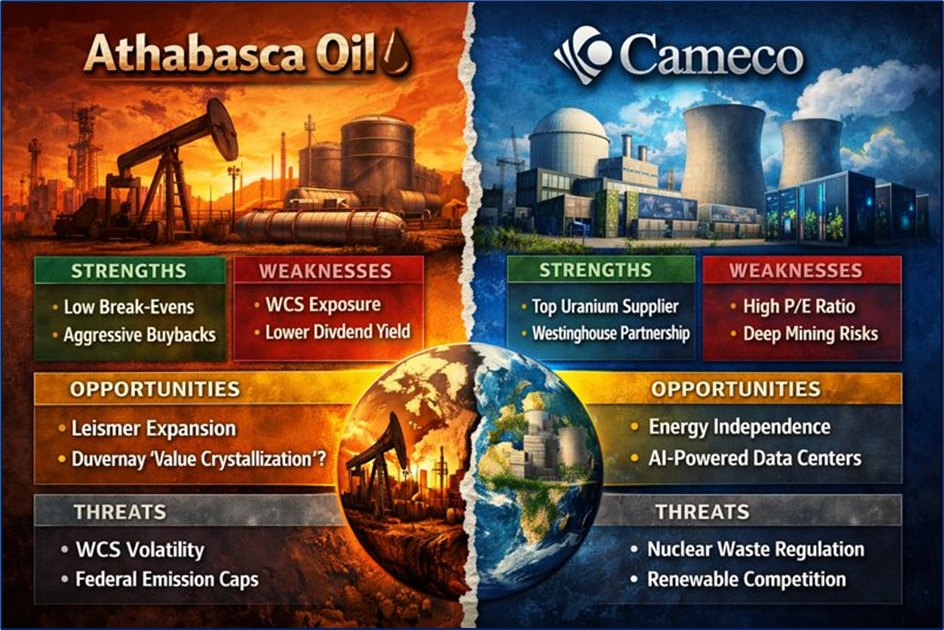
- Strengths: Industry-leading break-evens; aggressive buyback program; $2.1 billion in tax pools protecting future cash flows.
- Weaknesses: High concentration in Western Canadian Select (WCS); lower dividend yield compared to peers.
- Opportunities: Expansion of the Leismer project to reach 60,000 bbl/d by 2030; potential for "Value Crystallization" via the Duvernay Energy subsidiary.
- Threats: Volatility in the WCS-WTI differential; evolving federal emissions caps in Canada.
Cameco
- Strengths: Dominant market share in Western uranium supply; integration with Westinghouse; exposure to high-growth Small Modular Reactor (SMR) tech.
- Weaknesses: High P/E ratio suggests a "priced for perfection" valuation; operational risks associated with deep-well mining.
- Opportunities: Global push for energy independence from Russian fuel; AI data centres requiring 24/7 carbon-free baseload power.
- Threats: Potential regulatory shifts in nuclear waste management; competition from alternative renewable storage technologies.
Outlook and Risk Factors
The 2026 outlook for these TSX titans is largely constructive, yet distinct. Athabasca Oil is entering a "harvest phase" where capital discipline meets operational maturity. Its success depends on maintaining production exit rates above 43,000 boe/d and navigating the logistical constraints of the Canadian pipeline network. Risks include a potential global economic slowdown that could depress crude demand and the inherent cyclicality of the energy sector.
For Cameco, the outlook is tied to the "Nuclear Renaissance." With global nuclear capacity projected to double by 2040, the structural deficit in uranium is the primary tailwind. However, the company faces risks from potential production shortfalls at McArthur River due to technical challenges and the geopolitical complexity of its joint ventures in Kazakhstan (JV Inkai).
Conclusion
The surge of Athabasca Oil and Cameco on January 21 serves as a definitive signal that the "New Energy Reality" is being priced into the Canadian market. It is no longer a choice between traditional fossil fuels and future-tech energy; rather, it is a realization that both are essential for global stability. Athabasca’s relentless focus on returning capital to its owners and Cameco’s strategic grip on the nuclear fuel chain represent two different, yet equally potent, ways to play the resource super-cycle. As institutional capital rotates back into hard assets, these two stocks stand as the vanguard of a TSX that is increasingly defined by cash flow resilience and strategic necessity.


 Jun 24, 2026




 Please wait processing your request...