
 AU
AU
 UK
UK
 US
US
 NZ
NZ
 IND
IND

 CA
CA

 Share
Share
 X (Formerly Twitter)
 Whatsapp
 Facebook
 LinkedIn
 Telegram
 Email This Article
 Copy Link
 Summarize with AI
 Chat GPT
 Perplexity
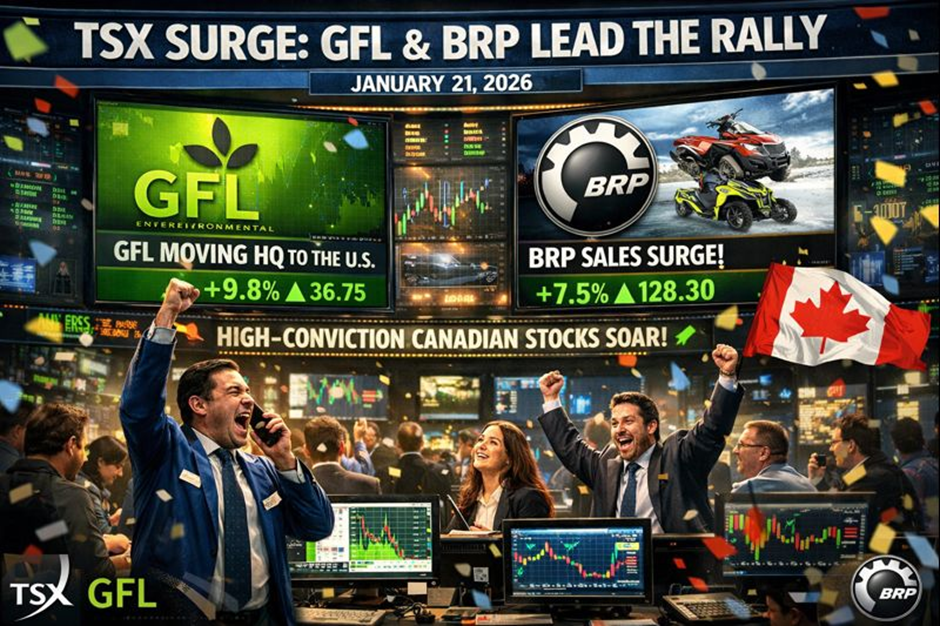
The Toronto Stock Exchange witnessed a significant divergence in momentum on January 21, 2026, as GFL Environmental Inc. (GFL) and BRP Inc. (DOO) emerged as the day's standout performers. While the broader market grappled with macroeconomic uncertainty, these two industrial titans decoupled from the indices, fueled by transformative corporate restructuring and a resurgence in consumer demand.
From GFL’s strategic move to relocate its executive headquarters to the U.S. for index inclusion to BRP’s aggressive market share gains in the powersports sector, the surge reflects a shift in investor sentiment toward "high conviction" Canadian equities.
Source: Kalkine Group
GFL Environmental Inc. (GFL): The Leap to Wall Street’s Front Door
Latest Drivers of the Surge The primary catalyst for GFL’s rally was the official announcement on January 21 that the company has relocated its executive headquarters from Ontario to Miami Beach, Florida. This move is a calculated play to qualify for inclusion in major U.S. equity indices, such as the S&P 400 or 600, which would force massive passive capital inflows from U.S.-based ETFs and institutional funds.
Current Business Model GFL operates as the fourth-largest diversified environmental services company in North America. Its model is built on "non-discretionary" essential services, including solid waste collection, recycling, and liquid waste management. It utilizes a "hub-and-spoke" operational strategy, acquiring local smaller players and integrating them into its massive infrastructure to achieve economies of scale.
Financial and Operational Updates In its latest filings, GFL reported a significant deleveraging milestone, reducing its net leverage to 3.4x run-rate EBITDA. The company also priced a $1 billion private offering of senior notes to bolster liquidity and fund its 2026 M&A pipeline (GFL Investor Relations, Jan 13, 2026).
Dividend Status GFL maintained its quarterly cash dividend of $0.0154 per share, paid on January 30, 2026, to shareholders of record as of January 13. This represents a 10% year-over-year growth in its payout (Company Press Release, Jan 2, 2026).
Latest SWOT Analysis
- Strengths: Essential service nature provides recession-proof cash flows; aggressive M&A execution.
- Weaknesses: High historical debt levels from rapid expansion; capital-intensive fleet maintenance.
- Opportunities: U.S. index inclusion driving liquidity; expansion of "Renewable Natural Gas" (RNG) projects at landfills.
- Threats: Rising labor costs; stringent environmental regulatory changes in the U.S. Southeast.
BRP Inc. (DOO): Throttling Past Market Headwinds
Latest Drivers of the Surge BRP’s surge was ignited by a combination of retail outperformance and the successful launch of its 2026 Off-Road Vehicle (ORV) lineup. The company reported record market share gains in the utility side-by-side segment, particularly with the new Can-Am Defender HD11, which saw a record-breaking October at retail despite a sluggish global economy.
Current Business Model BRP is a global leader in powersports, designing and manufacturing Ski-Doo snowmobiles, Sea-Doo watercraft, and Can-Am off-road vehicles. Its business model shifted in 2025 to "Leaner Network Inventory," reducing dealer stock by 20% to regain pricing power. It is currently divesting its marine (boat) operations to double down on its high-margin powersports core.
Financial and Operational Updates Latest quarterly results showed a 14% revenue increase to $2.3 billion. Most notably, BRP reported a 33% surge in normalized EPS to $1.59, significantly beating analyst estimates. The company also reactivated its share buyback program, intending to repurchase up to 3.1 million shares (BRP Q3 2026 Earnings Call, Dec 4, 2025).
Dividend Status BRP affirmed a quarterly dividend of $0.215 per share, which was paid on January 14, 2026. The company’s robust free cash flow of $320 million supports its current payout ratio (BRP Financial Statement, Dec 2025).
Latest SWOT Analysis
- Strengths: Unrivaled brand loyalty in snow and water segments; industry-leading R&D engine.
- Weaknesses: Exposure to discretionary consumer spending cycles; high debt-to-EBITDA (2.8x) compared to peers.
- Opportunities: Expansion into electric motorcycles and ATVs; recovery of Latin American retail markets (+13%).
- Threats: Potential tariffs on Mexico-manufactured goods; rising interest rates affecting consumer financing for "big-ticket" toys.
Outlook and Risks
The outlook for both GFL and BRP remains constructive as they head into mid-2026, though for different reasons. GFL is positioning itself as a "U.S. company with Canadian roots," betting on technical index inclusion to bridge the valuation gap with peers like Waste Management. BRP is betting on a "product-led" recovery, assuming that its innovation will continue to capture the "high-end" consumer who remains resilient to inflation.
The primary risks include a potential hard landing for the North American economy, which would dampen BRP’s luxury sales and GFL’s industrial/infrastructure service volume. Additionally, currency volatility between the CAD and USD continues to be a wild card for these dual-listed giants.
Conclusion
The January 21 surge of GFL and BRP underscores a critical theme for 2026: corporate agility. GFL’s headquarters shift and BRP’s inventory discipline demonstrate how TSX leaders are evolving to attract global capital. While their industries differ—one handling waste and the other selling adrenaline—their shared trajectory highlights a maturing Canadian market where strategic positioning is becoming as important as the bottom line.


 Jun 24, 2026




 Please wait processing your request...