
 AU
AU
 UK
UK
 US
US
 NZ
NZ
 IND
IND

 CA
CA

 Share
Share
 X (Formerly Twitter)
 Whatsapp
 Facebook
 LinkedIn
 Telegram
 Email This Article
 Copy Link
 Summarize with AI
 Chat GPT
 Perplexity
Enbridge’s 6% yield attracts income investors. Explore dividend safety, cash flow growth and ENB’s 2026 outlook.
Key Takeaways (January 2026 Update)
- 31st Consecutive Dividend Hike: Enbridge officially increased its quarterly dividend to $0.97 per share ($3.88 annualized), effective March 1, 2026 (Source: Enbridge IR).
- 2026 Guidance Strength: The company projects Adjusted EBITDA between $20.2 billion and $20.8 billion, a 4% increase over 2025 midpoints.
- TSX Dominance: With the S&P/TSX Composite hitting record highs above 33,350, Enbridge remains a core "defensive-growth" play.
- Infrastructure Growth: Over $8 billion in new projects are set to enter service in 2026, including major gas utility integrations.
- Yield Appeal: ENB currently offers a robust forward dividend yield of approximately 5.9% to 6.1%, outperforming the 10-year Canadian government bond.
Why Is Enbridge the Most Searched TSX Stock in January 2026?
As we enter January 2026, the Canadian stock market is witnessing a historic surge, and Enbridge Inc. (TSX: ENB) is at the epicenter of this momentum. Investors are aggressively searching for high-yield dividend stocks and energy infrastructure stability as global volatility persists. With the Bank of Canada holding interest rates at 2.25%, the hunt for yield has made Enbridge's 31-year dividend growth streak a viral sensation among retail and institutional investors alike.
Whether you are looking for passive income, a recession-proof portfolio, or a play on North American energy security, Enbridge’s recent acquisition of major U.S. gas utilities and its expansion into renewable energy and AI data center power make it a top-tier contender for the #1 spot on your watch list.
What Are the Current Global Market Dynamics Shaping Enbridge’s Future?
The global energy landscape in January 2026 is defined by a "Dual-Track" demand: a surge in natural gas for AI data centers and a steady requirement for crude oil despite the green transition.
- Crude Oil Dynamics: WTI prices are hovering around $55-$60/bbl, pressured by record U.S. and Canadian production, yet Enbridge’s "toll-booth" model protects it from direct price swings.
- Natural Gas Super-Cycle: Henry Hub prices have touched $4.00/MMBtu, driven by massive LNG export growth from the U.S. Gulf Coast and Canada’s West Coast. Enbridge’s gas transmission network now moves roughly 20% of all gas consumed in the U.S.
- The AI Factor: A trending driver for ENB is its role in powering the AI revolution. With the Canada-Alberta MOU prioritizing AI data centers, Enbridge’s gas utilities are uniquely positioned to provide the reliable, baseload power these facilities require.
How Is the Canadian Economy Affecting the TSX Composite and ENB?
The Canada economy in January 2026 is showing resilience, with a projected GDP recovery in the second half of the year.
- The CAD Analysis: The Canadian Dollar (CAD) has strengthened to a 16-month high against the USD, benefiting from high commodity prices and narrowing trade gaps.
- TSX Composite Analysis: The S&P/TSX Composite Index has pushed to fresh record highs above 33,000, led by the Materials and Energy sectors.
- Sector Outlook: While the Financials sector (Banks) has seen some profit-taking, the Utilities and Energy Infrastructure sectors are benefiting from a "flight to quality" as investors lock in yields before potential further rate cuts.
What Is the Analytical Outlook for Enbridge in the Short, Medium, and Long Term?
- Short Term (3-6 Months): Neutral to Bullish. The market is digesting the Q4 2025 results (to be released Feb 13, 2026) and the 3% dividend hike. Tactical investors are watching the $48.50 - $50.00 resistance levels.
- Medium Term (1-3 Years): Bullish. The integration of the three Dominion Energy gas utilities makes Enbridge the largest natural gas utility franchise in North America. This provides highly predictable, regulated cash flows.
- Long Term (5+ Years): Bullish. Enbridge is successfully pivoting toward low-carbon energy, including hydrogen, CCUS (Carbon Capture), and offshore wind in Europe. Its post-2026 growth outlook of ~5% across EBITDA and EPS ensures longevity.
What Forward-Looking Strategies Should Investors Consider Right Now?
- Short Term (Tactical): Focus on Dividend Reinvestment Plans (DRIP). With the stock trading near its 52-week high, using dividends to buy fractional shares helps dollar-cost average into the position.
- Medium Term (Growth): Monitor the Debt-to-EBITDA ratio. Enbridge aims to stay within the 4.5x - 5.0x range. As they de-lever post-acquisitions, credit rating upgrades could trigger a re-valuation of the share price.
- Long Term (Legacy): Treat ENB as a "Core Anchor". The logic is simple: the world needs more energy, and building new pipelines is nearly impossible due to regulations. Enbridge’s existing "steel in the ground" is a monopoly-like asset that grows in value every year.
Is Enbridge Bullish, Bearish, or Neutral? (Personal Analytical Insight)
- Retail Catchy Reasoning: "Don't fear the flatline, love the lifeline." While ENB's share price might not moon like a tech stock, its 6% yield acts as a massive "safety net."
- The Bull Case: The Mainline Optimization Phase 1 (MLO1) project is a game-changer. By increasing Canadian heavy oil egress to the U.S. Gulf Coast, Enbridge is capturing more volume in a supply-heavy market.
- The Bear Case: High interest rates in the past have burdened ENB with debt. Even with the Bank of Canada easing, any "sticky inflation" could keep financing costs high for their $10 billion 2026 capital program.
What Are the Latest Financial and Operational Updates from Enbridge?
According to the latest Enbridge 2026 Financial Guidance (Released Dec 3, 2025):
- EBITDA Guidance: $20.2B - $20.8B (Source: Enbridge News Release).
- Distributable Cash Flow (DCF): Expected between $5.70 and $6.10 per share.
- Capital Deployment: Enbridge expects to deploy $10 billion in growth capital in 2026.
- Dividend Aristocrat Status: The 3% hike marks 31 years of consecutive increases, a feat few companies globally can claim.
What Are the Latest Analyst Ratings and Share Price Forecasts for ENB?
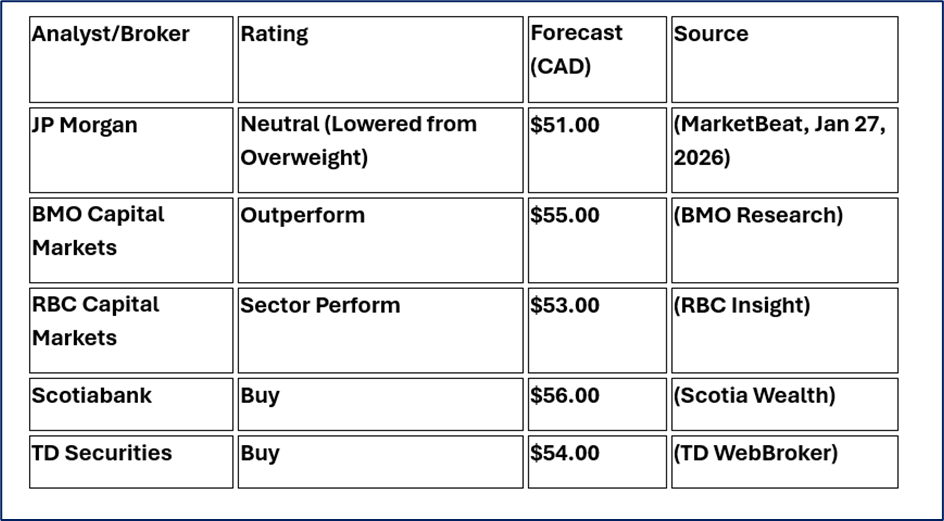
Source: Market Data
What Are the Key Risks for Enbridge Investors in 2026?
- Regulatory Hurdles: Future pipeline expansions face intense environmental scrutiny.
- Interest Rate Volatility: As a capital-intensive business, higher-for-longer rates increase interest expense.
- Energy Transition Speed: If the shift to EV/Renewables happens faster than the "Gas-as-a-Bridge" theory, long-term volumes could decline.
Latest FAQ for Investors
Q: When is the next Enbridge dividend payment?
A: The next dividend of $0.97 is payable on March 1, 2026, for shareholders of record on February 17, 2026.
Q: Is the Enbridge dividend safe?
A: Yes. The payout ratio remains within the target 60-70% of DCF, which is the "gold standard" for midstream sustainability.
Q: How does Enbridge benefit from AI?
A: AI data centers require massive, 24/7 power. Enbridge's natural gas utilities provide the fuel for the turbines that generate this electricity, creating a new, high-growth demand source.
Analytical Investment Conclusion: Buy, Sell, or Hold?
For the passive income seeker, Enbridge is a screaming BUY on any dips below $47.00. For the growth investor, it is a solid HOLD, as the massive capital expenditure program in 2026 may limit immediate share price "explosions." However, in a volatile 2026 market where the TSX is testing all-time highs, Enbridge provides the utility-like stability and inflation-protected income that every diversified portfolio needs.


 Jun 24, 2026




 Please wait processing your request...