
 NZ
 UK
 US
 AU
 IND

 CA

 Share
 X (Formerly Twitter)
 Whatsapp
 Facebook
 LinkedIn
 Telegram
 Email This Article
 Copy Link
 Summarize with AI
 Chat GPT
 Perplexity

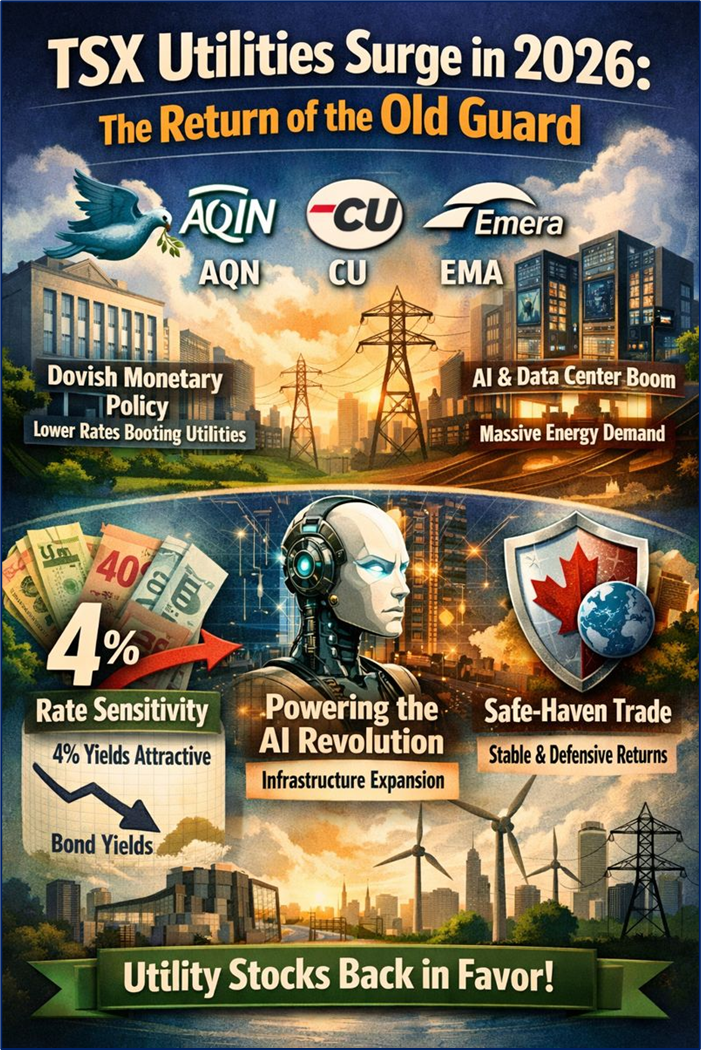
As the TSX Composite flirts with record highs in early 2026, a surprising leadership shift has emerged: the resurgence of the "Old Guard" utility sector. While technology dominated the previous year, the narrative for 2026 has pivoted toward stability and sustainable yield. Algonquin Power & Utilities (AQN), Canadian Utilities (CU), and Emera (EMA) have become the focal points for investors seeking to balance a 4% yield threshold with defensive growth.
This resurgence is fueled by a "Goldilocks" environment of moderating interest rates and a massive infrastructure build-out required to support the global AI and data centre boom.
Source: Kalkine Group
Latest Drivers and Reasons for the 2026 Sector Surge
The primary catalyst for the current surge in TSX utility stocks is the definitive pivot in global monetary policy. As of January 2026, the Federal Reserve and the Bank of Canada have signaled a continued "dovish tilt," which lower borrowing costs—a critical factor for capital-intensive utilities. Furthermore, the "safe-haven" trade has intensified due to geopolitical frictions, leading investors back to regulated assets with predictable cash flows.
- Rate Sensitivity: Lower yields on government bonds have made the 4% spreads offered by AQN, CU, and EMA significantly more attractive to income-focused retail and institutional desks.
- The AI Power Gap: There is an increasing realization that the AI revolution is energy-hungry; utilities with regulated transmission and distribution networks are the primary beneficiaries of the required grid upgrades.
- Operational De-risking: Recent asset sales and "pure-play" restructurings have cleaned up balance sheets, allowing companies to focus on core regulated earnings rather than volatile non-regulated projects.
Algonquin Power & Utilities Corp. (AQN)
Current Business Model: Following its strategic transformation completed in early 2025, AQN has transitioned into a pure-play regulated utility. By divesting its non-regulated renewable energy business to LS Power and selling its stake in Atlantica Sustainable Infrastructure, the company has narrowed its focus to providing electricity, gas, and water services to over 3 million customers across North America and beyond.
Latest Financial & Operational Updates:
- Cash Flow Surge: AQN reported a nearly 25% jump in cash flow in its latest update, reaching $171.3 million, driven by improved cost discipline and lower interest expenses (Company Source: Q3 2025 Financial Report / January 2026 Update).
- Dividend Stability: The quarterly dividend has been maintained at $0.065 USD ($0.0918 CAD), representing a sustainable payout ratio of approximately 60% to 70% of annual earnings (Company Source: Press Release Nov 7, 2025).
- Capital Spending: AQN has committed to a $2.5 billion capital investment plan between 2025 and 2027 focused exclusively on regulated utility upgrades (Company Source: Jan 19, 2026 Strategic Update).
SWOT Analysis:
- Strengths: Simplified business model; high percentage of regulated earnings; improved liquidity from asset sales.
- Weaknesses: History of dividend cuts (2024) still weighs on long-term sentiment; moderate revenue growth.
- Opportunities: Expansion of water and wastewater infrastructure in the U.S. sunbelt.
- Threats: Regulatory lag in rate case approvals; potential for higher-than-expected inflation in construction costs.
Canadian Utilities Limited (CU)
Current Business Model: Part of the ATCO Group, Canadian Utilities is a diversified global enterprise delivering essential services in energy, structures, and logistics. Its core remains its regulated electricity and natural gas distribution and transmission assets, primarily in Alberta and Australia.
Latest Financial & Operational Updates:
- Dividend Aristocrat Status: On January 13, 2026, the Board declared a quarterly dividend of $0.4623 per share, a 1% increase, marking over 50 consecutive years of increases—the longest streak for any Canadian publicly traded company (Company Source: Jan 2026 Dividend Declaration).
- Infrastructure Growth: The company continues to advance the Yellowhead Pipeline Project and has integrated new leadership with CEO Bob Myles to spearhead energy transition initiatives (Company Source: Operational Update Q4 2025).
- Yield Metrics: As of late January 2026, CU offers a forward yield of approximately 4.25% (Market Data: Jan 24, 2026).
SWOT Analysis:
- Strengths: Unparalleled dividend track record; highly diversified geographical footprint (Canada, Australia, Latin America).
- Weaknesses: High payout ratio (over 90% of earnings) leaves limited room for massive capital reinvestment without debt.
- Opportunities: Growth in hydrogen and renewable natural gas (RNG) infrastructure.
- Threats: Political and regulatory shifts in the Alberta power market; currency fluctuations in international operations.
Emera Inc. (EMA)
Current Business Model: Headquartered in Halifax, Emera operates a portfolio of regulated electric and gas utilities. Its primary assets include Tampa Electric, Nova Scotia Power, and Peoples Gas. The model is built on a "Cleaner Energy" strategy, aggressively transitioning from coal to natural gas and renewables.
Latest Financial & Operational Updates:
- Consistent Growth: Emera declared a quarterly dividend of $0.7325 per share in January 2026, following a 1% annual increase in late 2025. This marks 19 consecutive years of dividend growth (Company Source: Jan 13, 2026 Press Release).
- Rate Base Guidance: Management reiterated a forecasted 7% to 8% rate base growth through 2029, supported by a $2.93 annualized dividend (Company Source: Q2 2025 MD&A / Sept 2025 Update).
- Operational Focus: The company is prioritizing "energizing modern life" through its 2.6 million customer base, focusing on Florida’s growing demand for cooling and power (Company Source: Jan 2026 Investor Presentation).
SWOT Analysis:
- Strengths: Strong exposure to the high-growth Florida market; clear 5% to 7% EPS growth target.
- Weaknesses: High debt-to-equity ratio typical of the sector; exposure to Atlantic hurricane risks.
- Opportunities: Massive solar expansion in Florida; electrification of the Maritimes.
- Threats: Regulatory friction in Nova Scotia; rising costs for storm hardening and climate adaptation.
Sector Outlook and Risks
The outlook for TSX utilities for the remainder of 2026 is cautiously optimistic. The sector acts as a "bond proxy," meaning its performance will remain tethered to the trajectory of interest rates. As long as inflation remains contained and central banks avoid aggressive hikes, the 4% yield threshold should act as a floor for these stocks.
Key Risks:
- Regulatory Decisions: Any adverse rulings on rate cases could immediately impact the ability to pass costs to consumers.
- Capital Expenditures: The "AI-led" grid expansion requires billions in new spending, which could pressure cash flows if project timelines slip.
- Cost of Capital: While rates are stabilizing, they remain higher than the 2010–2020 average, keeping interest expense as a significant line item on income statements.
The combination of Algonquin’s lean new structure, Canadian Utilities’ legendary consistency, and Emera’s exposure to the Florida growth engine provides a comprehensive look at the utility landscape. In a 2026 market that prizes "certainty" above all else, these three firms represent the foundational infrastructure of the Canadian dividend ecosystem.


 Nov 20, 2026





 Please wait processing your request...