
 NZ
 UK
 US
 AU
 IND

 CA

 Share
 X (Formerly Twitter)
 Whatsapp
 Facebook
 LinkedIn
 Telegram
 Email This Article
 Copy Link
 Summarize with AI
 Chat GPT
 Perplexity

In an era where market volatility frequently tests investor patience, Gibson Energy (TSX: GEI) has emerged as a cornerstone of stability within the North American energy landscape, currently offering a compelling dividend yield of approximately 6.5% to 6.7%. As a premier liquids infrastructure company, Gibson operates at the vital intersection of supply and demand, managing "crown jewel" assets that facilitate the movement of crude oil from the Western Canadian Sedimentary Basin (WCSB) and the U.S. Permian Basin to global markets.
With a business model increasingly insulated from commodity price swings through long-term, take-or-pay contracts, the company has successfully transitioned into a highly predictable infrastructure vehicle. As of January 2026, the convergence of record throughput levels at its Edmonton and Hardisty terminals, combined with a strategic expansion into the U.S. Gulf Coast, has positioned Gibson as a critical enabler of North American energy exports, making its current yield a focal point for income-oriented portfolios.
Latest Drivers and Key Reasons for Surge
Source: Kalkine Group
The recent momentum in Gibson Energy’s stock and operational profile is driven by several transformative factors that have materialized over the last year.
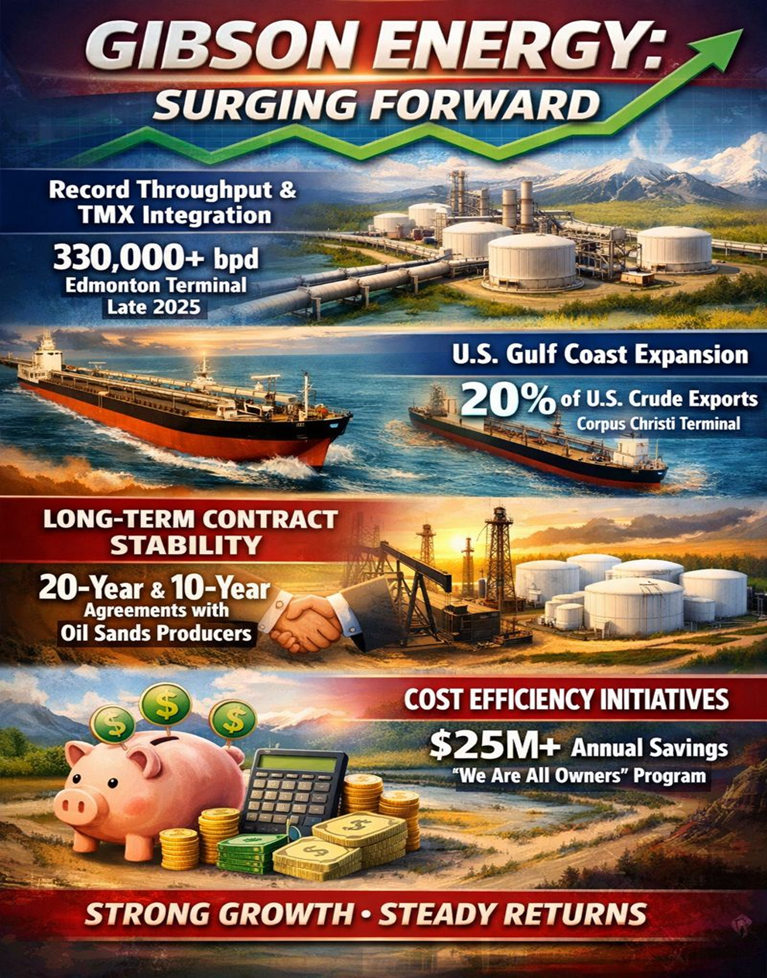
- Record Throughput and TMX Integration: The full-scale operation of the Trans Mountain Expansion (TMX) has fundamentally altered Western Canadian logistics. Gibson has captured significant volumes, reporting record throughput at its Edmonton terminal exceeding 330,000 barrels per day (bpd) in late 2025—more than double the volumes from the previous year (Gibson Q3 2025 Report).
- U.S. Gulf Coast Expansion: The strategic integration of the Gateway Terminal in Corpus Christi, Texas, has provided Gibson with a significant foothold in the world’s most active crude export hub. The company now manages approximately 20% of total U.S. crude exports through this facility (Gibson 2025 Investor Day).
- Long-Term Contract Stability: The recent announcement of major contract extensions at the Edmonton Terminal, including 20-year and 10-year take-or-pay agreements with senior oil sands producers, has significantly extended the company’s weighted average contract life (Financial Post, Dec 2025).
- Cost Efficiency Initiatives: The "We Are All Owners" initiative has successfully identified over $25 million in run-rate cost savings, enhancing the company’s distributable cash flow (DCF) even in periods where marketing margins are compressed (Gibson Q3 2025 Release).
Current Business Model
Gibson Energy operates under a bifurcated business model, though it has strategically pivoted to ensure the vast majority of its profit is derived from stable infrastructure.
- Infrastructure Segment: This is the core engine, contributing over 95% of the company's segment profit in recent quarters. It includes a massive network of storage terminals (over 25 million barrels of capacity), pipelines, and processing facilities. Most of this revenue is secured by "take-or-pay" or "fee-for-service" contracts, meaning Gibson gets paid regardless of the actual volume of oil flowing through the system.
- Marketing Segment: This segment utilizes Gibson's asset base to optimize crude quality and capture price differentials. While more volatile than infrastructure, it provides "top-up" earnings. The company has purposefully reduced the weight of this segment to lower the overall risk profile of the stock.
Latest Financial, Operational, and Dividend Updates (company sourced)
Based on the most recent corporate disclosures as of January 2026, Gibson Energy continues to demonstrate financial resilience despite a mixed earnings environment.
- Financial Performance: In its Q3 2025 results, Gibson reported revenue of $2.88 billion, significantly beating analyst forecasts of $2.39 billion due to high volumes. However, Adjusted EBITDA of $147 million was slightly down year-over-year, primarily due to lower margins in the marketing segment (Gibson Q3 2025 Management Discussion & Analysis).
- Operational Excellence: The company achieved its highest-ever quarterly throughput at the Hardisty terminal (over 1.1 million bpd) and maintained an industry-leading safety record with over 10 million hours worked without a lost-time injury (Gibson 2025 Investor Day).
- Dividend Growth: Gibson recently confirmed a quarterly dividend of $0.43 per share ($1.72 annualized), with the next payment scheduled for April 17, 2026. The company has a 15-year history of dividend payments and has increased its payout for six consecutive years (Gibson Investor Centre).
- 2026 Guidance: Management has sanctioned $150 million in growth capital for 2026, including the "Wink-to-Gateway" project in Texas, which will integrate Permian and Eagle Ford flows to increase export capacity (Gibson Press Release, Dec 2025).
Latest SWOT Analysis (2026)
Source: Kalkine Group
Strengths
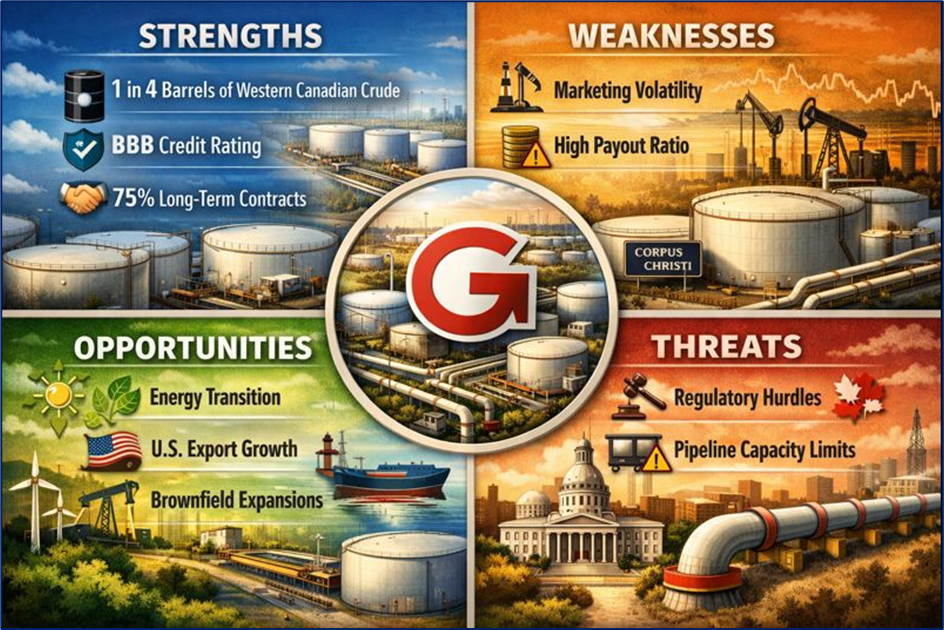
- Dominant Market Position: 1 in 4 barrels of Western Canadian crude flows through a Gibson terminal.
- Investment Grade Credit: Maintains BBB/BBB (low) ratings, providing access to low-cost capital for expansion.
- High Contract Coverage: Approximately 75% of infrastructure revenue is backstopped by long-term take-or-pay agreements.
Weaknesses
- Marketing Volatility: While small, the marketing segment remains sensitive to narrowing crude differentials, which can lead to earnings misses.
- High Payout Ratio: On a GAAP earnings basis, the payout ratio appears high, though it remains well-covered by stable distributable cash flow (Simply Wall St).
Opportunities
- Energy Transition: Potential to repurpose existing infrastructure for low-carbon liquids, such as biofuels and renewable diesel.
- U.S. Export Growth: The Corpus Christi facility is positioned to benefit from the projected 2026-2027 surge in U.S. crude exports.
- Brownfield Expansions: Low-cost "tuck-in" projects at existing sites offer high internal rates of return (IRR).
Threats
- Regulatory Hurdles: Stringent environmental regulations in Canada can delay new project approvals by two years or more.
- Egress Constraints: If production growth exceeds new pipeline capacity by 2027, it could temporarily impact throughput volumes.
Outlook and Risks
The outlook for Gibson Energy through 2026 remains cautiously optimistic, anchored by its aggressive expansion in the U.S. and its critical role in Canadian oil sands logistics. Management expects to reach a target net debt-to-EBITDA ratio of 3.0x to 3.5x by mid-2026, which would further solidify the balance sheet (CFO Riley Hicks, Nov 2025).
However, investors should monitor specific risks. These include potential project delays or cost overruns on the Wink-to-Gateway integration and the broader impact of fluctuating interest rates on midstream capital intensity. Additionally, while the TMX expansion is a current tailwind, any future shifts in global crude demand could affect long-term terminal utilization.
Compelling Conclusion
Gibson Energy stands as a quintessential "toll-booth" operator in the North American energy sector. By pivoting its business model toward 95% infrastructure-weighted profit and securing decades-long contracts with investment-grade producers, the company has transformed into a resilient cash-flow machine. With a dividend yield that consistently outpaces the broader TSX and a clear growth roadmap through its Texas export hubs, Gibson provides a rare combination of high-income certainty and strategic exposure to the global energy supply chain. As the world continues to demand reliable energy security, the infrastructure owned by Gibson remains more relevant—and more utilized—than ever before.


 Nov 20, 2026





 Please wait processing your request...