
 AU
AU
 UK
UK
 US
US
 NZ
NZ
 IND
IND

 CA
CA

 Share
Share
 X (Formerly Twitter)
 Whatsapp
 Facebook
 LinkedIn
 Telegram
 Email This Article
 Copy Link
 Summarize with AI
 Chat GPT
 Perplexity
With global industrial automation accelerating, AI-driven manufacturing expanding, and reshoring trends reshaping supply chains, can ATS Corporation deliver sustained earnings growth and shareholder value in 2026 and beyond?
Key Takeaways – February 2026 (Latest Update)
- ATS Corporation shares gained 4.4% on 10 February 2026, outperforming parts of the TSX industrial automation segment
- Momentum supported by improving global manufacturing sentiment and stability in the S&P/TSX Composite Index
- Structural exposure to EV battery automation, life sciences, pharmaceuticals, food & beverage, robotics, and smart manufacturing
- Dividend yield remains modest but sustainable, reflecting a reinvestment-first growth strategy
- Analysts maintain a generally constructive outlook, citing backlog visibility and margin discipline
Why Is ATS Corporation Stock Trending on the TSX in February 2026?
ATS Corporation has emerged as one of the most actively discussed Canadian industrial automation stocks after its 4.4% rally on 10 February 2026. Investor attention has intensified amid renewed enthusiasm for:
- AI-powered manufacturing systems
- Smart factories and Industry 4.0 integration
- Robotics and digital production platforms
- EV battery manufacturing automation
- Pharmaceutical and life sciences production systems
As global supply chains stabilize and capital expenditure cycles begin recovering across North America and Europe, ATS is increasingly viewed as a high-quality Canadian growth stock positioned at the intersection of artificial intelligence, electrification, and advanced manufacturing.
Broader market dynamics reinforce this trend. The February 2026 rotation into cyclicals and industrials on the TSX reflects renewed confidence in global GDP resilience, moderating inflation, and potential stabilization in interest rate policy.
How Is the S&P/TSX Composite Index Influencing ATS in February 2026?
The S&P/TSX Composite Index has demonstrated improving sector breadth in February 2026, with industrials and materials contributing meaningfully to gains.
A firmer Canadian macroeconomic backdrop — supported by resilient employment data and stabilizing inflation — has revived risk appetite for quality growth cyclicals such as ATS.
This macro setup matters because:
- Industrial capex cycles typically follow economic stabilization
- Tight labor markets increase demand for automation efficiency
- Manufacturers prioritize productivity investment during moderate growth phases
If TSX momentum continues, institutional flows into automation names like ATS could remain supportive.
How Are Canada’s Economy and the Canadian Dollar Affecting ATS?
Canada’s February 2026 macro environment reflects:
- Moderating inflation pressures
- Stable employment conditions
- Gradually normalizing central bank policy expectations
A relatively stable Canadian dollar versus the U.S. dollar enhances earnings visibility for ATS, given its meaningful U.S. and international revenue exposure. Currency stability reduces volatility and supports margin predictability — a key consideration for long-term industrial investors.
What Is ATS Corporation’s Business Model and Competitive Advantage in 2026?
ATS operates as a global automation and integration solutions provider, delivering:
- Custom automation systems
- Robotics integration
- Digital manufacturing platforms
- EV battery production lines
- Pharmaceutical and life sciences automation systems
Its diversified end-market exposure — spanning EV, healthcare, consumer goods, and food & beverage — reduces reliance on any single industry cycle.
Key competitive strengths include:
- Strong order backlog visibility
- Recurring service revenue streams
- Deep engineering and integration expertise
- Disciplined, acquisition-led growth strategy
This diversified automation platform aligns directly with structural megatrends including AI-enabled manufacturing, electrification of transport, and global supply chain reshoring.
Is the Dividend Attractive or Is Growth the Core Story?
ATS is not positioned as a high-yield income stock. Its dividend yield remains modest relative to TSX income leaders.
However:
- Dividend sustainability appears stable
- Capital allocation prioritizes reinvestment and strategic acquisitions
- Management emphasizes total shareholder return via earnings growth
For growth-oriented investors, ATS represents a capital appreciation story rather than a yield-focused investment.
What Drove the 4.4% Surge on 10 February 2026?
The recent rally appears supported by:
- Improved global manufacturing PMI data
- Continued EV investment cycle momentum
- Strong backlog visibility
- Positive sector sentiment within TSX industrials
- Constructive analyst commentary in February 2026
Operational focus on margin discipline and execution has reinforced investor confidence in earnings durability.
How Does ATS Compare to Global Automation Peers?
Relative positioning highlights:
- Stronger exposure to EV battery automation than traditional machinery peers
- Broader end-market diversification than single-sector automation providers
- Moderate leverage relative to larger U.S. automation competitors
Compared to U.S.-listed automation majors, ATS trades at a relative valuation discount — reflecting its mid-cap TSX status — while offering potential multiple expansion if execution remains consistent.
What Is the Short-Term Outlook (3–6 Months)?
Short-Term Bias: Moderately Bullish
Bullish Drivers:
- Sector rotation into industrials
- Stable Canadian macro backdrop
- Continued EV manufacturing investment
- Momentum-driven institutional inflows
Bearish Risks:
- Global slowdown fears
- Capex delays in automotive or life sciences
- Currency volatility
While short-term sentiment appears constructive following the February surge, cyclical volatility remains possible.
What Is the Medium-Term Outlook Through Late 2026?
Medium-term performance will depend on:
- EV adoption rates and battery manufacturing investment
- Pharmaceutical automation demand
- North American reshoring policy momentum
- Interest rate trajectory and global growth stability
If global capex cycles expand, ATS could benefit from multi-quarter order momentum and backlog conversion.
What Is the Long-Term Investment Thesis?
The long-term structural case centers on:
- AI-powered manufacturing transformation
- Accelerating robotics adoption
- EV supply chain buildout
- Healthcare and pharma automation growth
- Smart factory digitization
If ATS maintains disciplined acquisition strategy, backlog execution, and margin management, its structural growth narrative remains intact beyond 2026.
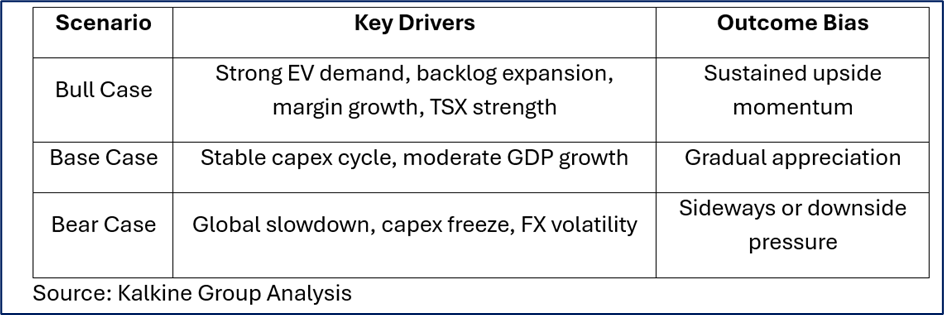
Bull vs Bear Case Matrix – February 2026
What Are Analysts Saying in February 2026?
Based on broker research summaries (February 2026):
- Majority ratings: Outperform / Buy
- Some: Hold
- Limited Neutral views
- Price targets generally positioned in the mid-to-high CAD range relative to recent trading levels
Consensus tone remains constructive, supported by backlog visibility and structural automation exposure.
Key Risks Investors Should Monitor
- Global recession risk
- EV demand deceleration
- Project execution or integration delays
- Acquisition integration challenges
- Currency fluctuations
- Competitive pressure from global automation leaders
Strategic Framework for Investors
Short Term:
Monitor TSX industrial momentum, manufacturing PMI trends, and breakout volume confirmation.
Medium Term:
Track quarterly backlog growth, EV battery automation demand, and margin expansion trends.
Long Term:
Evaluate global automation penetration rates, AI integration strategy, and reshoring investment cycles.
Final Investment Conclusion – February 2026
ATS Corporation reflects a structurally compelling automation growth narrative supported by:
- TSX industrial sector rotation
- Stabilizing global manufacturing trends
- EV supply chain expansion
- AI-driven smart factory transformation
Short-term momentum appears constructive following the 4.4% rally. Long-term structural megatrends in automation, robotics, and electrification remain intact. However, macroeconomic cyclicality and capital expenditure dynamics remain key variables.
This analysis is for informational purposes only and does not constitute investment advice.


 Jun 24, 2026




 Please wait processing your request...