
 AU
AU
 UK
UK
 US
US
 NZ
NZ
 IND
IND

 CA
CA

 Share
Share
 X (Formerly Twitter)
 Whatsapp
 Facebook
 LinkedIn
 Telegram
 Email This Article
 Copy Link
 Summarize with AI
 Chat GPT
 Perplexity
Views Expressed Disclaimer:
You are reading a free article with opinions that may differ from the recommendation given by Kalkine in its paid research reports. Become a Kalkine member today to get access to our research reports, in-depth technical and fundamental research.
Can Denison Mines deliver project-driven growth and shareholder returns? Explore risks, catalysts, and long-term potential.
Key Takeaways — February 2026
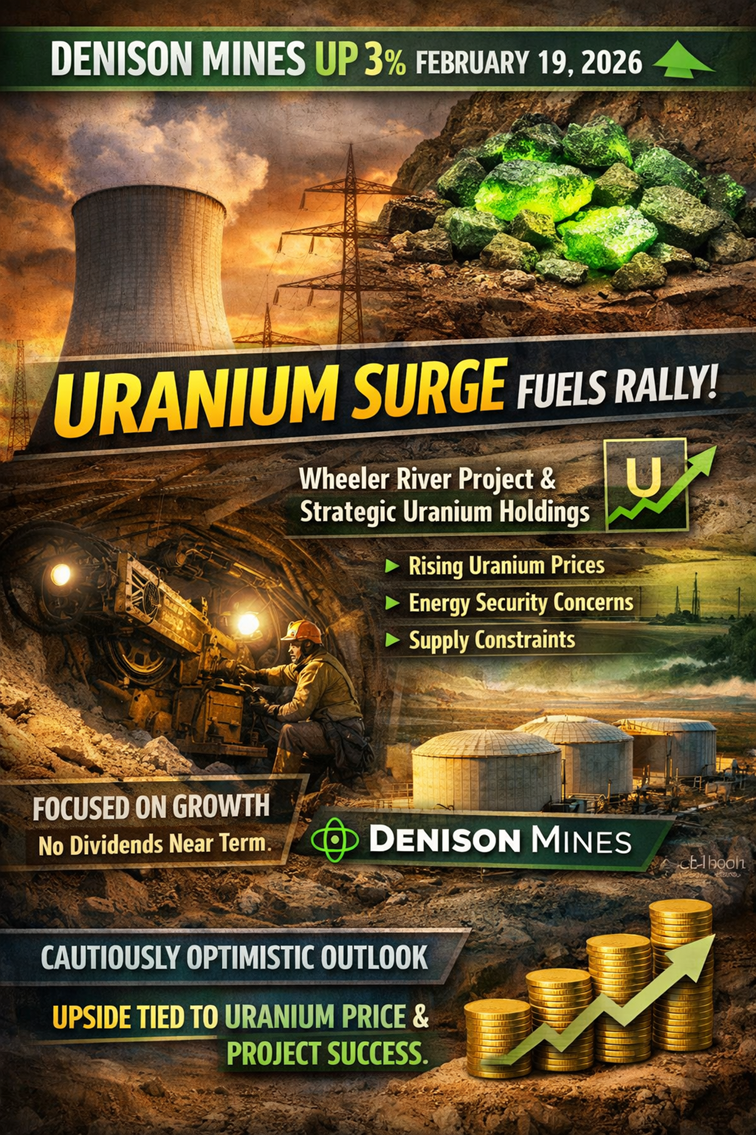
- Denison Mines stock rose approximately 3% on 19 February 2026, supported by strengthening uranium prices, improving nuclear energy sentiment, and renewed investor interest in TSX uranium mining stocks.
- Structural global demand for nuclear energy, energy security concerns, and supply constraints continue to drive bullish long-term uranium narratives.
- The company’s Wheeler River uranium project and strategic uranium holdings remain key valuation catalysts (company disclosures).
- Dividend payments remain unlikely near term as capital is prioritized for development and growth initiatives.
- Analysts maintain cautiously optimistic outlooks with upside tied primarily to uranium price cycles and project execution milestones.
Source: Kalkine Group
Why Is Denison Mines Stock Rising Today in February 2026 and What Is Driving Investor Attention?
Denison Mines stock, TSX uranium stocks, Canadian mining stocks, nuclear energy investments, uranium price forecast 2026, best uranium stocks to buy now, and clean energy transition investments are among the most searched financial keywords globally as investors hunt for high-growth commodity opportunities. Denison Mines shares gained roughly 3% on 19 February 2026, reflecting renewed optimism surrounding uranium markets and nuclear energy demand expectations, which are driving capital flows back into the uranium mining sector.
The rally is occurring within a broader macro environment where commodity equities are benefiting from expectations of monetary easing, improving global growth sentiment, and long-term structural supply deficits across critical energy materials. Investors searching for “top TSX mining stocks,” “nuclear energy stocks Canada,” and “uranium bull market 2026” are increasingly identifying Denison Mines as a leveraged play on future uranium price appreciation due to its project portfolio and strategic positioning.
Momentum has also been supported by sector-wide sentiment improvements following policy support for nuclear power in multiple countries, growing recognition of nuclear energy’s role in decarbonization, and expectations that uranium supply shortages could emerge later this decade.
How Are Global Uranium Markets and Nuclear Energy Trends Supporting the Investment Thesis?
The uranium sector is undergoing a structural transformation driven by energy transition priorities, geopolitical energy security concerns, and decarbonization mandates. Nuclear power is increasingly viewed as a critical baseload energy source capable of supporting renewable energy expansion while maintaining grid stability.
Major global catalysts include:
- Expansion of nuclear reactor construction pipelines globally
- Government incentives supporting nuclear energy adoption
- Increasing investment in small modular reactor (SMR) technology
- Long-term uranium supply shortages due to underinvestment
- Utility contracting cycles strengthening uranium demand
These macro factors create a supportive environment for uranium developers like Denison Mines, whose valuation is highly sensitive to future uranium price expectations.
What Role Are the Canadian Economy, TSX Composite, and Canadian Dollar Playing in the Rally?
Canada’s resource-heavy equity market structure provides natural leverage to commodity cycles. The TSX Composite Index contains significant exposure to mining, energy, and materials companies, which tend to outperform during commodity upcycles.
Key macroeconomic influences include:
- Expectations of potential Bank of Canada interest rate cuts
- Commodity-driven economic resilience in Canada
- Institutional capital rotation toward resource sectors
- Stable Canadian dollar relative to global currencies
Because uranium is typically priced in US dollars while many operating costs occur in Canadian dollars, currency stability can positively influence mining project economics.
What Is Denison Mines’ Business Model and Strategic Competitive Advantage?
Denison Mines operates as a uranium exploration, development, and investment company focused primarily on the Athabasca Basin region in Saskatchewan, one of the highest-grade uranium mining jurisdictions globally. Its flagship Wheeler River project is widely considered among the largest undeveloped uranium projects worldwide (company filings).
Strategic advantages include:
- High-grade uranium asset exposure
- Innovative in-situ recovery mining approach
- Strategic uranium inventory holdings
- Joint venture partnerships reducing capital risk
- Significant leverage to uranium price upside
The company’s hybrid model of project development combined with uranium asset exposure provides both operational and commodity-price optionality.
Does Denison Mines Offer Dividends and What Is the Long-Term Income Outlook?
Denison Mines does not currently pay dividends, as management is prioritizing capital allocation toward project advancement and long-term growth opportunities. Investors searching for “uranium dividend stocks” may find limited income potential in the near term.
Future dividend potential depends on:
- Successful transition to production
- Sustained higher uranium prices
- Free cash flow generation
- Balance sheet optimization
Until production begins, Denison remains primarily a growth-oriented investment rather than an income-focused stock.
How Does Denison Mines Compare With Other Leading Uranium Companies?
When benchmarked against peers such as major uranium producers and developers, Denison Mines occupies a high-growth but higher-risk position due to its development-stage status.
Comparative positioning highlights:
- Established producers offer revenue stability
- Large developers offer scale potential
- Denison offers innovation and price leverage
- Diversified players provide commodity risk mitigation
Denison’s valuation sensitivity to uranium prices may be greater than mature producers, making it more volatile but potentially more responsive during bullish cycles.
What Are the Short-Term, Medium-Term, and Long-Term Outlooks for the Stock and Sector?
Short-term outlook over the next several months appears moderately positive due to improving uranium sentiment, speculative trading interest, and macro commodity tailwinds.
Medium-term performance will depend on:
- Uranium price direction
- Project development milestones
- Financing conditions
Long-term outlook remains structurally constructive if nuclear energy adoption accelerates and uranium supply deficits materialize as projected.
What Forward-Looking Strategies Could Investors Evaluate Across Different Time Horizons?
Short-term approaches often focus on:
- Monitoring uranium price momentum
- Tracking technical market signals
- Watching macroeconomic catalysts
Medium-term perspectives typically emphasize:
- Project development progress
- Capital requirements and partnerships
- Industry supply-demand trends
Long-term considerations include:
- Global nuclear energy adoption
- Structural uranium shortages
- Company execution capability
Aligning investment horizon with risk tolerance is essential when evaluating development-stage mining equities.
Is Denison Mines Stock Currently Bullish, Bearish, or Neutral?
Short-term sentiment appears cautiously bullish due to positive sector momentum and improving macro conditions. However, volatility remains elevated because the company is not yet producing uranium.
Long-term sentiment trends constructive if uranium prices enter a sustained multi-year upcycle and development milestones are achieved successfully.
Key directional forces include:
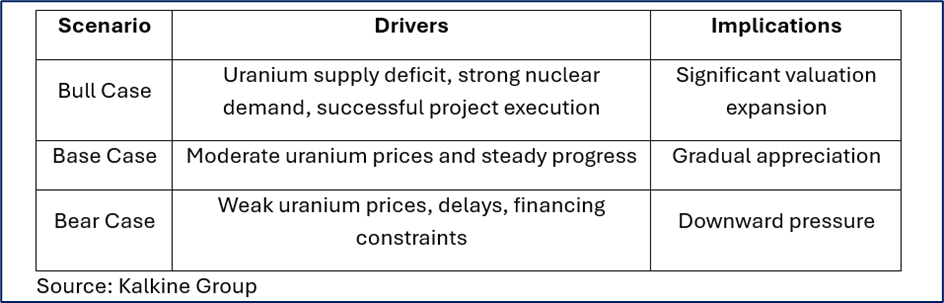
- Bullish drivers: uranium demand growth, project quality, macro tailwinds
- Bearish risks: execution delays, financing needs, commodity volatility
- Neutral factors: uncertain timelines and market cycles
What Are Analysts Saying About Denison Mines Valuation and Future Potential?
Consensus analyst views remain moderately positive with expectations tied to uranium market dynamics.
Latest analyst estimates (February 2026 consensus sources including Bloomberg and EODHD/Others):
- RBC Capital Markets: CAD 3.00
- Cantor Fitzgerald: CAD 3.25
- Scotiabank: CAD 2.80
- TD Securities: CAD 3.10
- BMO Capital Markets: CAD 2.75
Overall sentiment suggests potential upside contingent on favorable uranium price trends and project execution.
What Key Risks Could Impact Future Performance?
Investors are monitoring several critical risks:
- Uranium price volatility
- Project development delays
- Capital cost inflation
- Regulatory approvals
- Market sentiment toward nuclear energy
Development-stage mining companies typically exhibit higher uncertainty compared with established producers.
What Bull and Bear Scenarios Could Shape the Stock’s Future?
What Are Investors Frequently Asking About Denison Mines?
Is Denison Mines a good uranium stock for 2026?
It offers strong leverage to uranium prices but carries development risks.
Does the company pay dividends?
Currently no regular dividend due to growth priorities.
What is the biggest catalyst?
Uranium price increases and Wheeler River project milestones.
Is nuclear energy demand growing globally?
Yes, many governments are expanding nuclear capacity to meet climate and energy goals.
What Is the Final Investment Perspective for February 2026?
Denison Mines represents a high-beta uranium growth opportunity closely tied to macro nuclear energy trends, commodity cycles, and project execution success. The February 2026 share price increase primarily reflects improving sector sentiment rather than immediate financial performance changes.
The company offers meaningful upside potential if uranium markets tighten structurally and nuclear energy adoption accelerates globally. However, investors must also consider development risks, capital requirements, and commodity volatility when evaluating long-term prospects.
This analysis is informational and intended to support independent research.


 Jun 24, 2026




 Please wait processing your request...