
 AU
AU
 UK
UK
 US
US
 NZ
NZ
 IND
IND

 CA
CA

 Share
Share
 X (Formerly Twitter)
 Whatsapp
 Facebook
 LinkedIn
 Telegram
 Email This Article
 Copy Link
 Summarize with AI
 Chat GPT
 Perplexity
Views Expressed Disclaimer:
You are reading a free article with opinions that may differ from the recommendation given by Kalkine in its paid research reports. Become a Kalkine member today to get access to our research reports, in-depth technical and fundamental research.
Key Takeaways — Latest February 2026
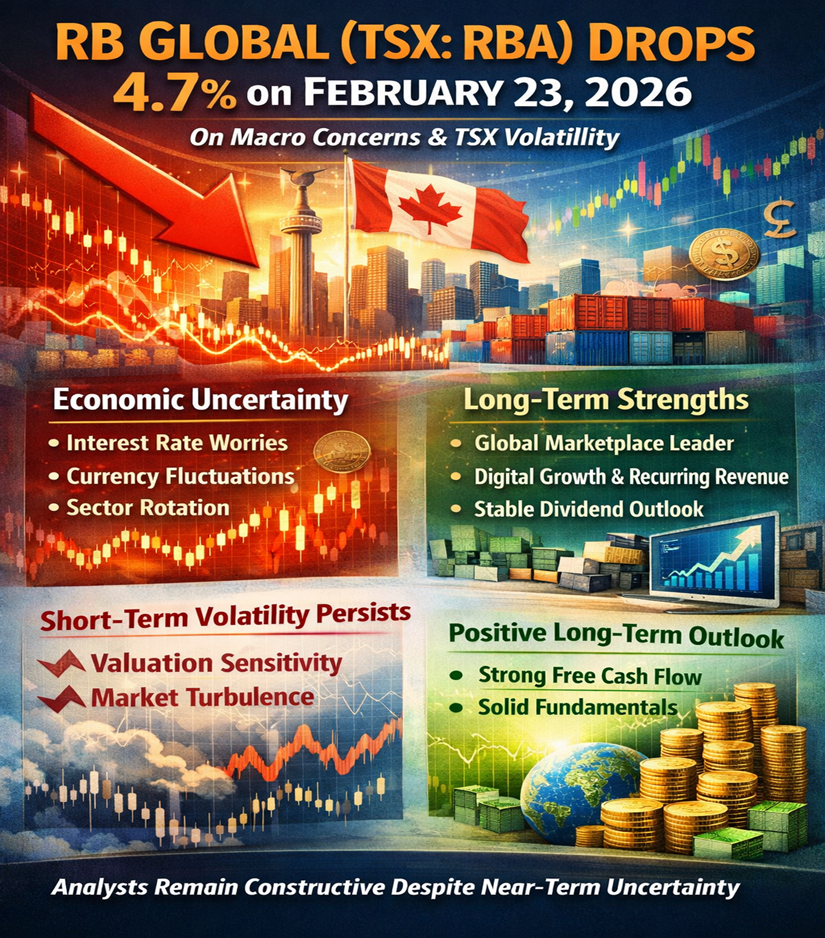
- RB Global (TSX: RBA) declined approximately 4.7% on 23 February 2026 mainly due to macroeconomic sentiment, TSX volatility, and sector rotation rather than company-specific deterioration.
• Canada economic uncertainty, interest rate expectations, and currency fluctuations contributed to cautious investor sentiment across industrial stocks.
• Long-term fundamentals remain supported by global marketplace leadership, digital platform growth, and recurring revenue expansion (company filings).
• Dividend outlook remains stable due to strong free cash flow and operational efficiency initiatives (company filings).
• Analysts remain broadly constructive long term, although short-term volatility may persist due to valuation sensitivity.
Source: Kalkine Group
Why Is RB Global (TSX: RBA) Stock Falling in February 2026?
RB Global stock, TSX RBA share price, Canadian industrial stocks, TSX Composite outlook 2026, Canada economy forecast, and RB Global dividend growth are currently trending across global investor platforms following the February decline. The share price drop appears primarily sentiment-driven rather than caused by any major deterioration in company fundamentals.
Several overlapping factors contributed to the weakness:
- Global equity markets entered a risk-off phase due to uncertainty around interest rate timing.
• Industrial and cyclical stocks experienced rotation toward defensive sectors.
• Profit-taking followed previous strong performance periods.
• Currency volatility and macro headlines created short-term investor caution.
No major negative company-specific announcements were reported during the period, reinforcing the view that the movement was largely macro driven.
How Are Global Market Conditions Influencing RB Global and Industrial Stocks?
The global macro environment in early 2026 is shaped by three dominant themes:
- Interest rates remaining higher for longer across developed economies.
• Slower but resilient global growth expectations.
• Normalization of industrial demand after pandemic-era expansion.
Industrial marketplace companies like RB Global often show sensitivity to economic cycles because transaction volumes correlate with capital investment, construction activity, and equipment turnover. However, RB Global also benefits from counter-cyclical characteristics, as economic stress can increase asset sales, restructuring, and liquidation activity.
This dual dynamic provides relative resilience compared with traditional cyclical industrial businesses.
What Is the Current Canada Economy and TSX Composite Outlook?
The Canadian macroeconomic backdrop remains mixed in February 2026:
- GDP growth is moderating but still positive.
• Inflation trends are gradually improving but remain elevated relative to targets.
• Interest rate policy uncertainty continues influencing investor behavior.
• Corporate investment remains cautious amid global uncertainty.
The TSX Composite Index has experienced volatility driven by:
- Commodity price fluctuations
• Financial sector sensitivity to interest rates
• Sector rotation across growth and value segments
Industrial stocks have seen short-term pressure despite relatively stable earnings outlooks, highlighting sentiment rather than fundamentals as the primary driver.
How Does the Canadian Dollar (CAD) Impact RB Global?
RB Global operates globally, making foreign exchange movements relevant to financial performance and investor perception.
Currency impacts include:
- Revenue translation from international markets
• Competitive positioning across regions
• Investor sentiment toward exporters
A weaker Canadian dollar can support reported revenue but also increases perceived volatility risk, influencing short-term trading patterns.
What Makes RB Global’s Business Model Attractive?
RB Global operates a global marketplace platform connecting buyers and sellers of commercial assets, equipment, and industrial inventory. The company’s strategic advantages include:
- Strong global network effects and liquidity
• Digital auction platform scalability
• Diversified revenue streams including services and commissions
• Data analytics enhancing pricing efficiency
Recent corporate strategy focuses on:
- Digital platform expansion
• Integration synergies from acquisitions
• Cross-selling opportunities
• Operational efficiency improvements
Company disclosures indicate continued progress in revenue growth and margin optimization initiatives (company filings).
What Are the Latest Financial and Dividend Developments?
Recent company updates highlight:
- Revenue growth supported by higher service penetration and transaction activity (company filings).
• Solid adjusted EBITDA margins reflecting operational efficiencies.
• Strong free cash flow enabling debt management and shareholder returns.
• Stable dividend policy aligned with earnings expansion.
Dividend sustainability remains supported by recurring revenue characteristics and strong cash generation.
How Does RB Global Compare With Peers?
Peer comparison within industrial marketplace and asset management sectors suggests:
Competitive strengths:
- Global scale leadership
• Brand recognition and trusted platform
• Diversified revenue mix
• Technology-driven operations
Potential limitations:
- Exposure to macroeconomic cycles
• Integration execution risk
• Premium valuation relative to some competitors
Overall competitive positioning remains favorable.
What Is the Outlook for the Industrial Sector?
Short-Term Outlook (3–6 Months):
- Continued volatility due to interest rate uncertainty and macro headlines.
• Sector rotation could persist across equity markets.
Medium-Term Outlook:
- Stabilization likely as economic clarity improves.
• Earnings resilience could support valuation recovery.
Long-Term Outlook:
- Structural growth supported by digitalization, efficiency trends, and global asset turnover demand.
• Marketplace platform models offer durable competitive advantages.
What Strategies Could Investors Consider Across Time Horizons?
Short-Term Considerations:
- Monitor macro indicators and central bank signals.
• Expect volatility and sentiment-driven movements.
Medium-Term Considerations:
- Evaluate earnings growth trajectory and integration progress.
• Watch valuation relative to historical ranges.
Long-Term Considerations:
- Focus on structural growth drivers and competitive positioning.
• Dividend reinvestment may enhance compounding potential.
These perspectives are informational, not advice.
Is RB Global Stock Bullish, Bearish, or Neutral?
Short-Term View:
Neutral to slightly bearish due to macro uncertainty and sector sentiment.
Long-Term View:
Moderately bullish based on:
- Strong business model
• Global leadership
• Recurring revenue potential
• Cash flow supporting dividends
What Are the Key Growth Drivers Ahead?
Potential catalysts include:
- Interest rate stabilization
• Strong earnings performance
• Successful acquisition integration
• Increased auction volumes during economic transitions
• Margin expansion initiatives
What Risks Could Impact the Stock?
Key risks include:
- Global economic slowdown
• Reduced transaction volumes
• Integration challenges
• Currency volatility
• Financing costs and debt levels
• Competitive pressures
What Do Analysts Forecast for RB Global?
Recent consensus from major brokerages indicates:
- Overall rating: Buy to Hold spectrum
• Estimated price target range: Approximately CAD 95 to CAD 120
• Long-term growth expectations remain positive due to marketplace scalability
(Sources: consensus analyst estimates from leading Canadian and global investment banks)
What Could Bull and Bear Scenarios Look Like?
Bull Case Drivers:
- Strong global economic recovery
• Accelerated digital adoption
• Margin expansion above expectations
• Dividend growth continuation
• Valuation multiple expansion
Bear Case Drivers:
- Prolonged economic slowdown
• Weak transaction volumes
• Integration execution challenges
• Higher financing costs
• Sector valuation compression
Scenario Matrix
Bull Scenario:
- High revenue growth
• Strong margins
• Investor confidence improves
• Dividend growth accelerates
Base Scenario:
- Moderate growth
• Stable margins
• Consistent dividends
• Normal valuation levels
Bear Scenario:
- Weak demand
• Margin pressure
• Slower dividend growth
• Valuation contraction
FAQ — Investor Questions
What caused RB Global stock to fall in February 2026?
The decline was mainly due to macroeconomic volatility and investor sentiment rather than company-specific issues.
Does RB Global pay dividends?
Yes, the company provides dividends supported by strong cash flow generation.
Is RB Global cyclical?
Partially, but its marketplace model provides some counter-cyclical resilience.
What is the long-term outlook?
Long-term prospects remain supported by digital growth, global expansion, and recurring revenue streams.
Final Investment Perspective — Informational Only
RB Global’s February 2026 share price decline appears primarily driven by macroeconomic sentiment rather than a deterioration in fundamentals. The company maintains strong competitive advantages through its global marketplace network, scalable digital platform, and recurring revenue streams.
Short-term volatility may continue due to interest rate uncertainty and broader market conditions. However, long-term structural drivers — including digital transformation, global asset turnover demand, and operational efficiencies — support a constructive outlook.
Investors focusing on long-term fundamentals rather than short-term market movements may find the company’s strategic positioning noteworthy. This content is informational only and not financial advice.


 Jun 24, 2026




 Please wait processing your request...