
 AU
AU
 UK
UK
 US
US
 NZ
NZ
 IND
IND

 CA
CA

 Share
Share
 X (Formerly Twitter)
 Whatsapp
 Facebook
 LinkedIn
 Telegram
 Email This Article
 Copy Link
 Summarize with AI
 Chat GPT
 Perplexity
As global gold discoveries become increasingly rare and capital-intensive, long-life gold developers are drawing renewed investor attention. Could Seabridge Gold Inc. (TSX:SEA) emerge as a strategic beneficiary of long-term gold supply shortages and sustained demand into 2026 and beyond?
Key Takeaways (Latest: February 2026 — Optimised for Google Featured Snippets)
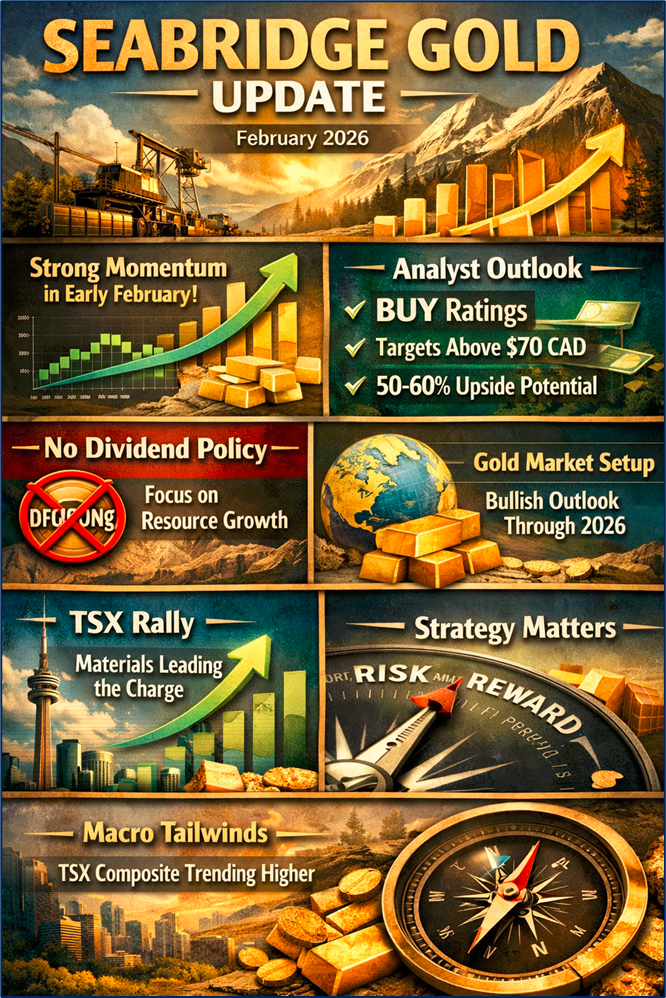
- Strong Momentum: Seabridge Gold shares surged approximately 7–10% in early February 2026, driven by renewed strength in gold prices and a broad TSX materials rally.
- No Dividend Policy: The company does not currently pay dividends, prioritising large-scale resource development and long-duration project value creation.
- Analyst Outlook: Consensus analyst ratings remain Buy, with average 12-month price targets above CAD 70, implying 50–60% potential upside from recent levels.
- Macro Tailwinds: Canada’s economic signals are mixed, but the TSX Composite Index is trending higher, supported by materials and commodities.
- Gold Market Setup: The global gold price outlook remains constructive through 2026, underpinning long-term optimism for gold developers.
- Strategy Matters: Short-, medium-, and long-term approaches differ materially depending on risk tolerance and gold cycle positioning.
Source: Kalkine Group
What Is Seabridge Gold’s Current TSX Stock Performance as of February 9, 2026?
As of February 9, 2026, Seabridge Gold shares are trading in the CAD 44.00–44.11 range, following a sharp multi-session advance that lifted the stock roughly 7–10% amid a resurgence in gold equities.
- 52-Week Range: Approximately CAD 13.40 to CAD 52.00, highlighting elevated volatility typical of pre-production gold developers.
- Technical Profile: Indicators suggest a neutral-to-bullish trend, supported by rising relative strength and improving sentiment across the materials sector.
- Income Profile: No dividend payments; capital appreciation remains the primary investment thesis.
Why Has Seabridge Gold Stock Rallied Recently?
Several powerful macroeconomic and sector-specific catalysts have contributed to Seabridge Gold’s recent price strength:
- Gold Price Resilience: Gold prices have rebounded sharply, reinforcing demand for mining equities as inflation hedges and safe-haven assets.
- Geopolitical & Inflation Risks: Persistent global uncertainty and central bank gold accumulation continue to support long-term gold demand.
- TSX Sector Rotation: Mining and materials stocks have outperformed as investors rotate back into real assets.
- Currency Dynamics: A strengthening Canadian dollar has coincided with improved commodity sentiment.
- Analyst Revisions: Upward revisions to price targets and valuation models have reinforced institutional interest.
How Do the TSX Composite and Canada’s Economy Influence Seabridge Gold?
The broader Canadian market environment has turned supportive for resource equities:
- The S&P/TSX Composite Index has advanced into February 2026, led by materials, energy, and financials.
- Canada’s labour data shows mixed signals—lower unemployment alongside softer net job creation—reflecting economic transition rather than contraction.
- A firmer Canadian dollar often aligns with stronger commodity pricing, indirectly benefiting gold-related equities.
Together, these factors form a constructive near-term backdrop for TSX-listed mining stocks.
Does Seabridge Gold Pay Dividends or Plan to in the Future?
- Current Status: Seabridge Gold does not offer a dividend at this stage.
- Reasoning: Capital is directed toward exploration, permitting, and long-term asset development.
- Future Potential: Dividends could become possible if projects transition into production, though no official guidance has been provided.
What Is the Analyst Consensus on Seabridge Gold Stock?
- Rating: Predominantly Buy across major research firms.
- Average Target Price: Approximately CAD 70–72 over the next 12 months.
- Implied Upside: More than 50% from early February 2026 trading levels.
Peer Context
Compared with established producers such as Agnico Eagle Mines and Barrick Mining, Seabridge Gold offers higher exploration leverage but carries greater execution risk, reflecting its development-stage profile.
Is Seabridge Gold Stock Bullish, Bearish, or Neutral Right Now?
Bullish Factors
- Strong gold price momentum extending into 2026
- Positive sector rotation within the TSX
- Significant analyst-implied valuation upside
Bearish Risks
- Ongoing negative earnings during development phase
- Sensitivity to gold price pullbacks
- Execution and permitting risks inherent in large-scale projects
Neutral Scenario
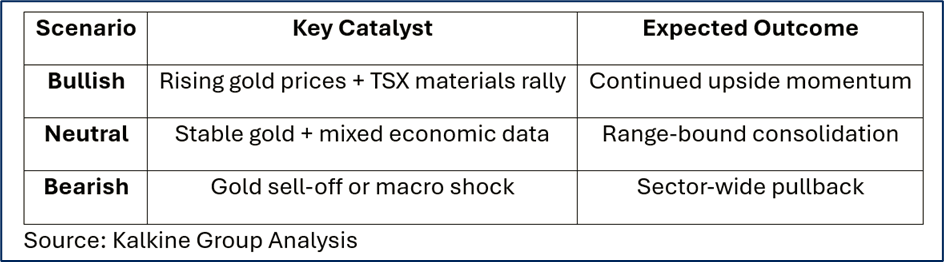
- Consolidation may occur if gold prices stabilise and investors await further project or macro catalysts.
Scenario Analysis: Possible Outcomes for Seabridge Gold
Short-, Medium-, and Long-Term Investor Strategies (Educational Only)
Short Term (0–6 months):
- Monitor gold price volatility and TSX sector trends
- Manage risk due to elevated mining stock swings
Medium Term (6–12 months):
- Track exploration updates, feasibility progress, and analyst revisions
- Reassess positioning as gold forecasts evolve
Long Term (1+ years):
- Structural gold scarcity, geopolitical risk, and supply constraints may favour long-duration gold developers
- Diversification across producers and developers can reduce project-specific risk
Frequently Asked Questions (SEO-Optimised)
Is Seabridge Gold a good stock to watch in February 2026?
The stock has shown strong recent momentum, supported by gold prices and analyst optimism, though volatility remains high.
Does Seabridge Gold pay dividends?
No. The company is focused on long-term project development rather than income distribution.
What primarily drives Seabridge Gold’s share price?
Gold prices, TSX materials performance, currency trends, and analyst sentiment.
What are the main risks?
Gold price volatility, development timelines, and execution risk.
Final Investment Perspective (Informational Only)
Seabridge Gold’s performance in February 2026 highlights renewed confidence in gold developers amid tightening global supply dynamics. While the absence of dividends and near-term earnings adds risk, the company’s scale, resource potential, and favourable gold macro outlook position it as a high-beta, long-term gold scarcity play. Near-term volatility is likely, but long-term outcomes remain closely tied to gold’s structural demand trajectory.


 Jun 24, 2026




 Please wait processing your request...