
 AU
AU
 UK
UK
 US
US
 NZ
NZ
 IND
IND

 CA
CA

 Share
Share
 X (Formerly Twitter)
 Whatsapp
 Facebook
 LinkedIn
 Telegram
 Email This Article
 Copy Link
 Summarize with AI
 Chat GPT
 Perplexity
Is the TSX Composite Reacting to Global Markets, Interest Rates, Oil Prices, and Canada’s Economy Right Now?
On 6 February 2026, the S&P/TSX Composite Index delivered a powerful but somewhat understated message to investors. The benchmark surged 1.5% to 32,470.98, marking its strongest single-day advance since mid-October and erasing most of the prior session’s sharp decline. The rally also sealed a weekly gain of roughly 1.7%, reinforcing the idea that buyers are still very much in control beneath the surface.
This move wasn’t random. It reflected a convergence of commodity rebounds, stable interest-rate expectations, global equity strength, and classic bargain hunting—all key signals long-term investors tend to watch closely.
Can the TSX’s 1.5% Rally Be Explained by Metals, Oil, and Bargain Hunting?
Yes—and very convincingly.
The February 6 advance was driven by a sharp turnaround in commodities, particularly precious metals. Gold jumped nearly 4.8%, with silver following closely, igniting strong gains across materials and mining stocks. At the same time, oil prices pushed higher, providing fresh tailwinds for energy producers.
After several sessions of weakness, investors also stepped in aggressively to buy quality names at discounted levels, amplifying the upside move. This blend of macro support and tactical buying explains why the rebound was both broad and forceful.
What Are the Key Market Forces Shaping the TSX and the Global Economy?
Canadian Economic Signals
Canada’s economic data painted a mixed—but ultimately supportive—picture:
- 24,800 jobs were lost in January, yet
- The unemployment rate fell to a 16-month low of 6.5%, suggesting labor force shifts rather than outright deterioration.
This combination eased fears of a hard slowdown while keeping Bank of Canada rate expectations relatively stable, a welcome backdrop for equities.
Meanwhile, the Canadian dollar rebounded about 0.5% against the U.S. dollar, recovering weekly losses and reinforcing confidence in domestic assets.
Global Market Tailwinds
Global sentiment also played a major role:
- U.S. markets closed sharply higher, with the Dow above 50,000 and the S&P 500 and Nasdaq up around 2%.
- Ongoing AI and technology optimism in the U.S. boosted global risk appetite, lifting Canadian equities alongside other international markets.
How Did Major Asset Classes Perform?
- Commodities: Gold and silver surged; oil prices advanced.
- Currencies: CAD strengthened versus USD.
- Bonds: Government bond yields edged higher, reflecting improved risk sentiment rather than stress.
This cross-asset alignment strongly favored equities and cyclical sectors.
Which TSX Sectors Led—and Which Lagged—on 6 February 2026?
Sectors in the Green
- Materials (+3.9%) – Powered by gold and mining stocks
- Energy (+1.9%) – Supported by higher crude prices
- Industrials (+1.5%) – Reflecting economic optimism
- Financials (+0.9%) – Banks and insurers joined the rally
- Most other sectors also closed higher, confirming broad participation
Sector in the Red
- Utilities (−0.2%) – Lagged as investors rotated out of defensive assets in a risk-on session
Which Stocks Were the Biggest Winners—and Why?
Top gainers reflected strength in financials, technology, and industrials, including:
- Fairfax Financial Holdings – Benefited from diversified insurance and investment exposure
- Celestica – Rallied on improved earnings sentiment and tech demand
- Boyd Group Services – Supported by resilient consumer and auto-service demand
- Constellation Software – Continued momentum from heavyweight tech leadership
- Kinaxis and Terravest Capital – Signs of broad-based market participation
Which Stocks Lagged Despite the Rally?
Even on strong market days, a few names fell behind:
- Thomson Reuters – Pressured by rotation within information and data services
- Altus Group – Real estate-related weakness weighed on sentiment
- Shopify – Experienced a pullback amid broader software sector rotation
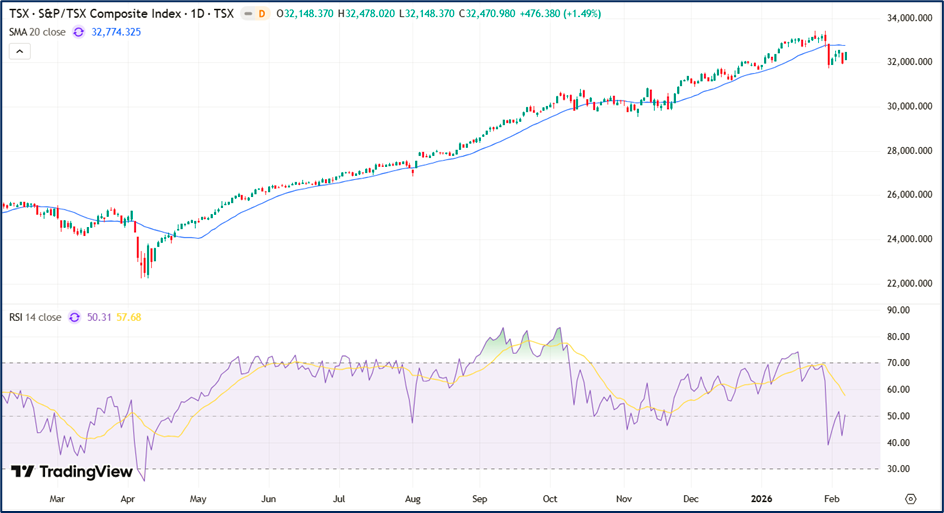
What Does the Technical Picture Say About the TSX Composite?
Source: Trading View
- The index remains close to its yearly highs, signaling resilience.
- Key support holds above the 32,000 psychological level.
- Momentum indicators suggest a shift back to a short-term bullish bias following oversold conditions earlier in the week.
What Is the TSX Outlook Across Time Horizons?
Short Term (0–3 Months)
- Continued influence from gold, silver, and oil prices
- Elevated volatility around macro data and global headlines
- Active sector rotation between resources, financials, and cyclicals
Medium Term (3–12 Months)
- Bank earnings and dividend strength could drive financials
- Materials and energy may stay resilient if global demand and geopolitical risks persist
- Performance remains tied to global growth and commodity cycles
Long Term (1–3+ Years)
- Canada’s heavy weighting in financials, energy, and materials underpins long-term stability
- Gradual expansion in tech and industrial exposure
- Structural themes like AI adoption, energy transition, and global macro shifts may reshape leadership over time
What Strategies Make Sense for Investors Right Now?
Short-Term Approach
- Trade momentum in commodities and earnings-driven sectors
- Use disciplined risk management and diversification
Medium-Term Focus
- Accumulate high-quality banks, insurers, and materials stocks
- Favor reliable dividend payers with strong balance sheets
Long-Term Positioning
- Hold core exposure to TSX heavyweight sectors
- Selectively add growth-oriented tech and industrial names with durable catalysts
What Are the Bull and Bear Scenarios for the TSX Composite?
Bull Case
- Sustained strength in gold, metals, and oil
- Solid earnings from banks and cyclicals
- Stabilizing global growth supports equity multiples
Bear Case
- Sharp pullback in commodities
- Macro shocks or renewed tightening fears
- Rising risk aversion pressures financials and cyclicals
Final Verdict: Is the TSX Composite Rally Sustainable in 2026?
The 6 February 2026 rally highlights renewed confidence driven by commodity strength, global market support, and resilient domestic fundamentals. While short-term volatility remains part of the equation, the TSX’s medium- and long-term outlook stays constructive, anchored by its exposure to materials, energy, financials, and dividends.
For investors, the message is clear: this wasn’t just a bounce—it was a signal worth paying attention to.


 Jun 24, 2026




 Please wait processing your request...