
 AU
AU
 UK
UK
 US
US
 NZ
NZ
 IND
IND

 CA
CA

 Share
Share
 X (Formerly Twitter)
 Whatsapp
 Facebook
 LinkedIn
 Telegram
 Email This Article
 Copy Link
 Summarize with AI
 Chat GPT
 Perplexity
Can Denison Mines (TSX: DML) Stock Deliver Outsized Returns in 2026 as Uranium Enters a New Supercycle?
Key Takeaways – Denison Mines Stock Outlook (February 2026)
- Denison Mines stock is trading with elevated volatility but strong long-term structural tailwinds driven by global uranium demand and nuclear energy expansion.
- The uranium sector is back in focus globally, positioning TSX uranium stocks as high-beta clean-energy plays.
- Canada’s resource-heavy economy, TSX Composite performance, and CAD currency dynamics continue to influence investor flows into mining equities.
- Denison’s Phoenix ISR uranium project remains the core long-term value driver, with regulatory and construction milestones watched closely.
- Analyst sentiment remains constructively bullish but divided, reflecting execution risk versus long-term upside potential.
Why Is Denison Mines Stock Trending Across Global Markets in February 2026?
Denison Mines stock, listed on the Toronto Stock Exchange under TSX: DML, continues to attract heightened attention in February 2026 as uranium demand, nuclear energy policy shifts, and clean-energy transition narratives converge. Investors searching for Denison Mines stock performance, TSX uranium stocks, Canada mining outlook, and nuclear energy investment opportunities are increasingly placing DML on their watchlists.
As of early February 2026, Denison Mines remains firmly positioned as a development-stage uranium company with strategic assets in the Athabasca Basin — one of the world’s most prolific uranium jurisdictions. While near-term price action reflects broader market volatility, the longer-term thesis is anchored in structural energy demand rather than cyclical hype.
From an SEO and investor-interest standpoint, Denison Mines benefits from exposure to three high-traffic themes simultaneously: uranium scarcity, nuclear power revival, and Canada’s resource-driven equity market.
How Is Denison Mines TSX DML Stock Performing Today on 3 February 2026?
Denison Mines shares are currently trading in a consolidation range, reflecting a tug-of-war between short-term profit-taking and long-term accumulation by investors positioning for future uranium supply constraints. Trading volumes remain healthy, signalling sustained institutional and retail participation.
Short-term price movements remain sensitive to:
- Uranium spot price fluctuations
- Broader TSX Composite index sentiment
- Global risk-on vs risk-off market positioning
Despite periodic pullbacks, Denison Mines stock continues to hold investor relevance, outperforming many early-stage resource peers on a risk-adjusted visibility basis.
How Are Global Market Dynamics Shaping Denison Mines Stock in 2026?
Global market conditions in 2026 are uniquely supportive of uranium-linked equities. Governments across North America, Europe, and Asia are re-embracing nuclear power as a stable, low-carbon baseload energy source.
Key global drivers supporting Denison Mines stock include:
- Rising electricity demand from AI data centres and electrification
- Energy security concerns reducing reliance on fossil fuels
- Uranium supply constraints due to years of underinvestment
As uranium transitions from a niche commodity into a strategic energy input, companies with advanced projects and scalable extraction methods stand to benefit disproportionately.
How Does the Canada Economy and TSX Composite Impact Denison Mines Shares?
Canada’s economy remains tightly linked to commodities, natural resources, and energy exports. This structural advantage supports sustained capital flows into TSX-listed mining stocks during commodity upcycles.
Key macro factors influencing DML include:
- TSX Composite performance driven by materials and energy stocks
- Canada’s stable mining regulations and geopolitical neutrality
- CAD currency movements affecting foreign investor inflows
When the TSX enters periods of resource-sector leadership, uranium developers like Denison Mines typically outperform broader indices due to higher operational leverage.
What Is Denison Mines’ Business Model and Why Does It Matter in 2026?
Denison Mines operates as a development-focused uranium company, prioritising asset quality, capital efficiency, and future production scalability rather than short-term revenue generation.
Its flagship Phoenix ISR project is central to the investment thesis:
- ISR (In-Situ Recovery) technology offers lower costs and reduced environmental footprint
- Potential for faster production ramp-up versus conventional mining
- Alignment with ESG-focused capital allocation trends
The company’s model is designed for long-duration value creation, not near-term dividend income.
Is Denison Mines Stock Bullish, Bearish, or Neutral in the Short Term?
Short-term outlook (3–6 months): Neutral to mildly bullish
- Momentum indicators remain mixed
- Volatility driven by uranium price swings
- Traders focused on regulatory and construction updates
Short-term sentiment remains cautious but constructive, suggesting range-bound trading with upside optionality.
Does Denison Mines Look Bullish Over the Medium Term?
Medium-term outlook (6–18 months): Bullish bias
- Anticipation of project execution milestones
- Improved visibility on capital expenditure and timelines
- Increased institutional participation in uranium equities
As uncertainty narrows, valuation re-rating potential improves.
Can Denison Mines Deliver Long-Term Value for Investors Beyond 2026?
Long-term outlook (2+ years): Structurally bullish
- First production targets underpin future cash-flow narratives
- Uranium demand expected to exceed supply for years
- Nuclear power positioned as a permanent part of energy mix
Long-term performance hinges less on sentiment and more on execution discipline and uranium fundamentals.
What Does the Bull vs Bear Case Scenario Matrix Look Like for Denison Mines?
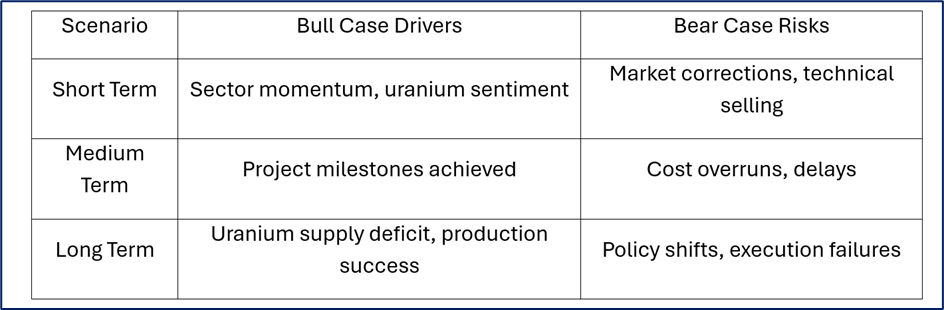
Source: Kalkine Group Analysis
What Are Analysts Saying About Denison Mines Stock in 2026?
Broker and analyst coverage reflects constructive optimism with measured caution:
- Consensus ratings lean Buy to Outperform
- Forecast price ranges remain wide, reflecting development risk
- Valuation debates focus on future cash flows vs current asset value
The dispersion of forecasts highlights high upside potential paired with elevated uncertainty — typical of advanced-stage resource developers.
What Are the Biggest Risks Facing Denison Mines Stock?
- Regulatory delays impacting project timelines
- Uranium price volatility tied to global macro conditions
- Capital-intensive development phase without current revenues
- Broader equity market risk-off events
Risk management remains essential for investors considering exposure.
What Forward-Looking Strategies Can Investors Consider for Denison Mines?
Short Term (3–6 months)
• Monitor uranium prices and TSX momentum
• Track regulatory announcements
• Focus on volatility management
Medium Term (6–18 months)
• Evaluate execution milestones
• Compare peer valuation metrics
• Assess balance sheet strength
Long Term (2+ years)
• Track production readiness
• Monitor global nuclear policy trends
• Assess long-term uranium supply dynamics
Final Investment Perspective on Denison Mines Stock in February 2026?
Denison Mines stock represents a high-conviction uranium development story with asymmetric long-term potential, balanced by near-term volatility and execution risk. Its relevance continues to grow as nuclear power re-establishes itself as a cornerstone of global energy security.
For investors focused on structural energy transitions rather than short-term price noise, Denison Mines remains one of the most closely watched TSX uranium stocks heading deeper into 2026.


 Jun 24, 2026




 Please wait processing your request...