
 AU
AU
 UK
UK
 US
US
 NZ
NZ
 IND
IND

 CA
CA

 Share
Share
 X (Formerly Twitter)
 Whatsapp
 Facebook
 LinkedIn
 Telegram
 Email This Article
 Copy Link
 Summarize with AI
 Chat GPT
 Perplexity
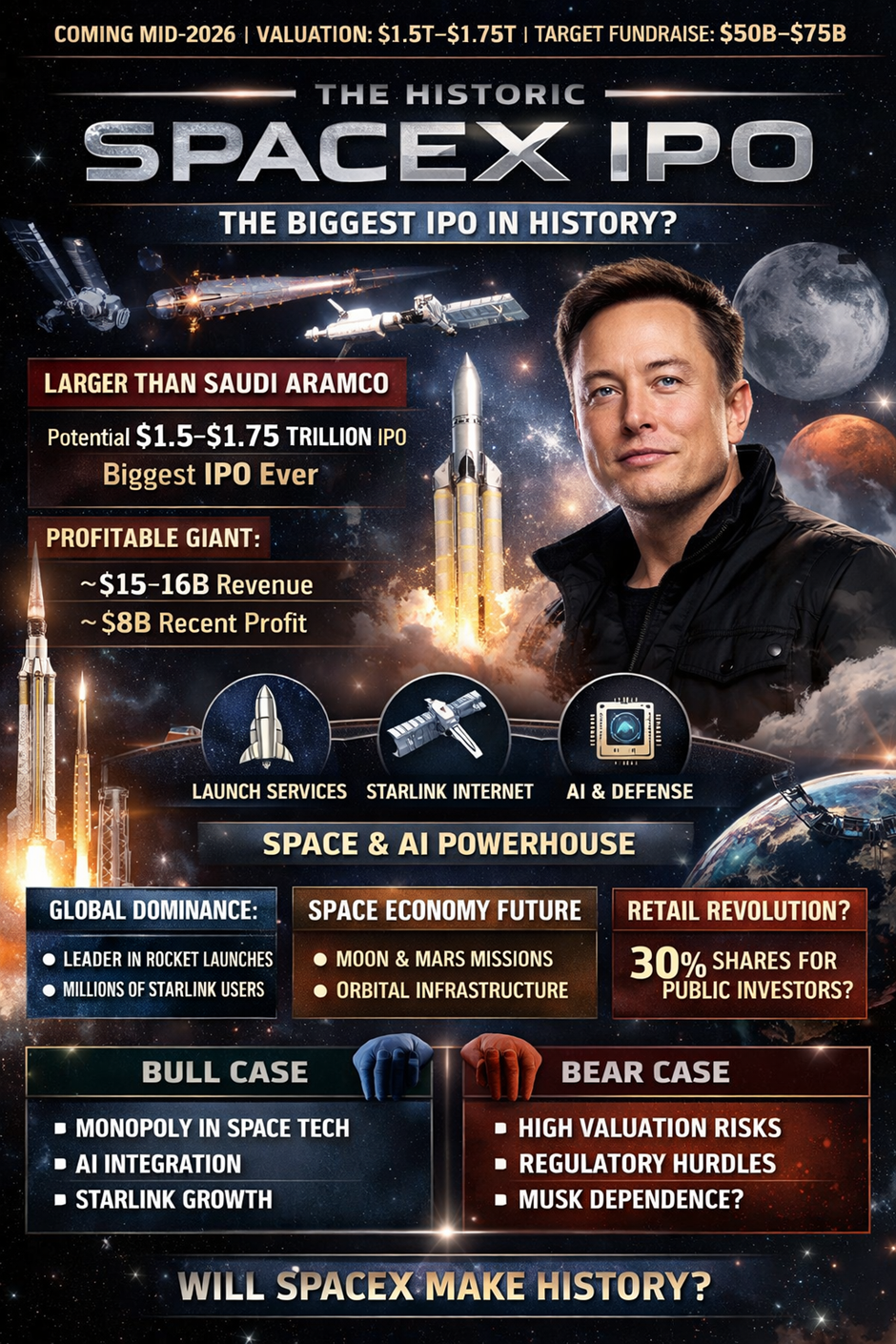
The world may be on the brink of witnessing the most consequential stock market event of the decade — the potential IPO of SpaceX. With valuations soaring toward $1.5–$1.75 trillion and fundraising estimates exceeding $50–$75 billion, this isn’t just another listing — it could become the largest IPO in history, surpassing Saudi Aramco.
Backed by Elon Musk, and powered by a fusion of space, AI, satellite internet, and defense, SpaceX’s public debut is shaping into a defining moment for global capital markets, retail investors, and the future of the space economy.
Source: Kalkine Group
Latest Developments (April 2026)
- SpaceX has confidentially filed for a U.S. IPO, with a listing potentially as early as June–July 2026
- Expected valuation: $1.5T–$1.75T, making it the largest IPO ever
- Fundraising target: $50B–$75B, dwarfing past mega listings
- Musk may allocate up to 30% of shares to retail investors, disrupting Wall Street norms
- Integration with AI firm xAI boosts valuation and strategic positioning
This IPO is not just about raising capital — it’s about opening the space economy to public markets.
What Makes SpaceX IPO So Historic?
- Scale Never Seen Before
If executed at expected levels, SpaceX will eclipse every IPO in history — including Saudi Aramco’s $29B debut.
- Multi-Sector Dominance
SpaceX is no longer just a rocket company. It spans:
- Satellite internet (Starlink)
- AI infrastructure (via xAI merger)
- Defense & government contracts
- Future space logistics and colonization
- Profitability + Growth
Unlike many IPOs, SpaceX is already profitable:
- ~$15–16B revenue
- ~$8B profit recently
This rare combination of scale + profitability + innovation is what’s driving massive investor anticipation.
Business Model Breakdown: The Space Conglomerate
Launch Services
- Dominates global rocket launches
- Reusable rockets drastically cut costs
Starlink (Cash Engine)
- Largest satellite internet network globally
- Critical for revenue and cash flow
AI + Data Infrastructure
- Integration with xAI creates space-based AI compute potential
- Future vision: data centers in orbit
Defense & Government
- Billions in contracts with agencies like NASA and defense programs
Valuation Debate: Is $1.75 Trillion Justified?
Bull Case (Why It Could Work)
- Monopoly-like dominance in launch economics
- Starlink scaling globally
- AI + space convergence
- First-mover advantage in space infrastructure
Bear Case (Risks)
- Extreme valuation multiples
- Capital-intensive business
- Regulatory risks
- Dependence on Elon Musk
As one analyst noted, valuation may depend heavily on “belief in Musk’s vision”
Money Managers Strategy: How Smart Capital Is Positioning
Institutional Investors
- Likely to treat SpaceX as a “must-own generational asset”
- Using sum-of-parts valuation:
- Starlink (telecom multiple)
- Launch business (industrial/defense multiple)
- AI (tech multiple)
Hedge Funds
- Expect:
- IPO-day volatility trades
- Options strategies post-listing
- Arbitrage via private market valuations
Sovereign Wealth Funds
- Already invested privately
- Will likely increase allocation post-IPO
Retail Investors
- Massive participation expected due to:
- Musk’s cult following
- Potential 30% retail allocation
Macro Impact: Why This IPO Matters Globally
Revival of IPO Markets
After years of weak listings, SpaceX could:
- Reignite tech IPO pipelines
- Unlock delayed unicorn listings
- Boost investor confidence
Capital Rotation
Risk: SpaceX may absorb global liquidity, crowding out other IPOs
New Asset Class: Space Economy
This IPO could:
- Institutionalize space investing
- Create benchmarks for space-tech valuation
- Accelerate funding into orbital infrastructure
Strategic Outlook: Short, Medium, Long Term
Short Term (0–1 Year)
- Massive demand oversubscription
- Potential IPO-day surge
- High volatility
Medium Term (1–3 Years)
- Focus shifts to:
- Starlink profitability
- AI monetization
- Execution risk
Long Term (5–10 Years)
- SpaceX becomes:
- “Space infrastructure backbone”
- Key player in AI compute revolution
- Possible trillion-dollar cash flow machine
Key Risks Investors Must Watch
- Valuation bubble risk
- Execution challenges in Starship & Mars missions
- Regulatory scrutiny (defense + AI)
- Musk concentration risk
- Geopolitical dependencies
Could This Make Elon Musk a Trillionaire?
Very likely.
- Musk owns ~40%+ of SpaceX
- A $1.75T valuation could push his net worth beyond $1 trillion
- Would make him the first trillionaire in history
Final Investment Take: Bubble or Once-in-a-Generation Opportunity?
SpaceX IPO is not just another tech listing — it’s a paradigm shift.
It represents:
- The commercialization of space
- The fusion of AI + infrastructure
- The rise of visionary-led mega companies
Base Case: Strong long-term compounder, but volatile
Bull Case: Becomes the “Amazon of space + AI”
Bear Case: Overvaluation leads to multi-year correction
For investors, this is not just about valuation — it’s about believing in the future of humanity beyond Earth.


 Jun 24, 2026




 Please wait processing your request...