
 NZ
 UK
 US
 AU
 IND

 CA

 Share
 X (Formerly Twitter)
 Whatsapp
 Facebook
 LinkedIn
 Telegram
 Email This Article
 Copy Link
 Summarize with AI
 Chat GPT
 Perplexity

The lithium sector has been a rollercoaster, but on January 6, 2026, Standard Lithium (TSXV: SLI) stole the spotlight with a sharp ~7% intraday surge. While the broader market is still licking its wounds from 2024’s oversupply, retail investors and institutional "smart money" are beginning to price in a massive structural deficit projected for late 2026.
Here is the analytical breakdown of why Standard Lithium is currently outperforming its peers and what the updated business model looks like as we head toward the "First Brine" milestone.
The "January Jump": Key Drivers Behind the 7% Move
Source: Kalkine Group
The spike on January 6 wasn't a fluke; it was the convergence of macro-optimism and micro-execution.
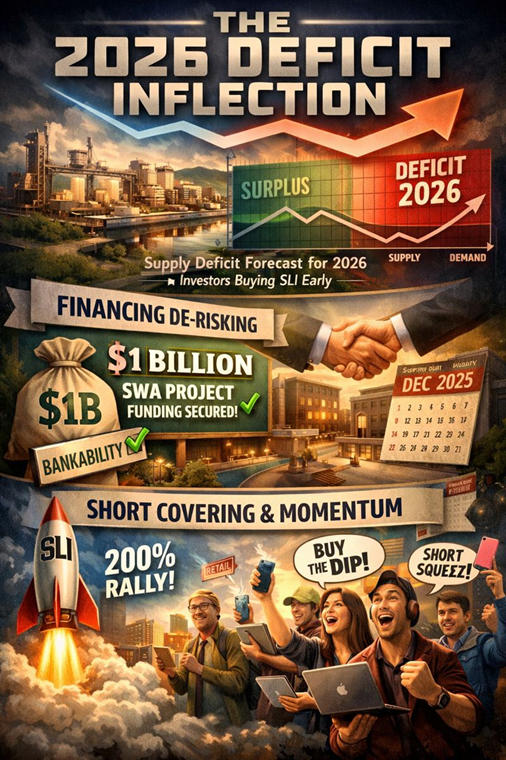
- The 2026 Deficit Narrative: Market analysts (including Fastmarkets and Arcane Research) have officially flipped their forecasts. After years of surplus, 2026 is now widely viewed as the "inflection year" where supply-demand dynamics move into a deficit. Investors are buying SLI now to get ahead of this shift.
- Financing De-risking: Following the December 2025 announcement that the South West Arkansas (SWA) Project received over $1 billion in indications of interest from lenders, the "bankability" risk has plummeted.
- Short Covering & Momentum: With low short interest and a successful year-end rally in 2025, the stock is seeing significant "dip-buying" from retail investors who missed the initial 200% run-up last year.
Latest Business Model: From Explorer to "DLE Powerhouse"
Standard Lithium has evolved from a speculative explorer into a technology-driven developer. Its current business model centers on three pillars:
- Direct Lithium Extraction (DLE) Leadership: Unlike traditional evaporation ponds that take years, SLI’s model uses the Li-Pro™ technology (recently acquired by Aquatech) to extract lithium from brine in hours.
- The "Smackover" Strategy: The company is leveraging the existing infrastructure of the Smackover Formation (Arkansas/Texas), which drastically reduces CapEx compared to building "greenfield" mines in the middle of nowhere.
- Joint Venture Synergy: By partnering with Equinor (the Norwegian energy giant), SLI has offloaded technical and financial heavy-lifting while maintaining a 55% controlling interest in its flagship projects.
Operational & Financial Health: The 2026 Pulse Check
Operational Milestones
- SWA Project: The Definitive Feasibility Study (DFS) is complete. The company is now approaching the Final Investment Decision (FID), expected in early 2026.
- Texas Expansion: The Franklin Project in East Texas recently reported the highest lithium-in-brine grades in North America (up to 806 mg/L), providing a massive secondary growth engine.
- Construction Timeline: Groundbreaking at the SWA Project is slated for mid-2026, with first commercial production targeted for late 2028.
Financial Snapshot
- Cash Position: Bolstered by a $130 million public offering in late 2025.
- Project Debt: Targeting $1 billion in debt financing; indications of interest currently exceed this amount.
- Grant Support: Backed by a $225 million U.S. Department of Energy (DOE) grant, providing a significant "non-dilutive" cushion.
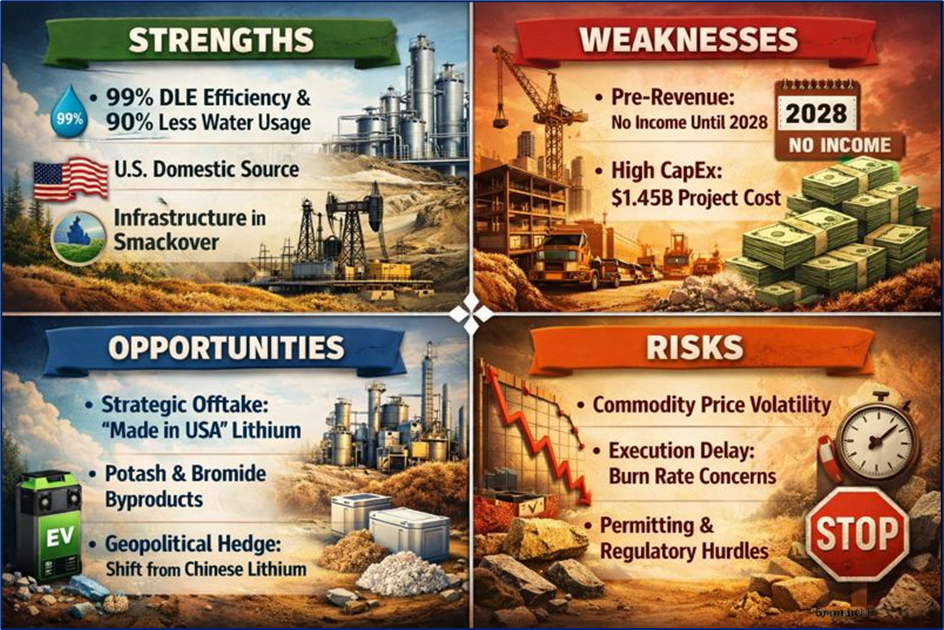
SWOT Analysis: Standard Lithium (2026 Update)
Source: Kalkine Group
Critical Risks to Watch
While the 7% move is bullish, investors shouldn't ignore the "Cold Reality" of pre-commercial mining:
- The "Funding Gap": While lenders are interested, the final binding agreements for $1 billion in debt are not yet signed.
- Inflationary Pressure: Construction costs for large-scale chemical plants have been rising; the $1.45B CapEx estimate includes a 12.3% contingency, but "scope creep" is a common industry killer.
- Market Timing: If EV adoption slows further in 2026, the projected "deficit" might be pushed to 2027 or 2028, leaving SLI in a "cash-burn" limbo.
Conclusion: The Verdict on SLI's Momentum
The price action on January 6, 2026, reflects a market that is finally looking past the "Lithium Winter" of 2024. Standard Lithium is no longer just a "concept stock"—it is a de-risked project with a multi-billion dollar resource and serious backing from both the U.S. government and global energy majors.
The next 6 months will be the most critical in the company’s history as it moves from "planning" to "pouring concrete."


 Nov 20, 2026





 Please wait processing your request...