
 AU
AU
 UK
UK
 US
US
 NZ
NZ
 IND
IND

 CA
CA

 Share
Share
 X (Formerly Twitter)
 Whatsapp
 Facebook
 LinkedIn
 Telegram
 Email This Article
 Copy Link
 Summarize with AI
 Chat GPT
 Perplexity
The Yield Sentinels: Navigating the 4% Frontier with Vermilion and Headwater
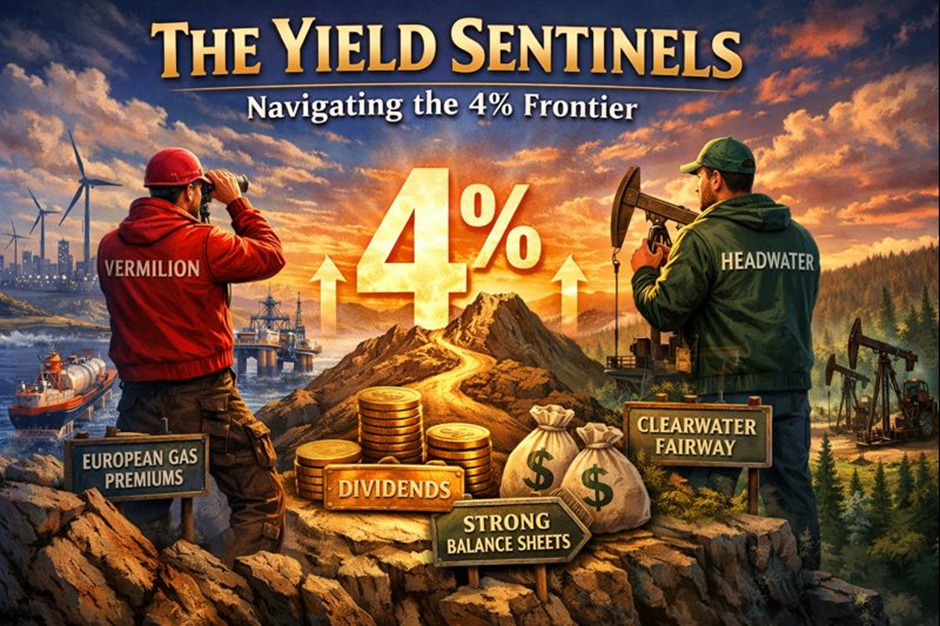
As the global energy landscape recalibrates toward a "higher-for-longer" commodity price environment, investors are increasingly scrutinizing the TSX for a rare combination of growth and income. In an era where capital discipline is no longer a suggestion but a survival trait, Vermilion Energy Inc. (TSX: VET) and Headwater Exploration Inc. (TSX: HWX) have emerged as distinct leaders in the mid-cap space. While Vermilion offers a sophisticated global arbitrage play on European gas premiums, Headwater provides a masterclass in pure-play operational efficiency within the prolific Clearwater fairway.
Both companies have successfully anchored their value propositions with dividend yields hovering around the 4% to 5% mark, supported by robust balance sheets and a relentless focus on free cash flow generation that transcends mere cyclical luck.
Source: Kalkine Group
Vermilion Energy (TSX:VET): The Global Gas Arbitrageur
Latest Drivers & Surge Reasons Vermilion has recently experienced a technical and fundamental resurgence, driven largely by its strategic pivot toward high-margin European natural gas. The stock saw a significant 6.6% jump in late January 2026, fueled by institutional repositioning from heavyweights like Goldman Sachs and a price target hike from Scotiabank. The primary catalyst remains the company’s exposure to the Title Transfer Facility (TTF) gas prices in Europe, which continue to trade at a massive premium compared to North American AECO benchmarks. Furthermore, the successful integration of the Westbrick acquisition and the divestiture of non-core assets in the U.S. and Saskatchewan have streamlined the portfolio, allowing for more aggressive debt reduction.
Current Business Model & Operational Updates Vermilion operates a globally diversified model with core assets in North America (Canada), Europe (France, Netherlands, Germany, Ireland), and Australia. This "hub-and-spoke" strategy allows them to capture the highest realized prices globally.
- Operational Scale: In Q3 2025, production averaged 119,062 boe/d, with a heavy weighting toward natural gas (67%).
- European Success: The company recently executed a successful two-well drilling program in the Netherlands, discovering commercial gas in the Rotliegend and Zechstein formations.
- 2026 Strategy: The newly released 2026 budget allocates $600 to $630 million in capital, with 85% focused on global gas assets to maximize margins (Vermilion Energy, Q3 2025 Report).
Financial & Dividend Updates
- Dividend Growth: Management announced a 4% increase in the quarterly cash dividend to $0.135 CAD per share, effective for the Q1 2026 payment.
- Debt Management: Net debt has been slashed by over $650 million since early 2025, reaching a target ratio of 1.4x trailing FFO.
- Cash Flow: Generated $254 million in Fund Flows from Operations (FFO) in the latest reported quarter (Vermilion Energy, Nov 2025 Press Release).
SWOT Analysis
- Strengths: Premium pricing via European gas exposure; diversified geographic risk; strong free cash flow (FCF) yield.
- Weaknesses: Complexity of international regulatory regimes; higher historical debt levels compared to pure-play peers.
- Opportunities: Expansion in Germany and Croatia; further optimization of the Alberta Deep Basin following the Westbrick deal.
- Threats: European windfall taxes; volatility in TTF pricing; currency fluctuations (EUR/CAD).
Outlook & Risks The outlook for Vermilion is centered on "value over volume." With 2026 production expected to remain steady near 120,000 boe/d, the focus is on capital efficiency and lowering unit operating costs by 30%. The primary risk remains the potential for new fiscal "solidarity" taxes in Europe and the inherent geopolitical risks of operating across multiple jurisdictions.
Headwater Exploration (TSX:HWX): The Clearwater Growth Engine
Latest Drivers & Surge Reasons Headwater Exploration remains a darling of the Canadian small-to-mid-cap energy space due to its best-in-class capital efficiency. The stock surged recently following an exceptional Q4 2025 operations update that revealed production growth of 12% per share year-over-year. Investors have responded positively to the company's "Secondary Recovery" success, which is effectively lowering the corporate decline rate and making the dividend more sustainable even at lower oil prices ($60/bbl WTI).
Current Business Model & Operational Updates Headwater is a heavy-oil focused producer with a dominant position in the Marten Hills and Greater Pelican areas of Alberta. Their model relies on high-margin, low-decline production from the Clearwater and Grand Rapids formations.
- Secondary Recovery: More than 50% of oil production is now supported by waterflood and polymer flood techniques, which have reduced corporate decline rates by 10%.
- 2026 Budget: Headwater plans to spend $185 million in 2026, with $50 million specifically earmarked for secondary recovery to enhance asset duration.
- Production Growth: The company anticipates 2026 production of 24,500 boe/d, representing 8% annual growth (Headwater Exploration, Dec 2025 Budget Update).
Financial & Dividend Updates
- Current Yield: Headwater pays a quarterly dividend of $0.11 per share, offering a yield of approximately 4% to 5% depending on the share price.
- Capital Efficiency: The 2026 budget is fully funded at US$60.00/bbl WTI, with a reinvestment rate of only 37%, leaving ample room for dividends.
- Working Capital: The company maintains a pristine balance sheet with zero debt and positive adjusted working capital (Headwater Exploration, Jan 2026 Operations Update).
SWOT Analysis
- Strengths: Zero debt; high insider ownership; industry-leading capital efficiency; low decline rates.
- Weaknesses: Pure-play concentration in the Clearwater/Grand Rapids areas; sensitive to Western Canadian Select (WCS) differentials.
- Opportunities: New play concepts in Greater Pelican; expansion of polymer flood technology to deeper horizons.
- Threats: Widening heavy oil differentials; Alberta regulatory changes; environmental pressure on heavy oil production.
Outlook & Risks Headwater’s 2026 outlook is characterized by "maintenance and growth." By the end of 2026, 60% of production will be under secondary recovery, providing a "moat" against commodity price swings. The main risk is the company’s reliance on heavy oil pricing, which can be volatile depending on pipeline capacity and refinery demand.
Conclusion
The divergence in strategies between Vermilion and Headwater highlights the depth of the TSX energy sector. Vermilion offers a sophisticated, global hedge against North American gas prices, while Headwater provides a disciplined, debt-free vehicle for heavy oil growth. For those tracking the 4% yield threshold, these two stocks represent the current gold standard of capital allocation in the Canadian oil patch. As 2026 unfolds, the success of Vermilion’s international exploration and Headwater’s polymer flood expansion will likely dictate whether these yields remain sustainable or evolve into even more aggressive shareholder return stories.


 Jun 24, 2026




 Please wait processing your request...