
 AU
AU
 UK
UK
 US
US
 NZ
NZ
 IND
IND

 CA
CA

 Share
Share
 X (Formerly Twitter)
 Whatsapp
 Facebook
 LinkedIn
 Telegram
 Email This Article
 Copy Link
 Summarize with AI
 Chat GPT
 Perplexity
Forget the S&P 500: Wall Street’s Elite are Piling Into the "Tidewater" Trade
As the global artificial intelligence rally begins to show signs of valuation fatigue, a quiet but massive rotation is underway. Top-tier fund managers and investment banks like BMO, RBC, and TD Cowen have shifted their gaze northward. The catalyst? A structural "policy reset" in Ottawa, the commissioning of major West Coast LNG infrastructure, and the newfound "tidewater access" provided by the Trans Mountain expansion.
While oil prices face global oversupply headwinds, the Canadian energy sector has evolved into a fortress of cash flow, trading at a significant valuation discount compared to its American peers.
Source: Kalkine Group
Key Reasons and Strategic Drivers
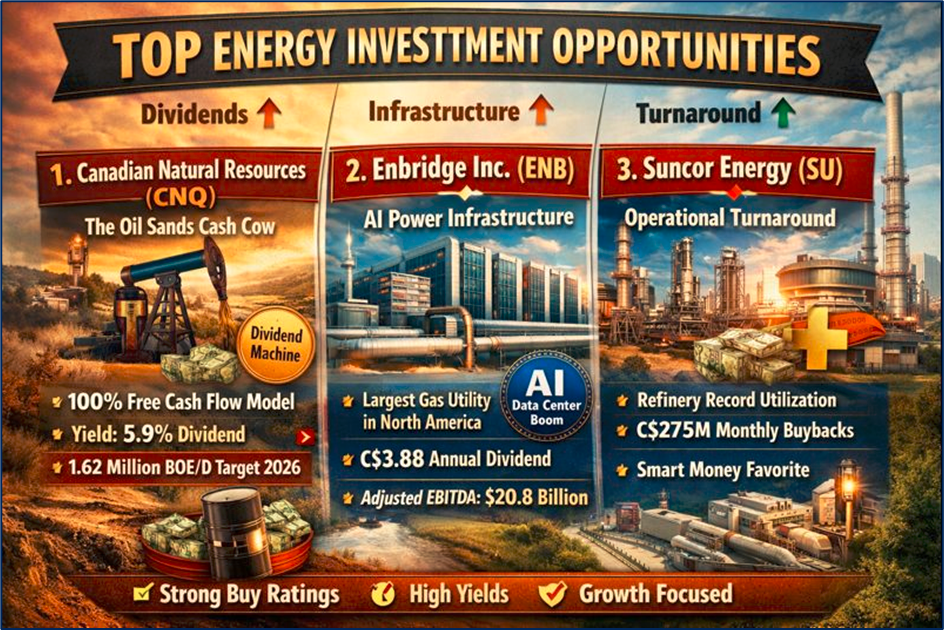
Canadian Natural Resources (CNQ) remains the "Gold Standard" for institutional investors seeking pure-play exposure to long-life, low-decline assets. The primary driver for 2026 is the company’s transition to a 100% free cash flow return model. Having hit its net debt targets, CNRL is now a dividend machine. Smart money is betting on its massive reserve base, which provides decades of production without the high exploration risks associated with shale.
Business Model and Financial Update
CNRL operates a highly diversified portfolio of light, synthetic, and heavy crude oil, alongside a significant natural gas footprint. In its latest December 2025 budget release, the company announced a disciplined $6.4 billion capital plan for 2026, targeting a 3% production growth to roughly 1.62 million BOE/d. This "value over volume" strategy ensures that even in a $60 WTI environment, the company remains highly profitable.
Dividend and Valuation
- Latest Dividend: C$0.5875 per share quarterly (approx. 5.9% yield). 2025 marked its 25th consecutive year of increases.
- Valuation: Currently trading at a P/E ratio significantly lower than its historical 10-year average, offering a "safety margin" for retail investors.
Technical Analysis and Analysts' View
Technically, CNQ has been consolidating in a healthy wedge pattern throughout late 2025, finding strong support at its 200-day moving average. Analysts recently reiterated a "Strong Buy" consensus, with Goldman Sachs and BMO highlighting the stock’s resilience against WCS (Western Canada Select) price volatility due to improved pipeline capacity.
Risks
Global crude oversupply and potential political shifts regarding carbon taxation remain the primary headwinds.
Key Reasons and Strategic Drivers
Enbridge is no longer just a pipeline company; it is being re-rated as a utility powerhouse essential to the AI revolution. Investment banks are highlighting Enbridge’s role in powering the massive data centers being built across North America. With the acquisition of three major U.S. gas utilities fully integrated, Enbridge now operates the largest natural gas utility platform in North America.
Business Model and Operational Update
The company’s model is built on "toll-booth" style cash flows, with 98% of EBITDA derived from cost-of-service or take-or-pay contracts. For 2026, Enbridge has issued guidance for Adjusted EBITDA of $20.2 billion to $20.8 billion. They have approximately $8 billion in new projects entering service this year, providing visible, contractual growth that is decoupled from volatile commodity prices.
Dividend and Valuation
- Latest Dividend: Increased by 3% to C$0.97 per quarter (C$3.88 annualized) for 2026, marking its 31st consecutive annual increase.
- Valuation: Trading at an attractive Forward EV/EBITDA multiple of roughly 11x, which many analysts consider "undervalued" given its utility-like risk profile.
Technical Analysis and Analysts' View
Enbridge’s stock has shown a classic "stair-step" recovery. After a brief dip in late 2025 due to interest rate jitters, the stock has broken above key resistance levels. RBC Capital Markets recently upgraded the sector outlook to "Selective," naming Enbridge a top defensive pick for 2026.
Risks
Prolonged high interest rates could increase the cost of servicing its significant debt load, though the company has hedged 85% of its 2026 debt.
Key Reasons and Strategic Drivers
Suncor has become a "Smart Money" favorite following a radical operational overhaul under new leadership. The company has shed non-core assets and focused intensely on "operational excellence." Brokers are particularly bullish on Suncor’s 2026 guidance, which anticipates record-breaking refinery utilization and a significant reduction in break-even costs.
Business Model and Financial Update
Suncor’s integrated model (upstream production + downstream refining) allows it to capture margins across the entire value chain. In its latest January 2026 update, Suncor projected annual production of 840,000 to 870,000 bbls/d. Crucially, the company has increased its share buyback pace to C$275 million per month, signaling massive confidence in its internal cash generation.
Dividend and Valuation
- Latest Dividend: Quarterly dividend currently yields approximately 4.2%, supported by a robust buyback program totaling C$3.3 billion projected for 2026.
- Valuation: Suncor trades at a deep discount to its peer Cenovus (CVE) on a Price-to-Cash-Flow basis, making it the "value play" of the trio.
Technical Analysis and Analysts' View
The stock is currently testing multi-year highs. Analysts at JP Morgan and Scotiabank recently issued upgrades, citing Suncor’s ability to exceed its 3-year Investor Day targets a year ahead of schedule. The technical "Golden Cross" (50-day moving average crossing above the 200-day) formed in November 2025 remains a bullish signal.
Risks
Unplanned maintenance at its aging oil sands base plants remains the "X-factor" that could disrupt production targets.
Conclusion: The 2026 Energy Playbook
The TSX energy sector enters 2026 with a "balanced foundation" that many U.S. sectors lack. By combining the income reliability of Enbridge, the asset quality of Canadian Natural, and the operational momentum of Suncor, investors are positioning for a year where "Value" finally outpaces "Growth." While geopolitical risks and global supply levels will cause daily fluctuations, the structural improvements in Canadian energy infrastructure have created a floor that hasn't existed for a decade.


 Jun 24, 2026




 Please wait processing your request...